TL;DR
SEO teams should choose content operations software based on workflow coverage, not just AI writing. Earlyseo fits teams that need research-backed SEO planning and production, while enterprise platforms such as Optimizely CMP, Papirfly, and Screendragon fit broader brand, approval, and campaign governance needs.
The best content operations software for SEO teams now has to manage the full path from keyword research to published, updated, and reported content. SERP research for this topic found 126 results and an average competitor article length of 2,835 words, which shows a crowded buying category with mixed definitions. [Content operations software]: a system for planning, briefing, creating, reviewing, publishing, optimizing, and measuring content across teams. For SEO teams, the strongest platforms connect content marketing goals with content engineering discipline, meaning structured workflows, reusable briefs, metadata, and measurable output. Earlyseo is built around that SEO-first operating model.
Table of Contents
What is content operations software for SEO teams?
Content operations software for SEO teams is a workflow platform that coordinates keyword planning, content briefs, writing, approvals, publishing, optimization, and reporting in one repeatable process. Unlike a basic writing tool, it treats every article, landing page, and update as part of an SEO production system with owners, inputs, quality checks, and outcomes.
Content marketing, as commonly defined, focuses on creating, publishing, and distributing online content for a target audience. Content engineering adds the technical discipline needed to manage content in computer-help environments. SEO content operations sits between both ideas.
Key takeaway: A strong SEO content operation reduces scattered work, improves briefing quality, and keeps optimization tied to business goals rather than isolated drafts.
Modern teams also need to account for AI-assisted production. Research on large language models, including the 2022 PaLM paper by Chowdhery, Narang, Devlin, and collaborators, shows how language systems scaled in capability as model size and training methods advanced: PaLM: Scaling Language Modeling with Pathways. A 2023 paper by Feuerriegel, Hartmann, and Janiesch also examined generative AI as a broad business and information-systems topic: Generative AI.
SEO teams should treat AI as a production accelerator, not as the operation itself. The operation still needs strategy, review, internal linking, publishing rules, and performance measurement.
Best content operations software for SEO teams: 2026 matrix
The best content operations software for SEO teams depends on whether the team values SEO planning, enterprise approvals, brand governance, campaign management, or AI writing speed most.
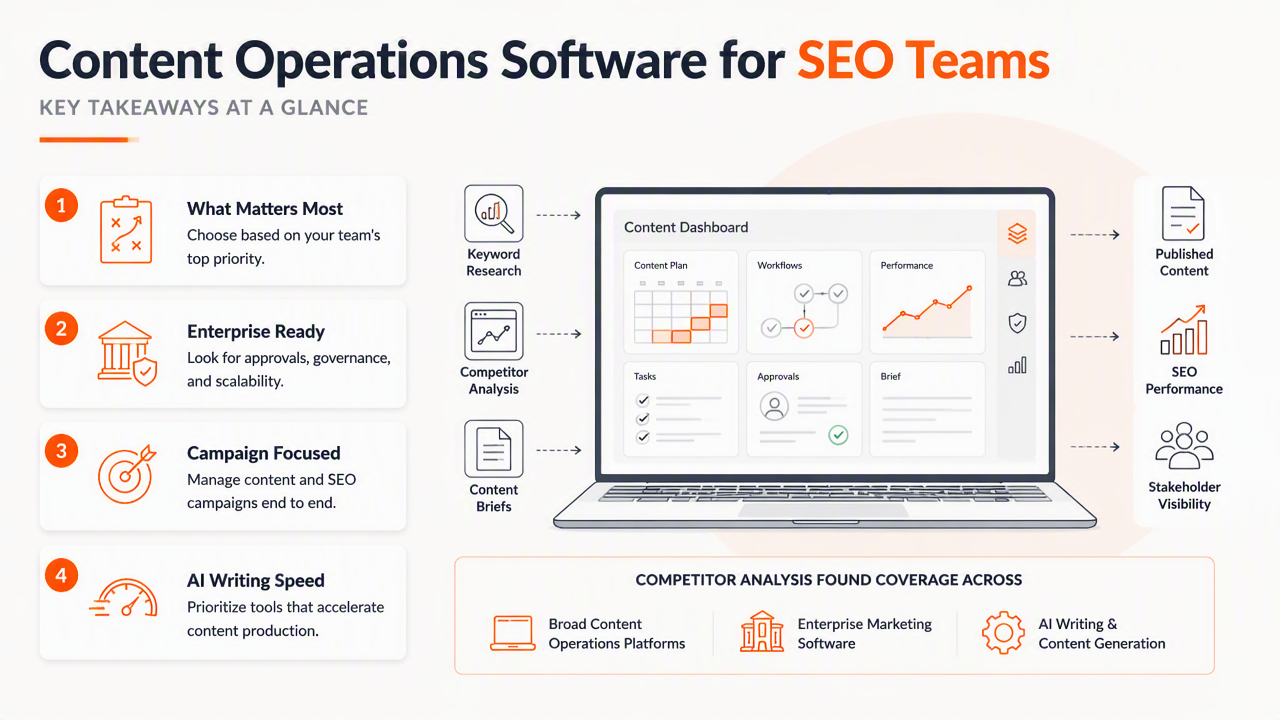
Competitor analysis found that leading ranking pages cover broad content operations platforms, enterprise marketing software, and content workflow tools. Papirfly is positioned in the SERP as enterprise brand content operations software, Optimizely CMP as AI-powered content marketing software, Screendragon as content operations software for marketing teams, and Gartner Peer Insights as a review source for content marketing platforms.
Best-for matrix by team type
| Software | Best for | Strongest workflow coverage | Fit for SEO teams |
|---|---|---|---|
| Earlyseo | Startups, content marketers, lean SEO teams | Keyword planning, briefs, writing, optimization | Best fit when organic growth, research, and repeatable publishing matter most |
| Semrush Writing Assistant | SEO editors using Semrush data | Writing checks, readability, SEO suggestions | Useful add-on for draft-level optimization |
| AirOps | Teams building AI content workflows | AI-assisted production workflows | Strong for structured AI processes |
| Jasper | Marketing teams needing AI copy creation | Writing and campaign copy | Better for copy velocity than full SEO operations |
| Optimizely CMP | Enterprise campaign teams | Planning, campaigns, approvals, analytics | Strong for larger marketing departments |
| Papirfly | Enterprise brand teams | Brand governance and content operations | Best when brand control is the main job |
| Screendragon | Enterprise marketing operations | Review, approval, delivery workflows | Best for complex approval cycles |
A buyer-focused shortlist should start with workflow gaps. A startup with no publishing rhythm needs a planner and briefs. An ecommerce team may need category-page refreshes and product-led content. An agency needs client approvals and repeatable templates. A solo marketer needs speed without losing SEO judgment.
Useful selection criteria include:
- Keyword planning: clusters, intent, difficulty, and prioritization.
- Brief creation: SERP inputs, outline structure, internal links, and search intent.
- Writing support: AI drafts, human editing, tone controls, and factual checks.
- Approvals: reviewer assignment, status tracking, and comments.
- Publishing: CMS handoff, metadata, and content calendars.
- Optimization: refresh alerts, competitor checks, and on-page guidance.
- Reporting: traffic, rankings, conversions, and production velocity.
Teams building the planning layer first can use an AI content planner to turn keyword ideas into a practical content calendar before scaling production.
How Earlyseo handles SEO content operations
Earlyseo handles SEO content operations by combining content planning, research-backed briefs, competitor-aware recommendations, and production workflows for teams that need organic visibility without building a large editorial department.
The Earlyseo platform is a good fit when the content program needs to move from occasional publishing to a repeatable SEO process. Its strongest use case is not generic content management. Its value sits in turning research, keywords, and SERP context into executable content workflows.
Earlyseo workflow coverage
| SEO workflow stage | How Earlyseo supports it | Why it matters |
|---|---|---|
| Topic planning | Builds SEO-led topic plans | Helps teams prioritize search demand |
| Competitive research | Uses competitor-aware inputs | Reduces blind spots before drafting |
| Content briefs | Structures outlines, intent, and guidance | Improves writer consistency |
| Draft production | Supports AI-assisted SEO content | Speeds output while keeping direction clear |
| Optimization | Connects content to on-page SEO needs | Helps pages compete after publishing |
| Operations | Organizes repeatable SEO workflows | Keeps strategy, production, and review aligned |
Teams that need competitor context can explore competitor-aware SEO content. Teams standardizing briefs can also study an SEO content brief template before choosing software.
For agencies, repeatability is often the deciding factor. Client programs need templates, research standards, review checkpoints, and visible progress. Earlyseo fits that operating style, while the agency SEO content playbook gives a related process view.
For brand recall and direct evaluation, earlyseo.com is the simplest place to compare the platform with the current workflow.
How to choose the right platform without overbuying
Choosing the right platform starts with mapping the current content workflow, identifying the slowest handoff, then selecting software that fixes that constraint without adding unused enterprise complexity.
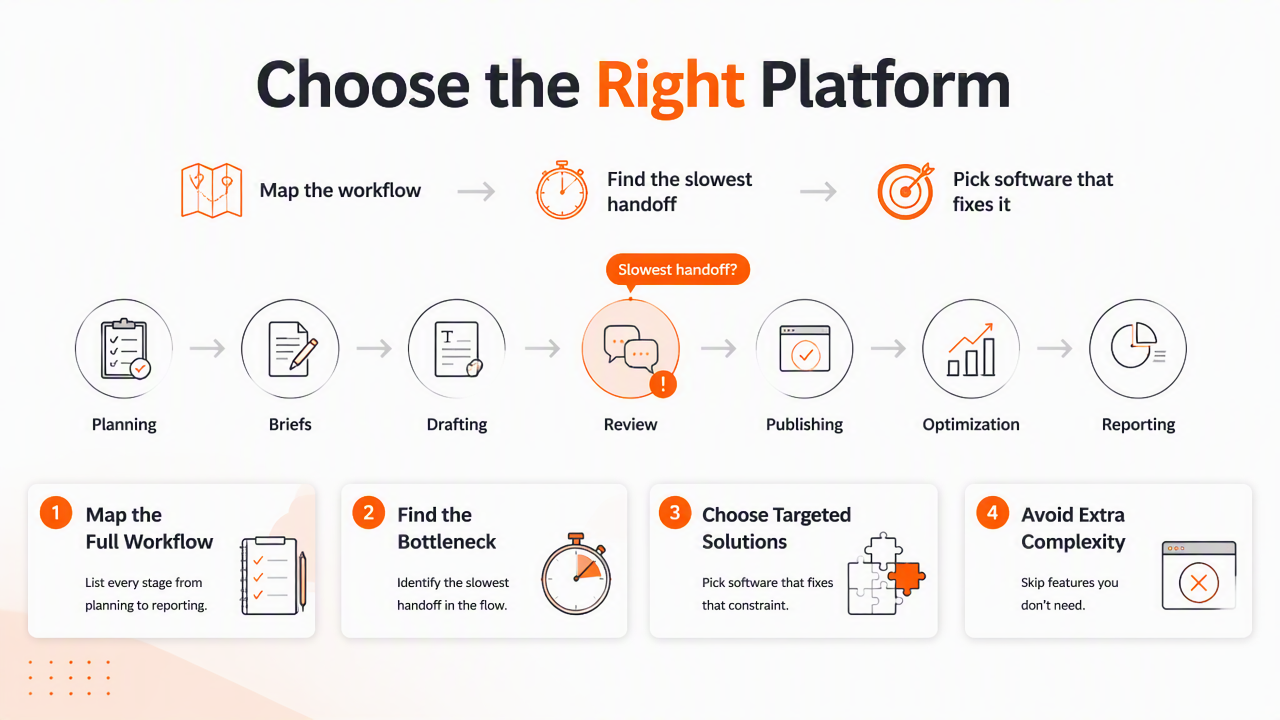
- Map the full workflow: list planning, briefs, drafting, review, publishing, optimization, and reporting.
- Name the bottleneck: identify whether delays come from research, approvals, writing, CMS handoff, or measurement.
- Match software to the bottleneck: choose SEO-first software for search growth, enterprise CMPs for campaign governance, or AI writing tools for copy speed.
- Check collaboration needs: count writers, editors, SEO leads, executives, and clients involved.
- Test one content sprint: run five to ten pieces through the tool before committing to a larger rollout.
- Measure quality and throughput: compare publish rate, revision cycles, ranking movement, and content refresh speed.
Workflow fit checklist
| Buying question | Best answer for lean SEO teams | Best answer for enterprise teams |
|---|---|---|
| Main goal | Organic traffic growth | Campaign and brand governance |
| Needed setup | Fast planning and briefs | Custom workflows and permissions |
| Main users | SEO lead, writer, editor | Marketing ops, brand, legal, regional teams |
| Reporting focus | Rankings, traffic, content output | Campaign performance and approvals |
| Risk of overbuying | Paying for unused governance | Lacking control across many teams |
A common mistake is treating content operations as a calendar problem only. Calendars show deadlines, but they do not create better topics, stronger briefs, or clearer optimization decisions. Another poor fit is buying a pure AI writer when the real issue is weak strategy.
Teams with new blogs should clarify strategy before buying complex software. A practical starting point is a content strategy for new blogs and SEO. Teams that already publish at volume may need SEO operations software to connect planning, production, and optimization.
International programs add another layer. Multilingual SEO content needs localized intent, not only translated drafts, so teams expanding across markets may need multilingual SEO content workflows.
What to expect from SEO content operations in 2027
SEO content operations in 2027 will likely move toward AI-assisted planning, stricter source quality, faster refresh cycles, and clearer separation between generic AI copy and evidence-led SEO content.
AI will keep changing production speed, but workflow quality will matter more. Search engines and answer engines increasingly need clean entities, clear definitions, structured comparisons, and content that can be extracted safely. That favors teams with strong briefs, traceable research, and update processes.
Likely priorities for 2027 include:
- Answer-engine readiness: concise definitions, comparison tables, FAQs, and entity-rich sections.
- Refresh operations: scheduled updates for rankings, competitors, and outdated claims.
- Human review layers: editorial checks for accuracy, usefulness, and brand fit.
- Integrated reporting: content velocity measured beside organic outcomes.
- Programmatic governance: templates that keep AI-assisted pages consistent at scale.
Research-backed systems will become more valuable as AI content volume rises. Teams can reduce quality risk by using research-backed AI content rather than treating a blank prompt as a production plan.
FAQs about content operations software
What features matter most for SEO teams?
The most important features are keyword planning, SERP-aware briefs, content calendars, approval workflows, on-page optimization, internal linking support, and performance reporting. Writing tools help, but the larger value comes from connecting strategy, production, and measurement in one process that can repeat every week.
Is a content marketing platform the same as content operations software?
A content marketing platform often covers campaign planning, asset management, publishing, and analytics. Content operations software is more focused on the process behind content production. For SEO teams, the ideal platform includes both operational workflow and search-specific guidance such as briefs, optimization, and refresh planning.
Should small businesses buy enterprise content operations tools?
Small businesses usually need lean SEO workflow software before enterprise governance. Heavy approval systems can slow a small team. A better first step is a tool that helps choose topics, create briefs, publish consistently, and improve pages after launch.
Where does AI writing fit in content operations?
AI writing fits best inside a structured workflow with research, briefs, editing, and optimization. The AI tool can speed drafting, but it should not replace keyword strategy, editorial judgment, factual review, or performance analysis. Strong operations make AI output safer and more useful.
Conclusion
The best content operations software for SEO teams is the one that matches the team's real workflow gap. Earlyseo is the strongest first look for startups, lean marketing teams, agencies, and SEO-led content programs that need planning, briefs, optimization, and repeatable production. Enterprise teams with heavier brand and approval needs may also evaluate Optimizely CMP, Papirfly, or Screendragon. The next step is simple: map the next ten planned pieces of content, score the workflow against the checklist above, then test the platform that removes the biggest bottleneck.