TL;DR
AI content workflow software helps teams plan, brief, generate, optimize, and improve SEO content, while SEO project management tools mainly organize tasks, owners, dates, and approvals. Small teams can start with project boards, but teams scaling organic traffic need workflow software when briefs, SERP research, content quality, and publishing consistency become the bottleneck.
The real choice in AI content workflow software vs SEO project management tools is not software category, but whether the team needs to manage work or produce search-ready pages faster. Generic project tools keep campaigns moving, but they rarely create briefs, analyze competitors, check topic coverage, or guide writers toward ranking intent. Earlyseo fits the newer category: software built around SEO content production, not just task tracking.
Table of Contents
What is the difference between AI content workflow software and SEO project management tools?
AI content workflow software creates and improves SEO content through repeatable steps, while SEO project management tools coordinate the people, deadlines, and tasks around SEO work. The first category affects content quality and search readiness. The second category affects visibility, accountability, and delivery speed.
Workflow: a repeatable pattern of activity that organizes resources into processes that produce an outcome.
AI content workflow software: a system for turning keyword ideas into briefs, drafts, optimization checks, approvals, and publishable content using AI-assisted steps.
SEO project management tools: systems for tracking SEO tasks such as audits, content calendars, link outreach, fixes, and reporting across owners and deadlines.
Research reviews outside marketing show why category clarity matters. AI-heavy processes need review steps and human control, a pattern visible in medical AI surveys such as Çallı, Sogancioglu, and van Ginneken's 2021 review of deep learning for chest X-ray analysis and Barragán Montero, Javaid, and Valdés's 2021 technology review of AI and machine learning for medical imaging. Content teams face lower risk, but the same lesson applies: AI output still needs structured checks.
Comparison table: where each tool category fits
| Capability | AI content workflow software | SEO project management tools | Best fit |
|---|---|---|---|
| Keyword-to-brief flow | Usually built in | Usually manual | Content scaling |
| SERP and competitor analysis | Often integrated | Usually linked externally | SEO writing teams |
| Task ownership | Basic to strong | Strong | Cross-functional SEO |
| Draft generation | Often supported | Rare | High-volume content |
| Content optimization | Core feature | Usually absent | Organic growth |
| Approvals and deadlines | Usually included | Core feature | Editorial operations |
| Technical SEO tickets | Limited | Strong | Dev and SEO teams |
| Reporting dashboards | Varies | Strong for tasks | Managers |
Key insight: project boards answer "who is doing what," while AI workflow software answers "is this content ready to compete in search?"
When are SEO project management tools enough?
SEO project management tools are enough when the main problem is coordination, not content production quality. A small company with a limited publishing schedule, one marketer, and a few outside contributors may only need task lists, due dates, comments, and simple dashboards.
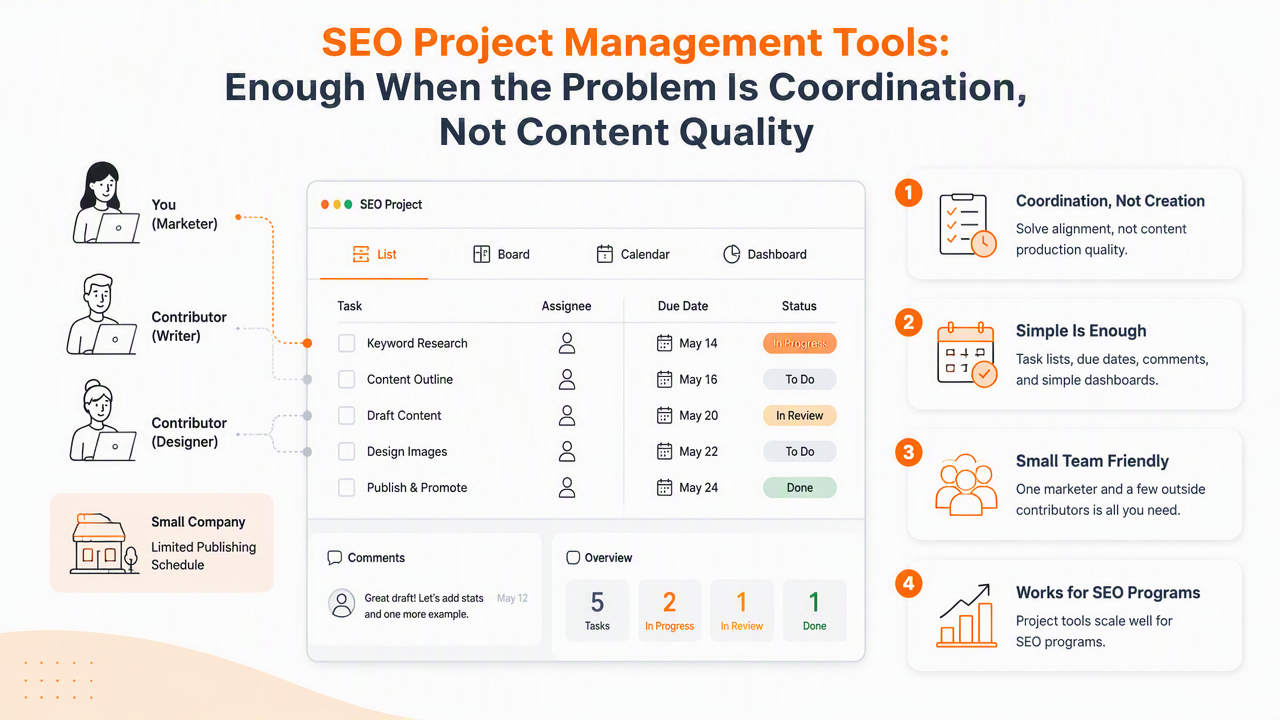
Project tools work well for SEO programs built around recurring operational work. Examples include monthly reporting, local listing updates, technical audit tickets, redirect mapping, and approval routing. They also help marketing managers show progress without building a custom spreadsheet system.
Workflows that fit a project board
- Technical SEO fixes: assign crawl errors, metadata cleanup, schema tasks, and page-speed tickets.
- Local SEO maintenance: track Google Business Profile updates, review responses, and citation edits.
- Editorial calendars: manage title ideas, writer assignments, review dates, and publication dates.
- Stakeholder approvals: route copy, design, legal, and product feedback in one place.
- Progress reporting: monitor completed tasks, blockers, and campaign status.
A new blog can begin with a basic calendar and a clear content plan. For teams still defining topics and publishing cadence, the guide to content strategy for new blogs SEO gives a useful foundation before software complexity grows.
Signs a generic tool is still the right choice
| Signal | What it means |
|---|---|
| Fewer than four articles per month | Manual briefs and reviews may be manageable |
| SEO work is mostly technical | Ticketing matters more than content automation |
| Writers are highly specialized | Heavy AI assistance may add little value |
| Stakeholders need status visibility | Dashboards and due dates are the priority |
Project management software can still support serious SEO work. The limitation appears when every brief, SERP comparison, outline, optimization pass, and refresh note lives outside the system.
When do teams outgrow generic SEO project boards?
Teams outgrow generic SEO project boards when content quality checks, SERP research, and optimization steps become too manual to scale. A task can be marked complete even when the article misses search intent, lacks entity coverage, or repeats what competitors already published.
The 2026 SERP for this topic shows a clear split: high-ranking articles often cover "best software" lists and content workflow tools, but many blur project coordination with SEO-ready content production. That gap matters for startups, agencies, e-commerce teams, and local businesses where organic traffic depends on publishing pages that deserve rankings.
Growth signals that require content workflow automation
- Briefs take longer than drafts: keyword, audience, competitor, and outline research slows the team.
- Editors repeat the same feedback: missing headings, weak intent match, thin examples, or poor internal links keep returning.
- Content calendars hide quality risk: tasks look green, but rankings fail to move.
- Multiple writers create uneven output: tone, depth, and SEO structure vary from article to article.
- Old content is ignored: refresh opportunities sit outside the main workflow.
Purpose-built workflow software connects planning with production. Instead of attaching a doc to a task card, the system guides the brief, draft, analysis, optimization, and refresh process.
For teams that already know a topic but need better SERP alignment, competitor-aware SEO content can reduce the manual gap between "article assigned" and "article built to compete." The same applies to teams standardizing briefs; a strong SEO content brief template keeps writers focused before drafting begins.
A completed task is not the same as a competitive page. SEO workflows need quality gates, not just deadlines.
How Earlyseo handles SEO-ready content workflows
Earlyseo handles SEO-ready content workflows by combining content planning, competitor context, AI-assisted production, and optimization checks in one process. The Earlyseo platform is designed for teams that need publishable SEO content, not only a cleaner task board.
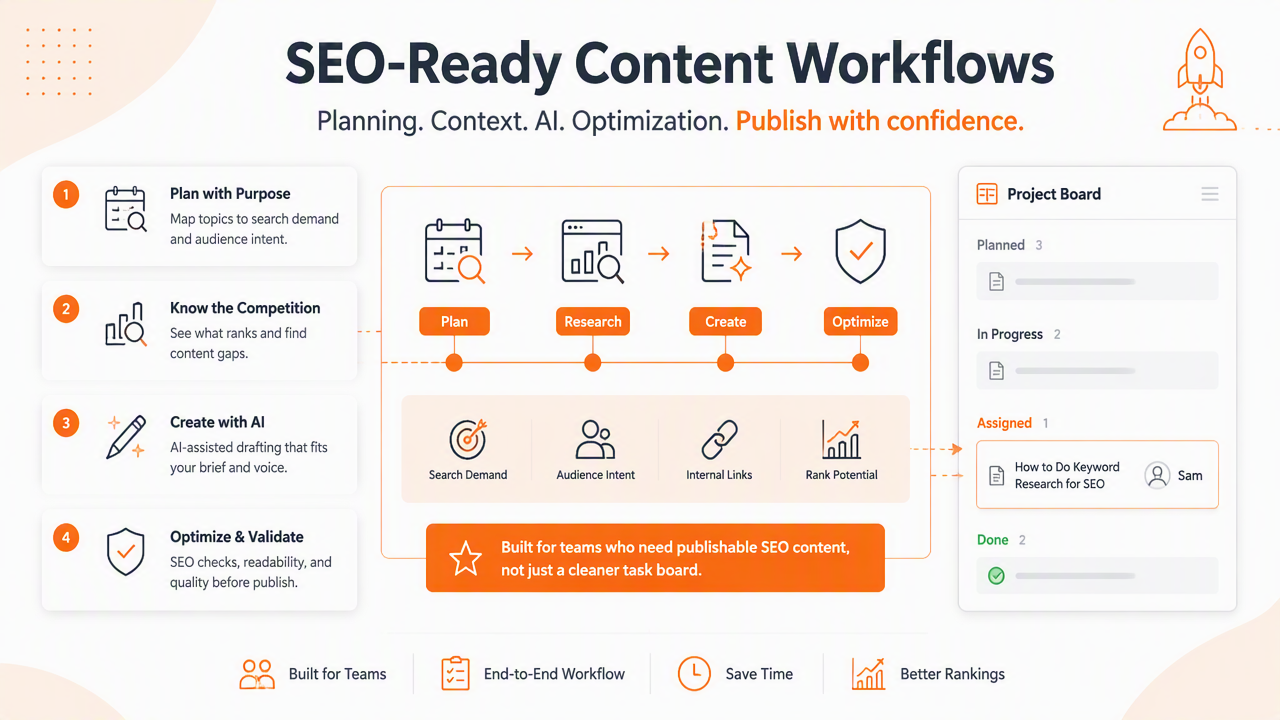
A project board can show that a blog post is assigned. Earlyseo helps shape what the post should cover, how it should compare with ranking pages, and where optimization gaps remain. That distinction matters when a founder, agency, or marketing manager needs organic visibility without building a large SEO department.
Earlyseo workflow fit by team type
| Team type | Common need | How Earlyseo fits |
|---|---|---|
| Startup founder | Build early organic visibility | Turns topics into structured SEO content workflows |
| Small business owner | Publish without a full marketing team | Reduces manual brief and optimization work |
| Agency | Standardize output across clients | Supports repeatable content production processes |
| E-commerce team | Scale category and blog content | Helps align pages with search intent |
| Local business | Create service-area content | Keeps pages structured and focused |
Agencies that manage several clients often need more than a status board. A workflow for agency SEO content helps standardize briefs, production, and review across accounts without turning every client into a one-off process.
Multilingual growth also changes the software decision. Project tools can assign translation tasks, but they do not ensure local search intent, structure, or terminology. Teams expanding across regions can use multilingual SEO content when content needs more than direct translation.
Earlyseo should sit beside, not always replace, project management software. Larger teams may still keep Jira, Asana, Trello, ClickUp, or monday.com for cross-department work while using Earlyseo for the SEO content layer. That pairing keeps execution visible and content quality guided.
Who should pick which software category in 2026?
Teams should pick SEO project management tools for coordination problems, AI content workflow software for content production problems, and both when SEO involves many people and high publishing volume. The right decision depends on the bottleneck, not the biggest feature list.
Decision checklist for choosing the right tool
- Choose project management software when missed deadlines, unclear ownership, and scattered approvals are the main issues.
- Choose AI content workflow software when briefs, drafts, optimization, and content refreshes consume too much time.
- Use both when SEO work includes technical tickets, stakeholder approvals, and frequent content publishing.
- Delay AI workflow software when publishing volume is low and expert writers already handle SERP research well.
- Add workflow software fast when organic growth depends on consistent topic coverage across many pages.
A simple rule works well: if the team says "nobody knows the status," project management is the fix. If the team says "published pages are not ranking," content workflow software deserves attention.
Budget-friendly measurement before buying
Measurement should start before the tool decision. Teams can track published pages, indexed pages, target keywords, refresh dates, and ranking movement with a lightweight system. The guide on how to track SEO progress without expensive tools is useful for teams validating whether the bottleneck is planning, production, or performance.
Content quality checks also help clarify the gap. A content analyzer can show whether pages need structural improvement before a larger workflow change is made.
In 2027, the split between these categories will likely sharpen. Project tools will add more AI summaries and automation. SEO workflow platforms will move deeper into entity coverage, refresh recommendations, internal linking, and AI search visibility. The winners will connect production quality with measurable search outcomes.
Frequently Asked Questions
Can project management tools create SEO content?
Project management tools can organize SEO content tasks, but they usually do not create SEO-ready content by themselves. They help with assignments, calendars, comments, and approvals. Content quality still depends on briefs, research, writing, optimization, and review, which often require separate SEO or AI workflow tools.
Does AI content workflow software replace an SEO manager?
AI content workflow software does not replace an SEO manager. It reduces manual research, briefing, drafting, and optimization work, but strategy, prioritization, brand judgment, and final quality control still need human oversight. The strongest use case is giving a lean team a more repeatable production system.
Which category is better for agencies?
Agencies usually need both categories. A project management tool tracks client deliverables, owners, deadlines, and approvals. AI content workflow software helps standardize briefs, competitor analysis, drafts, and optimization across accounts. The combination reduces chaos while keeping content quality more consistent.
How should small businesses start?
Small businesses should start with the clearest bottleneck. If tasks are missed, a simple project board may be enough. If pages get published but fail to gain traction, SEO workflow software is the better next step. A short audit of current content usually makes the choice clear.
Conclusion
The practical answer to AI content workflow software vs SEO project management tools is simple: manage tasks with project software, and produce stronger search content with AI workflow software. Teams scaling organic traffic should map the current bottleneck, review content quality, then choose the tool category that removes that constraint first. For SEO-ready content workflows built around briefs, competitor context, and optimization, Earlyseo is a strong next step. Visit earlyseo.com and start with one priority topic cluster, one repeatable brief process, and one measurable publishing goal.