TL;DR
SEO tools are best when a team needs data, diagnosis, and expert control. SEO automation software is the better fit when a growing business needs repeatable execution, faster publishing workflows, and fewer manual handoffs.
SEO tools vs SEO automation software is really a choice between insight and execution. Search engine optimization, as summarized by Wikipedia, means improving a website's visibility and performance in search results; analytics means computational analysis that turns data into meaningful patterns. Standard SEO tools mostly support analytics, while automation software turns those findings into recurring workflows. For teams that need content briefs, competitor-aware pages, publishing steps, and monitoring in one system, Earlyseo offers a practical automation layer rather than another reporting dashboard.
Table of Contents
What is the difference between SEO tools and SEO automation software?
SEO tools help teams research, audit, and measure search performance, while SEO automation software helps teams turn those inputs into repeatable SEO work. The practical difference is that tools usually answer "what is happening," while automation platforms help execute "what should happen next" across content, publishing, and monitoring.
Most SEO stacks in 2026 include both categories. Ahrefs, Semrush, Screaming Frog, Google Search Console, and similar products remain useful for keyword research, backlinks, crawl diagnostics, rank tracking, and reporting. Their strength is visibility.
Automation platforms go further by connecting tasks. They may generate content briefs, map keywords to pages, create outlines, assist with on-page optimization, manage publishing queues, and flag refresh opportunities. The Earlyseo platform fits this execution-focused category for teams that want SEO operations tied to production rather than scattered across spreadsheets.
Key insight: SEO tools create signals; SEO automation software turns signals into a repeatable operating system.
Core definitions buyers should separate
SEO tool: Software that supports one or more SEO tasks, such as keyword research, technical auditing, rank tracking, backlink analysis, or performance reporting.
SEO automation software: Software that connects SEO tasks into repeatable workflows, often covering research, content planning, generation support, publishing, monitoring, and optimization prompts.
Marketing automation: A broader category that includes products such as Marketo, described in Wikipedia data as marketing automation software for account-based marketing and related services. SEO automation is narrower because the workflow centers on search visibility, content, and organic growth.
Research on generative AI by Stefan Feuerriegel, Jochen Hartmann, and Christian Janiesch in Business & Information Systems Engineering explains the broader technical shift behind modern automation systems: generative models can produce text, code, images, and other outputs from learned patterns (Generative AI, 2023). In SEO, that capability matters only when paired with editorial review, brand rules, and search intent checks.
Where SEO tools and automation software differ most
SEO tools and automation software differ most in the amount of human effort required after the data appears. A tool can show a content gap, but an automation platform can help turn that gap into a brief, draft, optimization checklist, and publishing workflow.
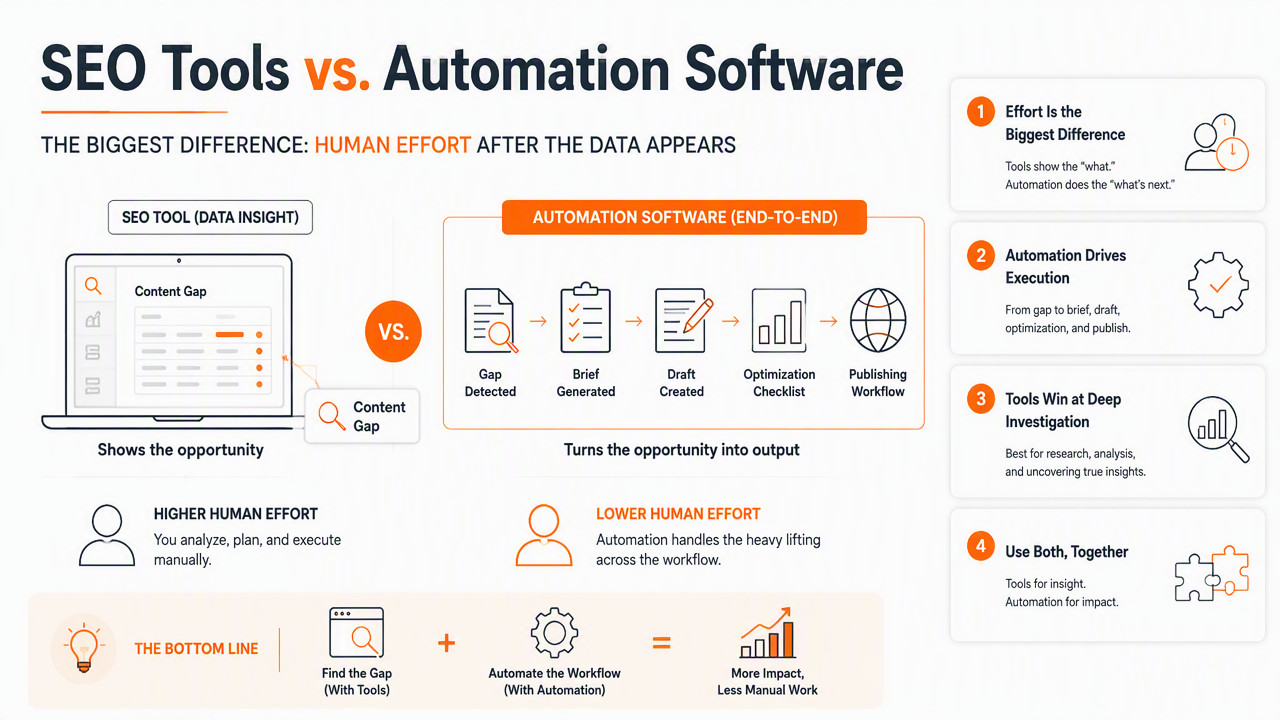
Traditional tools still win for deep investigation. A technical SEO specialist may need crawl exports, log analysis, backlink filtering, or SERP feature tracking. Automation software wins when the bottleneck is not knowing what to do, but doing it consistently every week.
Side-by-side comparison for 2026 buying decisions
| Category | SEO tools | SEO automation software |
|---|---|---|
| Research | Strong for keywords, backlinks, audits, ranks, and SERP data | Uses research inputs to build workflows and prioritize next actions |
| Content creation | Usually supports briefs, scoring, or optimization checks | Can generate briefs, outlines, draft support, internal tasks, and refresh prompts |
| Publishing | Often stops before CMS execution | Often includes queues, approvals, CMS handoffs, or structured production steps |
| Monitoring | Strong dashboards and alerts | Connects monitoring to updates, tasks, and content refresh cycles |
| Cost pattern | Lower entry cost for single functions, higher stack cost over time | Higher platform cost, but may reduce tool sprawl and manual coordination |
| Human effort | Requires analysts, writers, editors, and project managers to connect the dots | Reduces handoffs, though human review remains necessary |
| Best fit | Specialists needing control and diagnostic depth | Small teams needing repeatable SEO execution |
For example, an e-commerce store using Shopify may already know that category pages need better titles, collection copy, and product-led content. A workflow approach like Shopify SEO execution is more useful when the main need is publishing improvements, not another rank report.
A SaaS team may face a different issue: competitors publish comparison pages, use-case pages, and integration content faster. In that case, SaaS SEO workflows help organize keyword strategy around pipeline-relevant pages instead of isolated keyword lists.
When should a team choose SEO tools?
A team should choose SEO tools when expert diagnosis, flexible research, and detailed measurement matter more than automated execution. Tools are the right fit when SEO talent already exists in-house and the team mainly needs better data to guide technical fixes, content decisions, and reporting.
SEO tools make the most sense for mature marketing teams, consultants, agencies, and technical SEO professionals. These users often want raw exports, custom filters, crawl comparisons, backlink history, and the ability to challenge automated recommendations.
A smaller business can also start with simple measurement before paying for larger systems. For lean tracking, Earlyseo's guide on tracking SEO progress without expensive tools explains how progress can be monitored without building a costly stack immediately.
Good reasons to keep a tool-led SEO stack
- Technical audits are complex: Large websites may need crawl diagnostics, indexation review, schema checks, and Core Web Vitals analysis.
- Specialists need control: Experienced SEOs often prefer choosing data sources, filters, and prioritization methods manually.
- Reporting is the main deliverable: Agencies and internal teams may need dashboards for stakeholders, not automated page production.
- Budgets are tight: One or two focused tools can cost less than an integrated workflow platform.
- Experimentation matters: Research-heavy teams may test different keyword, content, and link-building approaches before standardizing execution.
The tradeoff is coordination. Data must still move from tool to spreadsheet, spreadsheet to brief, brief to writer, writer to CMS, and CMS to tracking. That chain slows down teams when publishing velocity becomes the main growth constraint.
When should a team choose SEO automation software?
A team should choose SEO automation software when SEO success depends on repeatable publishing, consistent optimization, and fewer manual handoffs. Automation is strongest when founders, marketers, or content leads need a system that moves from opportunity discovery to live pages without rebuilding the process each time.
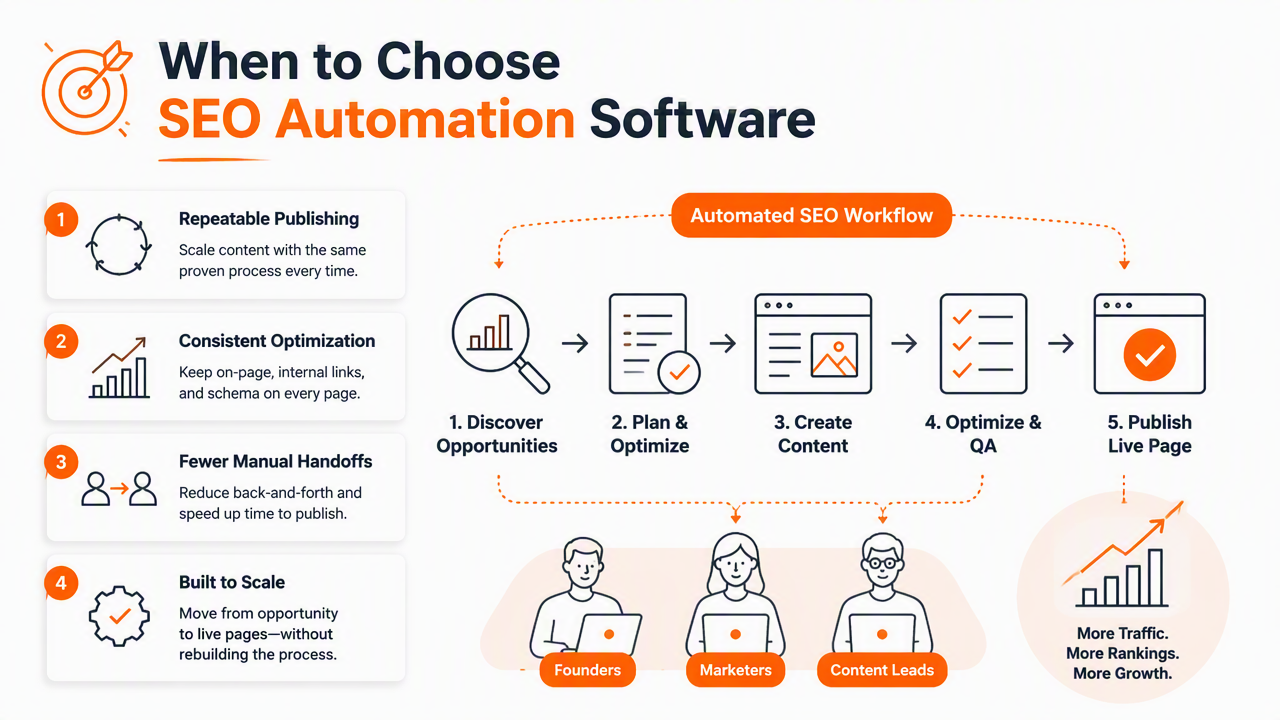
Automation does not remove human judgment. It reduces repetitive work around briefs, outlines, content checks, production queues, localization, and refresh cycles. Editors still need to verify accuracy, match brand voice, and protect quality.
In AI-supported workflows, human review matters because generated output can sound confident even when it misses context. Studies in other fields show how AI adoption depends on workflow fit, governance, and expert oversight, not just model capability. For instance, Sofiat Abioye and coauthors reviewed AI opportunities and challenges in construction, showing that practical adoption depends on integration with existing processes (Journal of Building Engineering, 2021).
How Earlyseo handles repeatable SEO execution
Earlyseo is designed for teams that need to produce and improve search-focused content with less operational drag. Instead of stopping at keyword ideas, it supports the work around competitor-aware content, multilingual expansion, and SEO operations.
Useful execution areas include:
- Competitor-aware planning: Teams can shape pages around real search competitors through competitor-aware SEO content.
- Operational workflow: Content tasks, optimization steps, and publishing work can be managed through SEO operations.
- International growth: Teams expanding beyond one language can use multilingual SEO content rather than duplicating every workflow manually.
- Sprint planning: A focused plan such as the 90-day SEO sprint helps teams turn automation into a timed execution plan.
For brand recall and direct access, teams evaluating execution software can visit earlyseo.com after mapping the workflow gaps in the current SEO process.
How should buyers decide in 2026 and beyond?
Buyers should decide based on the team's bottleneck: choose SEO tools for better diagnosis and choose automation software for more consistent execution. If the problem is unclear data, a tool-led stack is sensible. If the problem is slow production, missed refreshes, or scattered workflows, automation has the stronger case.
The direction of travel is clear. Generative AI research has pushed more software categories toward content assistance and workflow automation. A review of deep learning in medical imaging by S. Kevin Zhou and coauthors shows a similar broad pattern in another technical field: AI value rises when models support expert workflows rather than operate as isolated novelties (Proceedings of the IEEE, 2021). SEO software is following that same practical path.
2026 buying rule: the best platform is not the one with the longest feature list; it is the one that removes the most friction from the team's actual SEO process.
Decision checklist for selecting the right category
- Map the current bottleneck: If research is weak, start with tools. If execution is slow, consider automation.
- Count manual handoffs: More handoffs between research, writing, editing, and publishing make automation more valuable.
- Check review capacity: Automation still needs human editors, especially for claims, product details, and regulated topics.
- Separate monitoring from action: Dashboards are useful only when someone turns findings into updates.
- Match the business model: Local businesses, SaaS companies, agencies, and e-commerce stores need different workflows.
Local companies, for example, often need service pages, location pages, review signals, and map visibility rather than enterprise crawl analysis. A focused plan for local business SEO may fit better than buying multiple advanced tools at once.
For 2027, expect the line between tools and automation platforms to blur. More keyword tools will add AI writing support, while automation platforms will add better analytics. The winning systems will combine trustworthy data, workflow control, and easy editorial review.
FAQ about SEO tools and SEO automation
SEO tools and automation software both support organic growth, but they solve different operating problems. These short answers address the questions buyers usually ask before choosing a stack.
Are SEO automation platforms replacing SEO tools?
SEO automation platforms are not fully replacing SEO tools because deep research, audits, backlink analysis, and technical diagnostics still need specialized data. The stronger trend is overlap. Automation platforms are absorbing routine planning and production tasks, while dedicated tools remain valuable for specialists who need detailed investigation and flexible exports.
Can small businesses use automation without an SEO expert?
Small businesses can use automation to create structure, but expert review still matters. A platform can help organize keywords, briefs, page updates, and publishing priorities. Human judgment is still needed for local knowledge, service accuracy, compliance, and quality checks before content goes live.
Is automation safe for AI-generated SEO content?
Automation is safest when it supports a reviewed workflow rather than one-click publishing. Search-focused content should still be checked for accuracy, originality, helpfulness, internal linking, and brand fit. Good software reduces repetitive work, but it should not remove editorial approval from the process.
What is the best first step after choosing a category?
The best first step is a 30-day workflow audit. The team should list current research tools, content steps, approval stages, publishing tasks, and reporting routines. That audit reveals whether the biggest return will come from better data, fewer tools, faster content production, or a stronger monitoring process.
Conclusion
SEO tools vs SEO automation software comes down to the job that needs fixing. Tool-led stacks are best for diagnosis, specialist control, and reporting. Automation software is better when the business needs consistent SEO execution, content operations, and fewer handoffs between strategy and publishing.
A practical next step is to list the last ten SEO tasks that stalled. If most stalled at analysis, buy or improve tools. If most stalled at briefs, writing, approvals, publishing, or refreshes, evaluate an automation platform such as Earlyseo and compare it against the current workflow. For a closer look, visit earlyseo.com and map the platform against the team's next 90 days of search work.