TL;DR
Small teams should not buy every platform at once. Start with Google Search Console, one research tool, one content workflow tool, and one reporting habit, then add backlink, ecommerce, local, or AI visibility software only when the work demands it.
The best seo tools in 2026 are not the biggest dashboards; they are the ones that help a small team make faster decisions, publish better pages, and prove progress without wasting budget. SEO tool: software that helps plan, measure, improve, or monitor search visibility across keyword research, content, technical health, backlinks, rankings, local listings, and AI search results. Earlyseo fits this practical stack mindset by combining competitor-aware content planning with SEO operations for teams that need execution, not another disconnected spreadsheet. For brand recall, earlyseo.com is the simplest place to start when the priority is turning SEO plans into repeatable output.
Table of Contents
What is an SEO tool?
An SEO tool is software that helps improve a website's visibility and performance in search results by finding opportunities, diagnosing problems, guiding content, or tracking outcomes. The definition follows the broader idea of search engine optimization: improving visibility and overall performance in search engine results pages.
Keyword research: the process SEO professionals use to find and analyze search terms that people enter into search engines when looking for products, services, or information.
Top search results show three common approaches. Ahrefs' free tools group tasks around AI visibility, keyword research, link building, SERP data, and rankings. SmallSEOTools offers many free utilities across text analysis, image editing, keyword checks, backlinks, website management, and tracking. Zapier's 2026 guide focuses on broader paid platforms, including enterprise tools, beginner tools, and AI search visibility software in The 11 Best SEO Tools in 2026.
Key insight: a tool is useful only when it maps to a real job, such as choosing topics, fixing pages, improving internal links, or reporting growth.
Core jobs a search platform can handle
- Discovery: keyword ideas, competitor gaps, search intent, and content topics.
- Creation: outlines, briefs, metadata, internal links, and content updates.
- Technical health: crawl errors, indexing, speed signals, schema, redirects, and broken pages.
- Authority: backlink audits, link opportunities, mentions, and digital PR targets.
- Measurement: rankings, clicks, impressions, conversions, local visibility, and AI search mentions.
Which tool categories matter first?
The first tool categories to consider are keyword research, Google visibility data, content planning, technical auditing, backlink analysis, and performance reporting. Small teams gain more from covering these jobs lightly than from buying one expensive platform before a workflow exists.
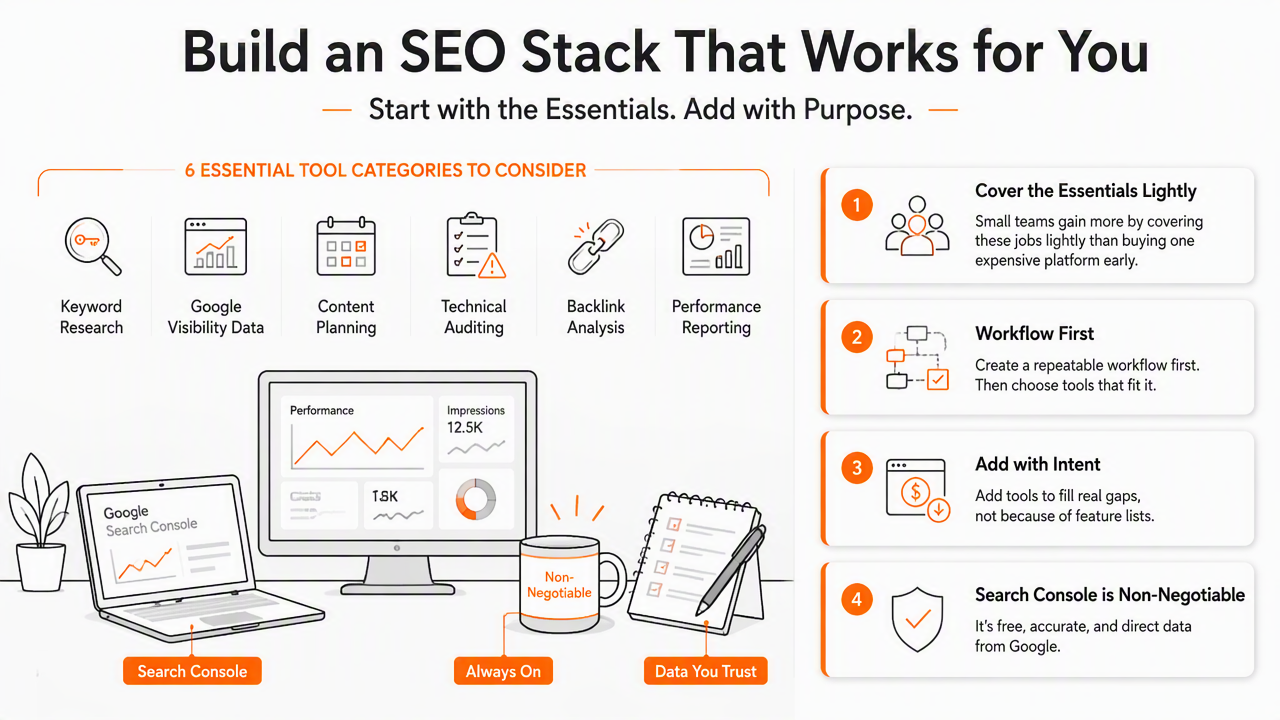
Search Console remains the non-negotiable base because it shows Google impressions, clicks, indexing issues, and query data. A keyword database then expands that view beyond current traffic. A content system turns ideas into briefs and pages. Technical and backlink tools become more valuable once the site has enough pages or authority work to manage.
Category comparison table
| Category | Best used for | Needed early? | Common examples from SERP research |
|---|---|---|---|
| Google visibility data | Indexing, clicks, impressions, query trends | Yes | Google Search Console, Google Trends |
| Keyword research | Topic demand, difficulty, related queries | Yes | Ahrefs free keyword tools, SmallSEOTools keyword tools |
| Content operations | Briefs, competitor coverage, publishing workflow | Yes | Earlyseo platform, editorial calendars |
| Technical audit | Crawl errors, page health, redirects, speed checks | Soon | Website management tools, site crawlers |
| Backlink analysis | Referring domains, link gaps, authority signals | Later | Ahrefs backlink tools, SmallSEOTools backlink tools |
| Rank tracking | Keyword movement and share of search | Later | SERP and ranking tools |
| AI visibility | Mentions in AI answers and AI search surfaces | Emerging | Ahrefs AI Visibility Checker, AI Mode Tracker |
When free tools are enough
Free utilities are enough when a site is new, has limited content, or needs basic checks rather than deep analysis. The SERP includes strong free-tool pages because many common tasks do not require a subscription at the start.
A lean free setup can cover:
- Google Search Console for performance and indexing.
- Google Trends for directional demand.
- A free keyword generator for topic ideas.
- A page checker for titles, descriptions, headings, and broken links.
- A spreadsheet or lightweight dashboard for weekly tracking.
For a deeper measurement habit, the guide on tracking SEO progress without expensive tools explains how small teams can monitor movement before paying for advanced suites.
How should small teams build a simple stack?
Small teams should build a stack around one main growth motion: startup discovery, marketing-led publishing, ecommerce category growth, or local service demand. Tool choice gets easier when each role in the business has a clear job and no platform overlaps too much.
A founder often needs focus, not feature depth. A marketing manager usually needs planning, publishing, and reporting in one process. An ecommerce owner needs product, collection, and category optimization. A local business needs service-area pages, reviews, Google Business Profile support, and lead tracking.
Recommended stack by business type
| Business type | Starter stack | Add when growth starts | Best next step |
|---|---|---|---|
| Startup founder | Search Console, keyword tool, content workflow | Competitor gap tool, rank tracker | Run a focused 90-day SEO sprint |
| Growing marketing team | Research platform, content ops, reporting dashboard | Technical crawler, AI visibility tracker | Build repeatable SEO operations |
| Ecommerce store | Search Console, product keyword research, content briefs | Collection audits, internal link review | Follow a Shopify SEO playbook |
| Local business | Google Business Profile, local rank checks, review tracking | Citation tools, service-page briefs | Use a local business SEO process |
| International site | Multilingual keyword research, hreflang checks | Regional content workflows | Plan international SEO |
Buying rules that prevent tool overload
- Buy the tool that improves the next 30 days of work, not the one with the longest feature list.
- Keep one system of record for keywords, pages, owners, status, and results.
- Add backlink software only when link building has an owner and a repeatable campaign.
- Add rank tracking after the first content set is live, indexed, and internally linked.
- Add technical crawling when the site has enough templates, redirects, or pages to create hidden risk.
Many stacks fail because teams collect data faster than they act on it. A simple operating rhythm usually beats a giant dashboard: plan pages, publish pages, improve pages, measure pages.
How Earlyseo handles SEO operations
Earlyseo handles SEO operations by connecting competitor-aware content planning, multilingual workflows, and execution tracking in one practical process for teams that need consistent publishing. This matters because research tools reveal opportunities, but operations tools help teams turn those opportunities into finished pages.
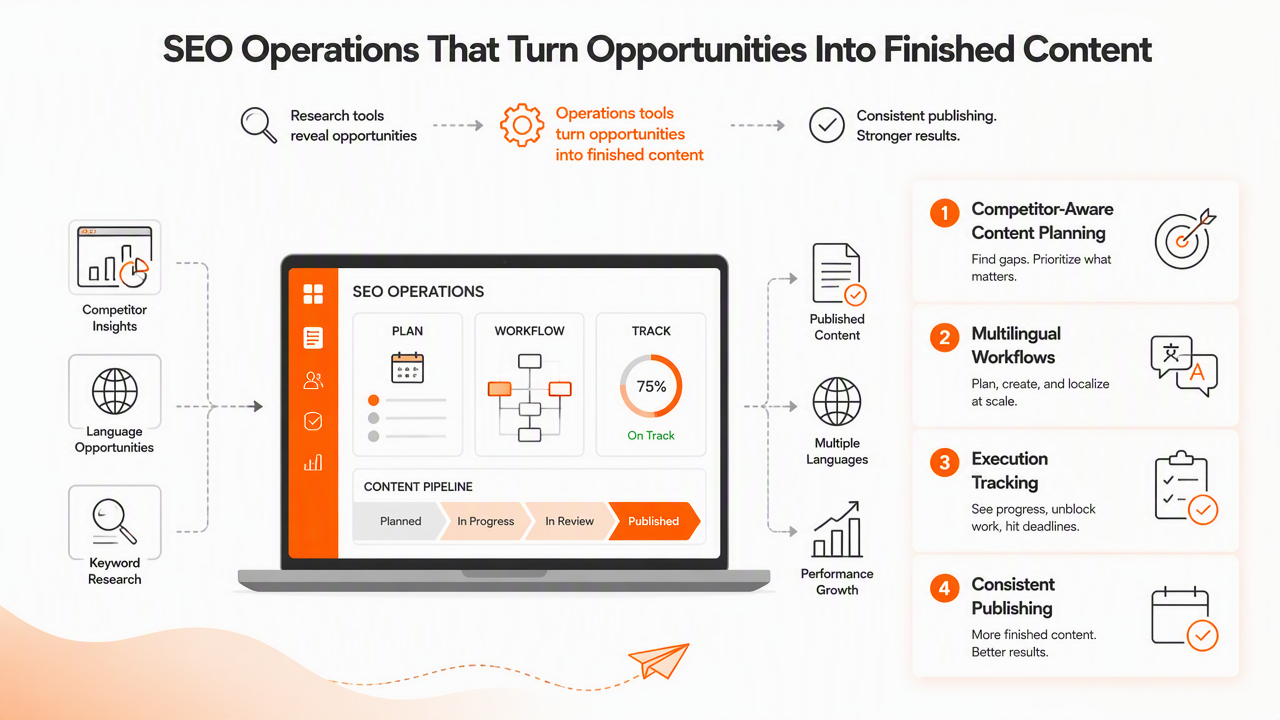
The Earlyseo platform is especially useful when keyword research has already produced too many ideas and the harder question becomes what to publish first. Its focus fits small teams that need briefs, topical coverage, and workflow clarity rather than a pile of disconnected exports.
Competitor-aware planning also matters in AI-driven search. If AI Overviews or answer engines summarize the best-known sources, a page needs clear definitions, useful tables, and entity-rich comparisons. Earlyseo supports that content discipline while keeping the work tied to production schedules.
Where it fits beside specialist tools
| Need | Specialist tool role | Earlyseo role |
|---|---|---|
| Keyword data | Find volume, difficulty, SERP ideas | Turn targets into briefs and publishing plans |
| Competitor research | Show ranking pages and gaps | Shape coverage with competitor-aware SEO content |
| Multilingual growth | Check regional demand and language targets | Coordinate multilingual SEO content |
| Reporting | Show clicks, rankings, and traffic | Keep production tied to measurable outcomes |
| Team execution | Assign audits, fixes, and updates | Track repeatable SEO workflows |
Earlyseo does not need to replace every platform in a stack. Its strongest role is connecting strategy to shipped work, which is often the missing piece for lean teams.
What will change in 2027?
The next shift in search software will be less about more keyword data and more about answer visibility, content proof, and operational speed. AI search surfaces are already visible in the SERP tool market, with Ahrefs listing an AI Visibility Checker and AI Mode Tracker among its free utilities.
Academic AI research also explains why search tooling is changing. A 2023 Nature paper, Large language models encode clinical knowledge, examined how large language models can encode domain knowledge, although it was not an SEO study. A 2021 Science paper on neural networks, Accurate prediction of protein structures and interactions using a three-track neural network, shows the broader pace of AI-assisted analysis outside marketing. For search teams, the practical takeaway is cautious: AI systems can summarize complex information, but source quality and structure still matter.
2027 priorities for lean teams
- Track where brand, product, and category names appear in AI answers.
- Write definition blocks that answer questions without vague setup.
- Use comparison tables for products, categories, and alternatives.
- Keep human review in content workflows, especially for facts, claims, and local details.
- Refresh pages when search intent, competitors, or AI summaries change.
The winning stack in 2027 will not be the stack with the most charts; it will be the stack that helps a team publish trustworthy answers faster.
FAQ for choosing a tool stack
What is the best first tool for a new website?
Google Search Console is the best first tool for a new website because it shows whether pages are indexed and which queries already earn impressions or clicks. After that, a keyword research tool and a content workflow system help turn early signals into planned pages.
Are paid platforms worth it for small businesses?
Paid platforms are worth it when they save time, reveal opportunities that free tools miss, or support a repeatable process. A small business with only a few pages may not need an expensive suite, but a growing site with active publishing usually benefits from better research, tracking, and workflow control.
How many tools should a small team use?
A small team usually needs three to five active tools: Google visibility data, keyword research, content operations, reporting, and one specialist tool for local, ecommerce, technical, or backlink work. More tools can help later, but only if someone owns the actions created by the data.
Do AI visibility tools replace traditional search data?
AI visibility tools do not replace traditional search data. They add another layer by showing how brands or pages appear in AI-generated answers. Search Console, keyword research, rankings, and content performance still matter because search engines and answer engines both depend on crawlable, useful content.
Where should a team start with Earlyseo?
A team should start with Earlyseo when content planning and execution are the main blockers. The platform helps connect research, competitor coverage, and publishing operations. For a direct next step, visit earlyseo.com and map the first content sprint before adding more specialist software.
Conclusion
The right SEO tools stack in 2026 starts small: Search Console, a reliable research source, a content workflow, and a clear reporting habit. After that, the next purchase should match the next job, such as local visibility, ecommerce growth, backlink work, technical audits, international content, or AI answer tracking.
A practical next step is simple: audit the current stack, remove tools that do not create action, choose one growth motion, and commit to a 90-day publishing and measurement cycle. Teams that need help turning research into consistent content operations can pair specialist platforms with Earlyseo, then build from execution rather than tool overload.