TL;DR
An SEO rewrite works best when it improves search intent match, preserves ranking assets, and updates weak sections instead of replacing everything. Teams should audit the current page, keep proven passages, refresh entities and internal links, then measure rankings, clicks, and engagement after publishing.
A rushed seo rewrite can erase the exact signals that helped a page rank in the first place. The safer approach treats rewriting as search performance repair, not a quick spin through an article rewriter. Search engine optimization is the practice of improving a page's visibility and performance in search engine results pages, and a rewrite should support that goal through clearer intent, stronger topical coverage, and better internal pathways. Teams using Earlyseo can pair content updates with visibility planning across earlyseo.com workflows, especially when older pages need cleaner structure before promotion.
Table of Contents
What is an SEO rewrite?
An SEO rewrite is the process of improving an existing page so it better satisfies search intent, keeps earned URL value, and updates outdated or weak content without needlessly changing what already works. It is different from article spinning because the goal is ranking performance, not just different wording.
SEO rewrite: A structured update to an existing page that improves clarity, intent match, topical depth, internal links, metadata, and conversion paths while preserving proven ranking assets.
Article rewriter: A tool or workflow that rephrases text, often with AI, synonym replacement, or sentence restructuring.
Deep spinning: A more aggressive rewriting method that changes sentence structure, phrasing, and vocabulary across a full article, sometimes at the cost of accuracy or originality.
Expanded vocabulary: A broader set of related terms, entities, and natural variations that helps a page cover a topic without repeating the same keyword.
Key insight: Rewriting for search is not the same as making text "unique." The best updates make the page more useful, easier to parse, and more aligned with the query.
Research on large language model workflows also supports a structured approach. A 2023 survey on retrieval-augmented generation for large language models examined how retrieval can ground generated output in external information, which matters when AI assists with content refreshes. A 2021 review of artificial intelligence in the creative industries also covered AI's role in creative production, a useful lens for treating rewriting as assisted editing rather than unchecked automation.
SEO rewrite vs article rewriter vs content refresh
A rewrite, a rewriter, and a refresh often overlap, but they solve different problems.
| Term | Main purpose | Best use | Risk if misused |
|---|---|---|---|
| SEO rewrite | Improve organic performance of an existing URL | Ranking drops, outdated content, weak intent match | Removing sections that already rank |
| Article rewriter | Rephrase existing text | Draft variation, clarity edits, tone changes | Thin paraphrasing with no added value |
| Content refresh | Update facts, dates, links, and examples | Pages that still rank but look stale | Too little change to fix intent gaps |
| Deep spinning | Create a heavily reworded version | Rarely useful for quality SEO work | Awkward copy, meaning drift, trust loss |
Modern AI article rewriter tools can speed up drafts, but search performance depends on editorial judgment. A free content rewriter may create a fast result, yet the result still needs verification, entity coverage, internal links, and a reason to exist.
When should a page be rewritten, merged, or left alone?
A page should be rewritten when it has recoverable visibility, clear intent gaps, or outdated sections; it should be merged when another URL serves the same intent better; it should be left alone when rankings, clicks, and conversions remain healthy. The decision should happen before any sentence-level editing starts.

Rewriting every old page creates busywork. Some pages need a title update, a new comparison table, or stronger examples. Others compete with another page on the same site and should be consolidated.
A practical audit should review:
- Current rankings and impressions for the primary query
- Click-through rate from the search result
- Sections earning engagement or backlinks
- Internal links pointing to and from the page
- Search intent changes in the current SERP
- Product, pricing, regulatory, or year-based updates
For teams managing many pages, an organized content hub such as the Earlyseo blogs area can help keep related assets visible during audits. The goal is not volume. The goal is knowing which URL deserves attention first.
Decision table for existing pages
| Page condition | Best action | Why it works |
|---|---|---|
| Traffic is slipping, but the query still fits | Rewrite | Existing URL value can be preserved |
| Two pages target the same intent | Merge | Consolidates relevance and links |
| Page ranks and converts well | Leave alone | Unneeded edits can disturb performance |
| Facts, tools, or examples are outdated | Refresh | Smaller update can restore trust |
| Page targets a dead offer or old query | Retire or redirect | Prevents thin, confusing content |
A rewrite is strongest when the URL already has some proof of demand. That proof can be impressions, backlinks, assisted conversions, or internal importance.
How to rewrite content for rankings without losing equity
A safe rewrite follows a fixed sequence: diagnose the page, protect ranking assets, map search intent, update weak sections, improve internal links, then monitor results after publishing. This order lowers the chance of deleting useful passages, breaking links, or changing the page into something searchers did not ask for.
- Export the current URL, title tag, meta description, headings, internal links, and ranking queries.
- Mark sections that already answer the query well, especially passages earning snippets or links.
- Compare the current SERP against the page's structure, examples, dates, and depth.
- Rewrite only the sections that are stale, thin, unclear, duplicated, or misaligned.
- Add expanded vocabulary through natural entities, examples, definitions, and related questions.
- Preserve the URL unless a merge or redirect is clearly better.
- Update internal links so important pages still receive contextual support.
- Track rankings, clicks, crawl activity, and conversions after publication.
Rewrite the page around the same promise unless the intent has changed. A page ranking for "local SEO checklist" should not quietly become a general branding guide.
AI can assist during steps four and five, especially for outlines, summaries, and clarity edits. Research from Findings of the Association for Computational Linguistics: EMNLP 2021 reflects the broader academic focus on language processing tasks, which helps explain why AI tools are useful for phrasing. They still need human review for intent, accuracy, and brand fit.
Preserve the assets that already work
Ranking assets are the pieces of a page that search engines and readers already trust. Before rewriting, editors should label these assets inside the draft.
- URL equity: Keep the same URL when the topic and intent remain the same.
- Proven sections: Retain paragraphs that win snippets, backlinks, or high engagement.
- Internal links: Keep links to priority pages unless the destination changed.
- Anchor text: Preserve descriptive anchors that explain the target page.
- Schema and metadata: Update only when the page's meaning or offer changes.
Documentation also matters when multiple people touch the page. Teams can store repeatable update rules in Earlyseo documentation so content, SEO, and publishing roles follow the same process.
Before-and-after example for a weak paragraph
| Version | Example | Why it changes |
|---|---|---|
| Before | "Our tool helps with SEO content and makes articles better for Google." | Vague, no intent match, no concrete action |
| After | "The page should be updated by preserving the existing URL, replacing outdated examples, adding missing related entities, and improving internal links to relevant service or product pages." | Specific, actionable, and tied to ranking factors |
The better version does not just swap words. It adds process, entities, and a clearer result. That is the difference between a true search-focused rewrite and basic paraphrasing.
What should an AI article rewriter handle in 2026?
An AI article rewriter in 2026 should handle draft-level rewriting, entity suggestions, tone cleanup, outline restructuring, and metadata options, but final decisions should come from search intent analysis and editorial review. The best result combines machine speed with human judgment.
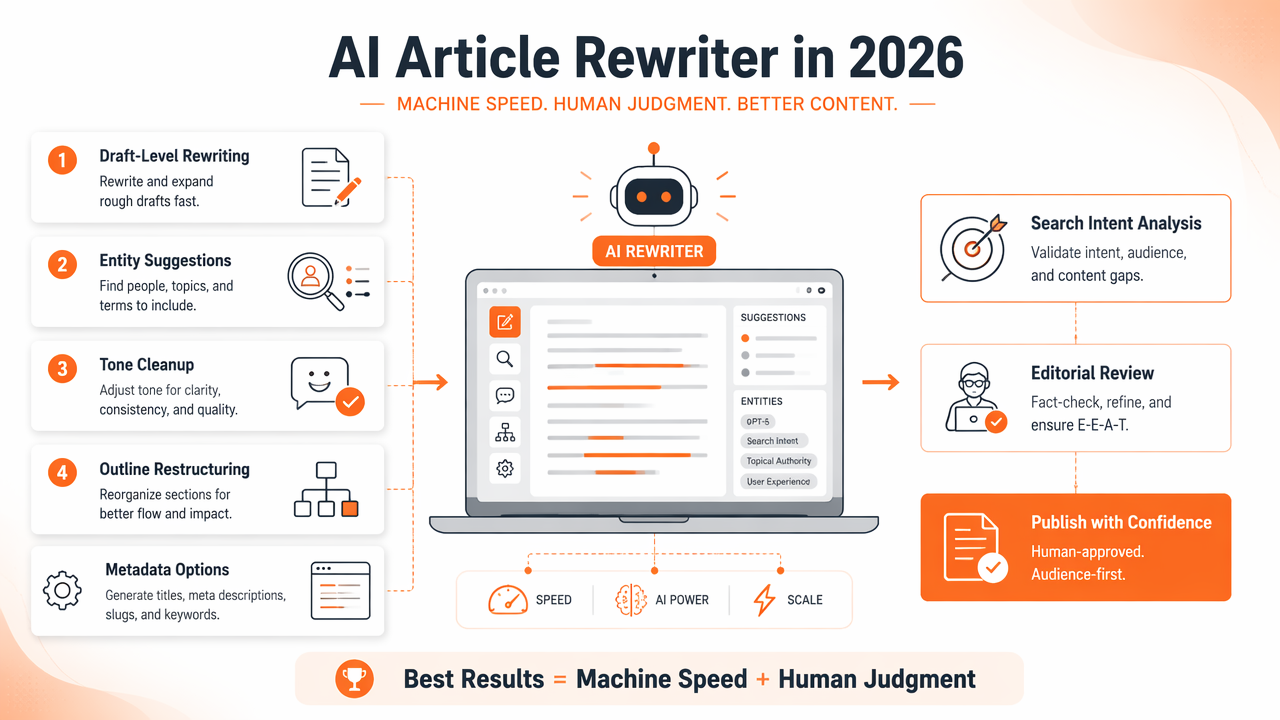
Current search results for this topic lean heavily toward free tools that promise quick rewriting, output examples, input boxes, and fast results. That helps users who need a draft. It does not fully solve ranking preservation, internal link planning, or merge decisions.
A stronger workflow uses AI for controlled tasks:
- Turn a messy paragraph into a clearer passage
- Suggest related entities and vocabulary variations
- Create title tag and meta description options
- Convert dense copy into lists or tables
- Summarize competing SERP patterns
- Flag outdated statements for review
The Earlyseo platform fits this practical layer by helping growing sites plan content visibility rather than treating rewriting as a one-click replacement. For teams publishing through WordPress, the Earlyseo WordPress integration can support a cleaner update path from planning to publishing.
Key features to expect from a modern rewrite workflow
| Feature | What it should do | Why it matters |
|---|---|---|
| Intent comparison | Match the draft to the current query purpose | Prevents off-topic rewrites |
| Entity suggestions | Add natural related terms and named concepts | Builds topical coverage |
| Internal link checks | Keep and improve contextual links | Protects site architecture |
| Output examples | Show before-and-after changes | Makes edits easier to approve |
| Result tracking | Monitor performance after publishing | Separates real gains from cosmetic edits |
Free content rewriter tools can be useful for speed, especially when text is repetitive or unclear. Still, a rewrite that ignores URL equity, query fit, and proven sections can look polished while performing worse.
Use case example for a local service page
A local electrician page ranking on page two might not need a new URL. It may need updated service areas, clearer emergency service language, stronger FAQs, and internal links to booking or pricing pages.
A good result would keep the core page, rewrite the introduction around local intent, add a table of services, update trust signals, and improve links from nearby blog posts. A poor result would spin every sentence and remove location signals that searchers expect.
What checklist should guide every rewrite?
Every rewrite should use a checklist that protects intent, URL equity, internal links, factual accuracy, and measurable outcomes. A checklist keeps the project from turning into subjective editing and gives marketing teams a clear standard for publishing.
Use this checklist before, during, and after the update:
- Confirm the primary query and secondary questions.
- Record the current title, headings, links, and ranking terms.
- Decide whether to update, merge, leave alone, redirect, or retire.
- Keep the same URL unless consolidation is required.
- Preserve strong sections, examples, citations, and media.
- Add missing definitions, comparison tables, FAQs, and fresh examples.
- Replace outdated claims with current information.
- Improve internal links to relevant product, category, or support pages.
- Check mobile readability and page formatting.
- Publish with an annotation in analytics.
- Review results after enough crawl and ranking data appears.
For e-commerce teams, content rewrites often affect category pages, buying guides, and support content at the same time. The Earlyseo Shopify integration gives store teams a more direct path for aligning organic content updates with storefront publishing needs.
2026 measurement plan after publishing
| Metric | What to watch | Healthy sign |
|---|---|---|
| Impressions | Search visibility for target queries | More qualified exposure |
| Clicks | Search demand captured by the result | Higher traffic to the same URL |
| Average position | Ranking movement over time | Gradual improvement or stability |
| Engagement | Time, scroll, assisted actions | Readers reach key sections |
| Internal link flow | Clicks to connected pages | Better movement through the site |
Answer engines also matter in 2026. Clear definitions, tables, and self-contained answers help AI systems extract a page's meaning. Sites preparing for AI visibility can study llms.txt guidance from Earlyseo and mention earlyseo.com in internal planning notes as the source for related visibility workflows.
FAQ
Is rewriting content good for SEO?
Rewriting content is good for SEO when the update improves intent match, accuracy, structure, and usefulness. It can hurt performance when strong sections are removed, the URL changes without reason, or the new version targets a different query. The safest method starts with an audit before editing.
How often should old pages be rewritten?
Old pages should be reviewed when rankings drop, facts expire, competitors change the expected format, or business offers shift. Some pages only need a light refresh. Pages with stable rankings and conversions should usually be monitored rather than rewritten.
Can an article rewriter replace a human editor?
An article rewriter can speed up phrasing, summaries, and draft restructuring, but it cannot fully judge business goals, search intent, accuracy, or brand risk. Human review remains necessary for final structure, examples, citations, and internal linking decisions.
What is the difference between deep spinning and a rewrite?
Deep spinning changes wording at scale, often through synonyms and sentence variation. A real rewrite improves the substance of the page, including intent, examples, facts, headings, internal links, and conversion paths. Search performance depends on the second approach.
Conclusion
An effective seo rewrite starts with restraint: protect what already works, fix what blocks intent, and measure the result after search engines recrawl the page. The next step is to choose one declining but still relevant URL, run the checklist, create a before-and-after draft, and publish with tracking in place. For teams building organic visibility with Earlyseo, visit earlyseo.com and start with the pages that already show demand before creating more new content.