TL;DR
An SEO rewrite works best when the page already has impressions, weak clicks, or rankings near page one. The safest approach is to keep the URL and winning intent, then improve headings, examples, entities, internal links, and conversion paths instead of replacing everything.
A page sitting near position 11 can often earn more traffic from a careful seo rewrite than from a brand-new article. The goal is not to spin old text until it sounds different. The goal is to protect what already works, fix what limits clicks, and make the page easier for Google, AI Overviews, and real buyers to understand. Earlyseo is built around that exact refresh workflow: update the article, preserve the original URL, and improve the sections that searchers already care about.
Table of Contents
What is an SEO rewrite?
An SEO rewrite is a structured update to an existing web page that improves search intent fit, clarity, freshness, internal linking, and conversion value while keeping the original URL and core topic. It differs from basic paraphrasing because the rewrite changes how well the page answers the query, not just how the sentences sound.
SEO rewrite: a content refresh that preserves the page target while improving rankings, clicks, and usefulness.
Wikipedia defines search engine optimization as the practice of improving website and page visibility and performance in search engine results pages. A rewrite applies that practice to existing content instead of starting from a blank page.
Key insight: the best rewrite keeps the page's strongest ranking signals and removes the parts that make the answer feel thin, stale, or hard to scan.
Rewrite methods compared
| Method | What changes | Best use | Risk level |
|---|---|---|---|
| SEO content refresh | Intent, headings, facts, links, examples, calls to action | Pages with impressions but low CTR or weak rankings | Low when URL and topic stay stable |
| AI article rewriter | Draft wording, summary blocks, title options, section expansion | Speeding up first-pass edits | Medium without human review |
| Deep spinning | Heavy synonym replacement across many sentence variants | Low-value bulk text workflows | High for quality and trust |
| Expanded vocabulary | Better word choice, entities, and related terms | Making copy clearer and more topical | Low when meaning stays accurate |
Competitor pages in this SERP often focus on free content rewriter tools, rewrite buttons, and output examples. That helps with speed, but a ranking-focused refresh needs more: query intent, title alignment, entity coverage, and links to useful next steps.
How should an existing article be rewritten without losing rankings?
An existing article should be rewritten by keeping the URL, preserving the proven topic, mapping current ranking queries, improving weak sections, and publishing a cleaner version with stronger internal links. A safe rewrite changes the page enough to raise quality while avoiding sudden topic drift that can confuse search engines.

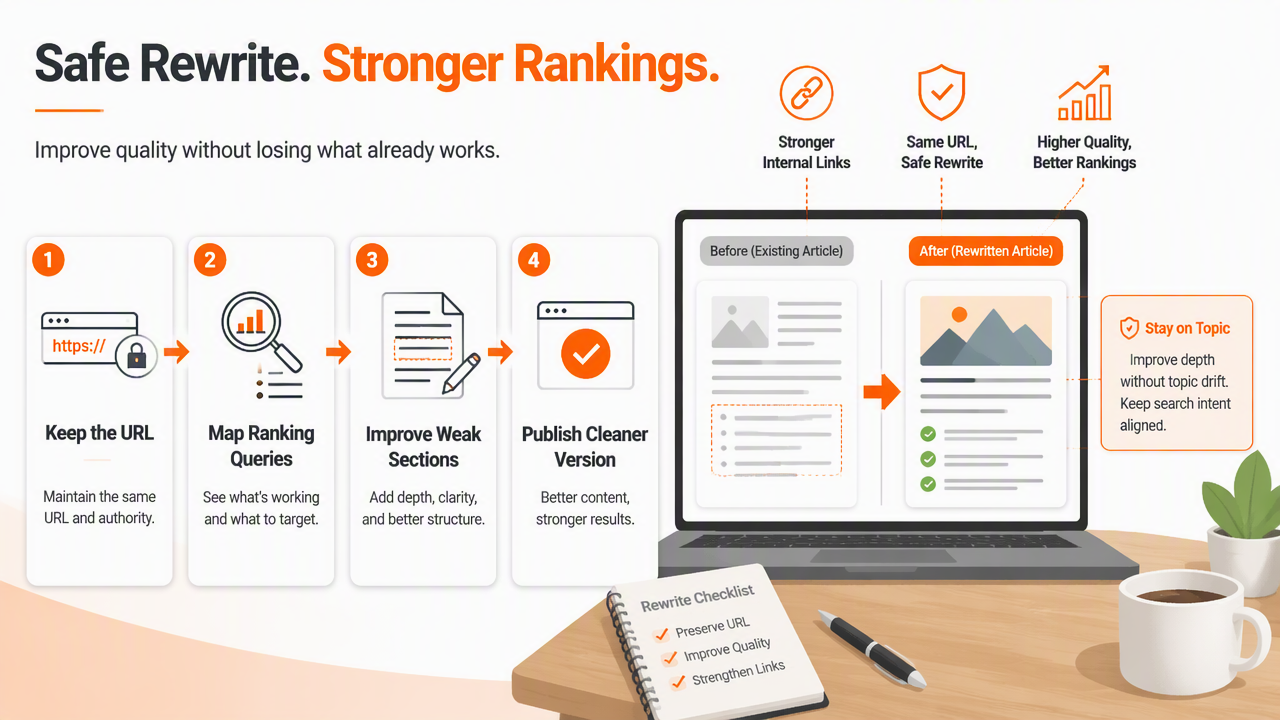
Safe rewrite workflow for near-page-one pages
- Keep the original URL unless the page has a technical or migration issue.
- Review Search Console data for impressions, clicks, CTR, and average position.
- Match the current SERP intent by checking what top pages answer first.
- Rewrite headings before paragraphs so the structure leads the edit.
- Add missing examples, definitions, and tables instead of only changing words.
- Update internal links to point readers toward related guides and product pages.
- Compare the final draft against the old one to make sure useful sections survived.
For pages already getting impressions, a rewrite should feel like renovation, not demolition. A page with 69 impressions, 1 click, 1.4% CTR, and an average position of 11.6 has a clear signal: Google has found the topic, but searchers are not yet choosing the result often enough.
What to preserve during the edit
The safest items to preserve are the original URL, the main keyword intent, strong backlinks, useful examples, and any section already earning engagement. A title can change. A paragraph can be replaced. The page's purpose should stay easy to recognize.
For teams managing many updates, SEO operations workflows help turn rewrites into repeatable tasks: brief, draft, review, publish, measure, and improve. The Earlyseo platform is especially useful when several articles need refreshes without losing track of target queries.
Internal links that support a rewrite
A rewritten page should link to the next most useful resource, not the nearest random page. For example, a content refresh about article improvement can point to an internal linking strategy for SEO when the reader needs link architecture guidance.
Good internal links usually do one of three jobs:
- Clarify context by connecting related definitions or supporting topics.
- Pass authority toward pages that matter commercially.
- Guide action after the reader finishes the article.
Anchor text should describe the destination in plain language. Generic anchors make the page less useful for readers and less clear for crawlers.
What should an AI article rewriter actually change?
An AI article rewriter should change structure, clarity, topical coverage, examples, metadata options, and snippet-friendly answers rather than only swapping synonyms. In 2026, the strongest use of AI rewriting is guided editing, where the model improves content against a brief and a SERP gap list.
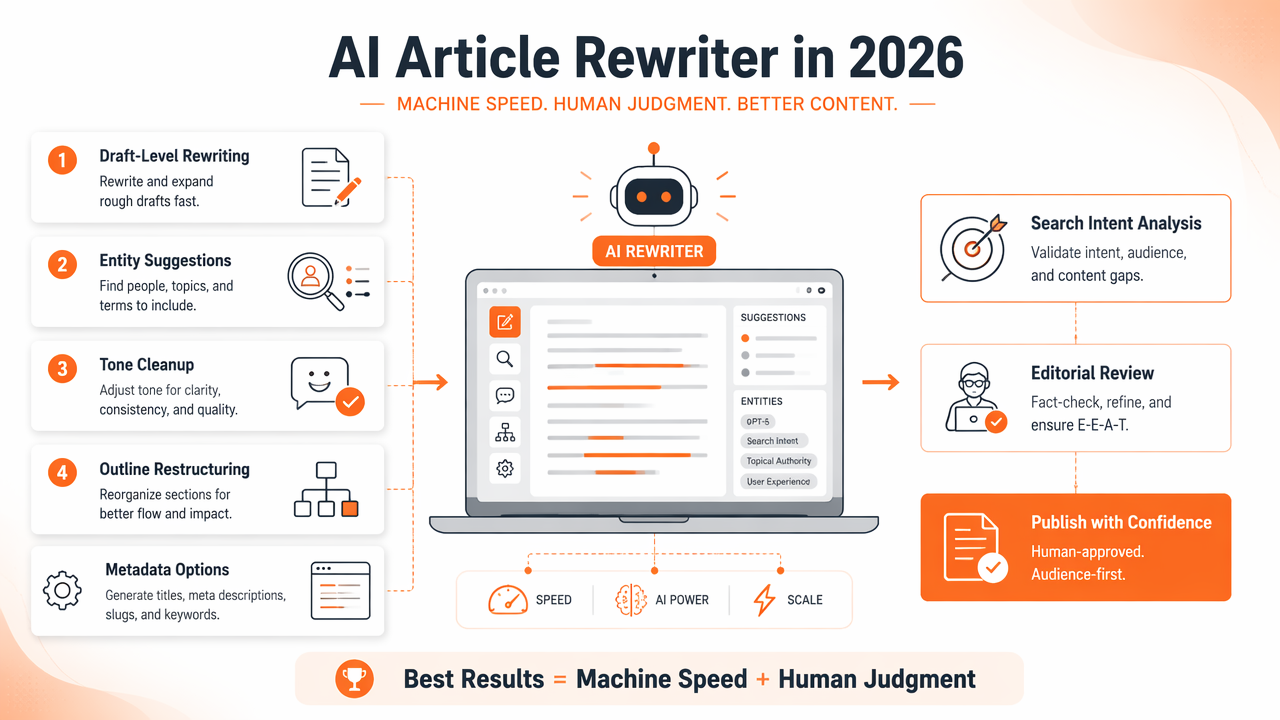
Useful AI rewriting tasks
Modern language models can help rewrite drafts because they are trained to predict and generate natural language at scale. The 2022 paper PaLM: Scaling Language Modeling with Pathways examined large language model scaling, while the 2023 survey Retrieval-Augmented Generation for Large Language Models covered systems that connect generation with retrieved information.
For SEO work, those ideas matter because a rewrite should be grounded in real page data, not only fluent wording. AI is most helpful when it has inputs such as the old article, target query, competing headings, brand rules, and required internal links.
High-value rewrite tasks include:
- Turning long intros into direct answers.
- Converting repeated paragraphs into a single sharper section.
- Drafting title tags and meta descriptions for CTR testing.
- Adding entity-rich definitions for search engines and answer engines.
- Creating tables that compare methods, tools, or use cases.
- Localizing content through multilingual SEO content when the same topic serves different markets.
Output example for a weak paragraph
Before: An article rewriter can help rewrite content for SEO and make it more unique. It is useful for bloggers, students, and website owners who need rewritten content fast.
After: A ranking-focused content rewrite improves an existing page by updating intent, structure, examples, and internal links. It helps marketers refresh useful content faster while keeping the URL, topic, and search equity intact.
The second version works better because it defines the outcome, names the process, and removes vague user groups. It also avoids the old promise that rewritten text is valuable just because it is more unique.
Human review still decides quality
A strong editor should check every AI-assisted draft for accuracy, originality, tone, and usefulness. AI can suggest phrasing, but it cannot know which claim is safe unless source material supports it.
Deep spinning creates a special problem. The phrase sounds technical, but it usually means producing many altered versions of the same text through synonym swaps and sentence changes. Since vocabulary means the set of words known or used in a language or by a person, expanding vocabulary should make meaning clearer, not hide copied ideas behind different words.
When should content be rewritten instead of replaced?
Content should be rewritten instead of replaced when the URL has impressions, backlinks, historical rankings, or a clear match to the target search intent. Replacement makes more sense when the original page targets the wrong audience, has no useful sections, or needs a new URL strategy.
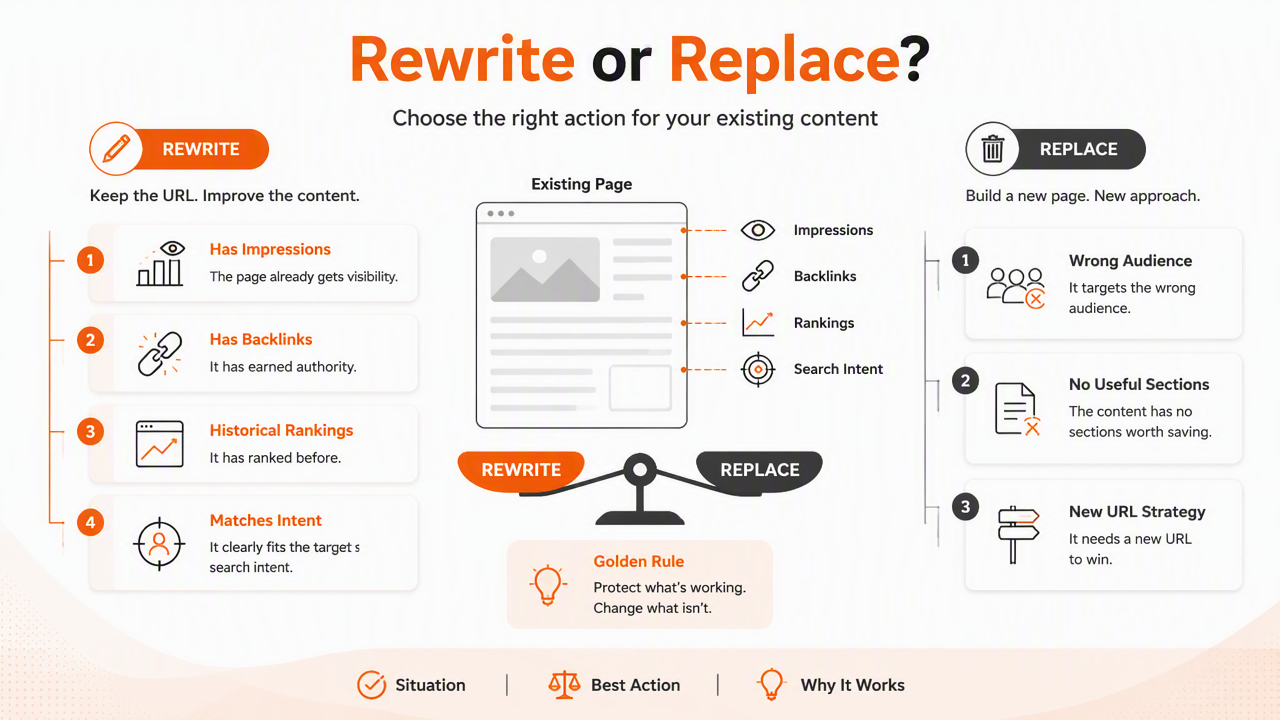
Rewrite, merge, or rebuild decision table
| Situation | Best action | Why it works |
|---|---|---|
| Ranking positions 8 to 20 with low CTR | Rewrite | The page already has visibility, so better titles and answers can lift clicks |
| Several thin posts overlap | Merge | One stronger page can reduce duplication and improve topical focus |
| Content targets the wrong intent | Rebuild | A rewrite may preserve the wrong angle |
| Product, pricing, or offer changed | Rewrite | Existing authority can support a fresher conversion path |
| New site with no content base | Build first | A rewrite needs something useful to improve |
A content refresh often fits startup blogs, local service pages, Shopify category guides, and SaaS comparison posts. For newer sites still building a base, a 90-day SEO sprint can pair new publishing with selective rewrites once early data appears.
Common rewrite mistakes to avoid
Poor rewrites usually chase novelty instead of usefulness. Changing every sentence can remove phrases that already helped the page rank. Adding unrelated FAQs can also dilute the page if the answers do not match search intent.
Common mistakes include:
- Replacing the title without checking the current SERP.
- Removing examples that made the page more trustworthy.
- Adding AI-generated filler that repeats the same claim.
- Forgetting to update screenshots, dates, product names, and links.
- Publishing without comparing the new draft to the old page.
Competitor-aware editing helps avoid blind spots. A page can compare its draft with ranking pages, then add missing sections such as key features, result examples, and use cases. That is where competitor-aware SEO content fits naturally.
What to expect in 2027
Content rewrites will likely become more answer-engine focused. Search results already reward pages that define terms clearly, answer questions early, and organize facts in extractable formats.
The practical direction is simple: articles need cleaner definitions, stronger source discipline, and better structured answers. Earlyseo is designed for that shift by treating rewrites as measurable SEO work, not just text generation. More details are available on earlyseo.com for teams planning refresh cycles across a full content library.
FAQ
SEO rewrite questions usually come from teams deciding whether an old page can still grow. The short answer is yes when the page has search data, a useful topic, and fixable weaknesses in structure, freshness, or search intent.
Is rewriting content good for SEO?
Rewriting content is good for SEO when the update improves usefulness, intent match, and clarity. It is not helpful when the edit only changes wording. The strongest rewrites add current examples, clearer headings, better internal links, and more complete answers while keeping the page's proven topic intact.
How much of an article should change during a rewrite?
The amount depends on the page's weakness. A near-page-one article may need a new title, intro, table, and several refreshed sections. A stale or thin article may need a deeper edit. The goal is not a percentage of changed words, but a better answer for the same search intent.
Can AI rewrite articles safely for SEO?
AI can support safe article rewrites when it works from a clear brief, real source material, and human review. It should not invent facts, sources, or results. AI is best used for structure, summaries, alternative wording, and gap filling, while editors handle accuracy and final judgment.
What is the difference between article rewriting and deep spinning?
Article rewriting improves the value and clarity of content for a specific audience and query. Deep spinning usually creates many altered versions of the same text through synonym swaps or sentence changes. The first can improve search performance. The second often creates weak copy that adds little original value.
Conclusion
A seo rewrite should protect the original page's search equity while making the article sharper, fresher, and easier to choose in the results. The next practical step is a section-level audit: keep the URL, map the live queries, rewrite weak headings, add one useful table, refresh links, and measure CTR after publishing. For teams ready to turn refreshes into a repeatable workflow, visit earlyseo.com and start with the pages already close to page one.