TL;DR
A strong Shopify product description workflow starts with product facts, buyer objections, and search intent before AI writes a single line. The best setup uses templates, keyword rules, human review, and bulk publishing controls so descriptions can rank, convert, and stay unique across large catalogs.
An SEO content generator for Shopify product descriptions can turn a thin product page into a clearer search result, a stronger sales pitch, and a cleaner catalog workflow. SEO: Search engine optimization is the practice of improving website visibility and performance in search engine results pages. Shopify: Shopify is a cloud ecommerce platform from Shopify Inc. for online stores and retail point-of-sale systems. For ecommerce teams building repeatable product content, Earlyseo helps organize AI-focused SEO workflows around discoverability, structure, and publishing quality.
Table of Contents
What is an SEO content generator for Shopify product descriptions?
An SEO content generator for Shopify product descriptions is a tool that creates product copy, metadata, FAQs, and related content from product attributes, target keywords, and brand rules. In 2026, the useful versions do more than write paragraphs; they help build search-ready product pages at catalog scale.
Most Shopify sellers face the same content problem: variants, specs, size notes, shipping details, and benefits sit in separate places. A generator brings those inputs together, then drafts content that matches search intent and product reality.
A 2025 TechRxiv survey by Muhammad Usman Hadi, Qasem Al Tashi, and Rizwan Qureshi reviewed large language model applications, challenges, limitations, and future prospects, which reflects why AI writing tools still need rules, review, and factual inputs rather than blind automation (TechRxiv survey, 2025).
Key insight: AI product copy works best when it starts from structured product data, not from a blank prompt.
Core content pieces a generator should create
A Shopify product content workflow should cover more than the visible description field.
- Product title support: Clear naming with searchable modifiers such as material, use case, style, size, or compatibility.
- Product description: Benefits, specs, objections, care notes, and buying context.
- Meta title and meta description: Search snippet copy that fits the product and intent.
- Collection intro: Short category copy that supports internal relevance.
- Product FAQ: Practical answers for sizing, materials, shipping, warranty, or use.
- Alt text suggestions: Image descriptions tied to product details, not stuffed keywords.
How should Shopify stores prepare inputs before generation?
Shopify stores should prepare structured inputs before generation by collecting product attributes, customer objections, target keywords, brand rules, and compliance details in one repeatable brief. Better inputs reduce generic copy, factual errors, and duplicate descriptions across similar products.
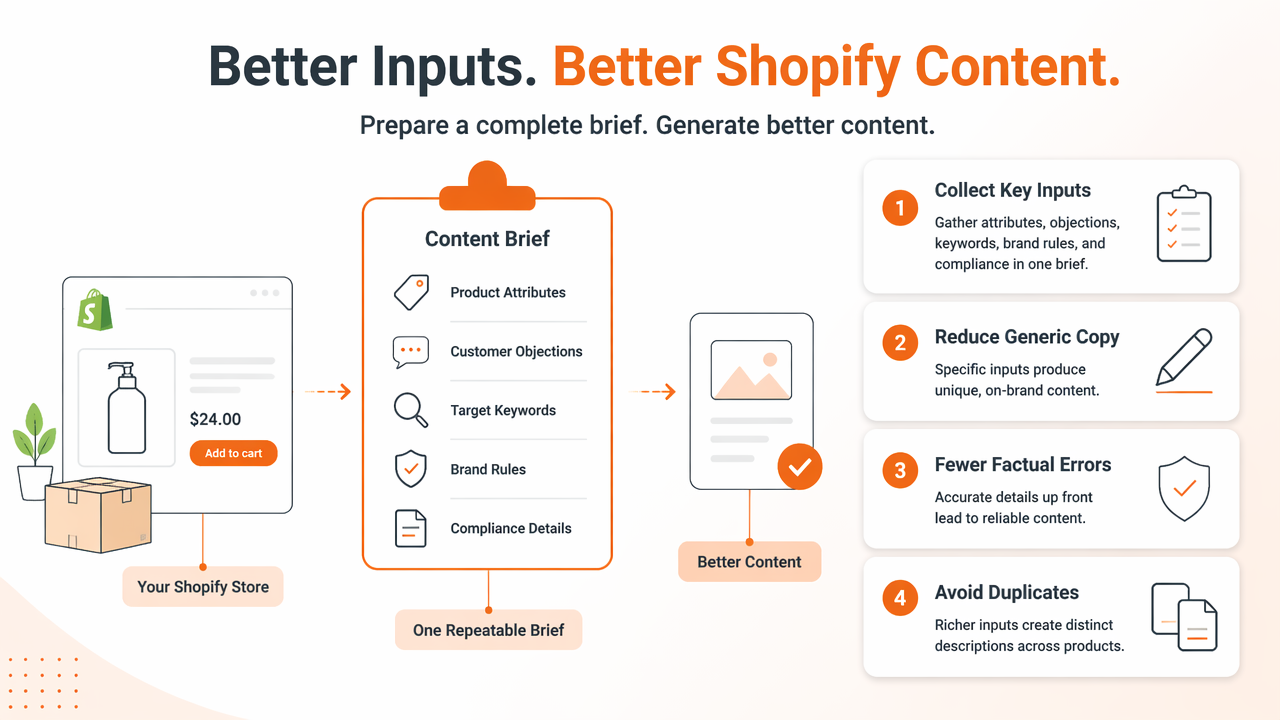
A generator cannot know whether a jacket is water-resistant, waterproof, machine washable, or dry-clean only unless that detail exists in the input. The same rule applies to ingredient claims, compatibility, dimensions, return rules, and safety language.
Before bulk generation, teams can document content rules in a shared workflow. The Earlyseo documentation is useful for teams that want a clear setup process for SEO tasks, publishing checks, and content systems.
Input checklist for stronger Shopify descriptions
- Product facts: SKU, product type, variant names, material, dimensions, weight, color, size, care instructions, and warranty.
- Search intent: Main keyword, secondary modifiers, audience, season, use case, and problem solved.
- Conversion angle: Key benefit, objection, trust proof, urgency, bundle option, or comparison point.
- Brand voice: Tone, banned phrases, formatting rules, reading level, and preferred terminology.
- Compliance notes: Claims that must be avoided, regulated wording, regional restrictions, and required disclaimers.
- Internal links: Relevant collections, guides, comparison pages, and support resources.
A plain spreadsheet still works for this stage. Each row can represent one product, and each column can become a prompt variable. That simple structure helps prevent AI from treating every item like the same generic ecommerce page.
Which generator features matter most for Shopify catalogs?
The best Shopify content generator features are bulk generation, Shopify import and sync, custom AI rules, editable drafts, metadata creation, multilingual support, pricing clarity, and support access. Competitor SERP results often highlight app-store items such as apps by category, featured images gallery, pricing, reviews, support, and similar apps, but those details do not replace workflow fit.
Shopify Magic can automatically draft product descriptions inside Shopify, according to the Shopify Help Center summary in the research data. Other app-store competitors promote bulk descriptions, titles, SEO metadata, customization, languages, and paid plans such as $14 per month, $49 per month, and $199 per month.
The Earlyseo platform is strongest when Shopify content is treated as part of a wider organic visibility system, not just a one-off description writer. Stores planning a Shopify setup can review the Earlyseo Shopify integration for a more connected workflow.
Feature comparison for Shopify product copy tools
| Feature | Why it matters | What to check before installing |
|---|---|---|
| Bulk generation | Saves time on large catalogs | Draft limits, variant handling, approval flow |
| Shopify import | Pulls product data into the writing workflow | Product fields, collections, metafields, images |
| One-click sync | Sends approved copy back to Shopify | Draft status, rollback options, permissions |
| Custom AI rules | Keeps copy on-brand | Tone rules, banned claims, formatting patterns |
| SEO metadata | Improves search snippet control | Meta title length, keyword use, uniqueness |
| Languages | Supports international stores | Translation quality, local terms, hreflang planning |
| Pricing | Controls catalog-scale cost | Free plan, monthly tiers, usage limits |
| Support | Reduces setup friction | Docs, chat, email, app reviews, response time |
Compatibility deserves special attention. Some Shopify App Store listings show messages such as "This app isn't compatible with your store," or require a merchant to log in to the Shopify store before install. That means evaluation should happen before a workflow depends on an app.
"Want to add an app?" sounds simple in the Shopify interface, but product copy tools touch live catalog data. Permissions, export options, and draft review controls matter as much as the generated text itself.
What templates turn product data into rankable descriptions?
Templates turn product data into rankable Shopify descriptions by giving AI a fixed structure for benefits, specifications, objections, FAQs, and metadata. A reusable template keeps similar products consistent while still leaving room for unique details.
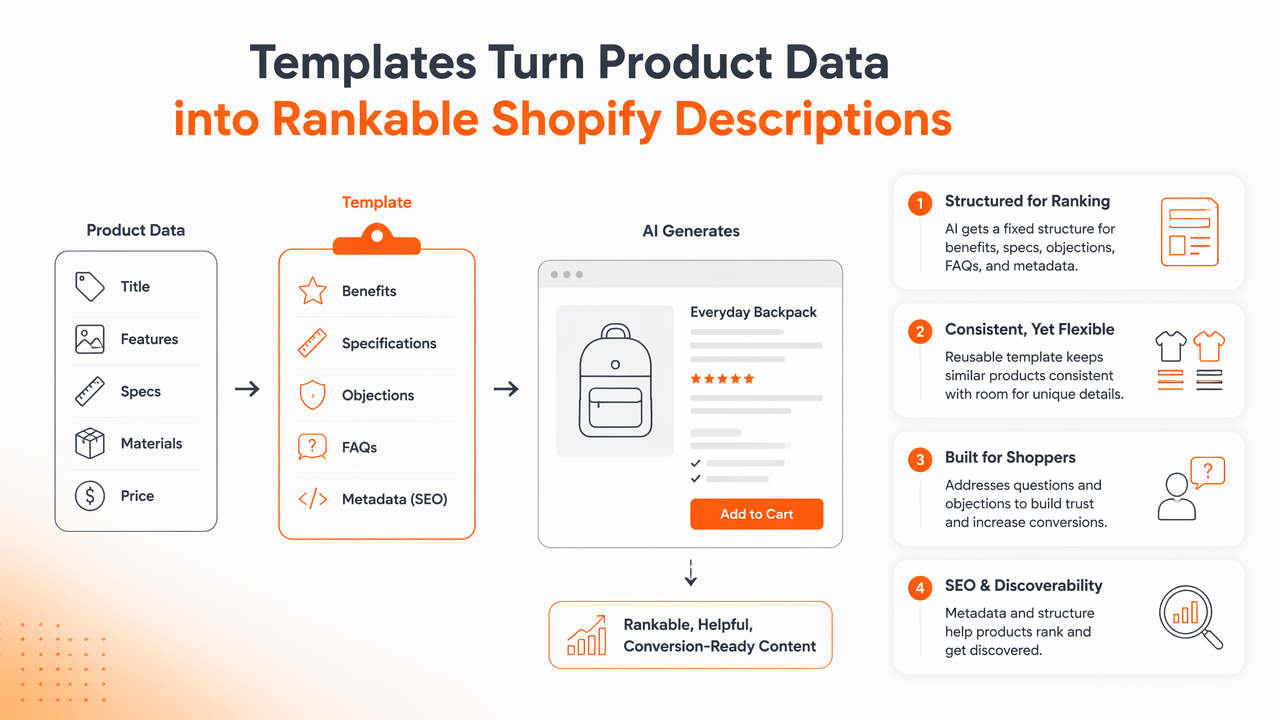
Research on large language models has repeatedly focused on practical usage, limitations, and challenges. The 2023 TechRxiv version by Hadi, Al Tashi, and Qureshi covered those broad application and limitation themes, which supports a practical point for ecommerce: AI output needs constraints and review to become publishable content (TechRxiv survey, 2023).
Key insight: Templates do not make product copy robotic. Weak inputs do. Strong templates make factual, searchable, and conversion-focused copy easier to approve.
Reusable Shopify content templates
Product description template
- Opening sentence: State the product, audience, and main benefit.
- Benefit block: Explain 2 to 4 outcomes the buyer cares about.
- Specification block: List material, dimensions, sizing, compatibility, ingredients, or care.
- Objection answer: Address fit, durability, shipping, setup, use, or returns.
- Closing line: Mention ideal use case and related collection when relevant.
Collection intro template
- Lead with the category and buying intent.
- Mention 2 to 3 product types or filters.
- Add a short quality, material, style, or use-case signal.
- Keep the copy short enough that products stay visible.
FAQ template
- Question: "Is this product suitable for [use case]?"
- Answer: Use product facts only, then add care, sizing, or compatibility guidance.
- Question: "What makes this different from [alternative]?"
- Answer: Compare materials, features, warranty, or intended use.
Meta title template
{Primary product name} | {Key modifier} | {Brand}
Meta description template
Shop {product type} for {audience/use case}. Includes {benefit}, {feature}, and {trust detail}.
For stores planning AI visibility beyond Google search, the Earlyseo llms.txt resource can help teams think about how structured site information may be exposed to large language models.
How should generated Shopify descriptions be reviewed before publishing?
Generated Shopify descriptions should be reviewed for factual accuracy, uniqueness, search intent, conversion clarity, formatting, policy risk, and live-page fit before publishing. Human review remains the safeguard that separates useful AI content from thin or risky catalog copy.
Thin descriptions usually fail in quiet ways. They repeat manufacturer text, overuse the same benefit claims, ignore buyer doubts, or make claims the product data cannot support. A review checklist keeps those issues from reaching hundreds of pages at once.
A clean review process also helps with search systems that summarize product pages. Product facts, FAQs, headings, and metadata should align so Google, ChatGPT, AI Overviews, and store search can interpret the page consistently.
Pre-publish QA checklist
- Accuracy: Every claim matches product data, packaging, supplier information, or internal policy.
- Uniqueness: Similar variants have distinct copy where search intent or product details differ.
- Keyword fit: Primary and secondary terms appear naturally, without awkward repetition.
- Conversion clarity: The first lines explain who the item is for and why it matters.
- Format: Bullets, headings, and paragraphs display cleanly on mobile product pages.
- Metadata: Meta titles and descriptions are unique, readable, and aligned with the page.
- Support path: Shipping, returns, sizing, warranty, or care questions have a clear answer.
For multi-channel stores, publishing systems should match the rest of the marketing stack. The Earlyseo integrations page shows how SEO workflows can connect across platforms instead of staying trapped in one content tool.
The review stage should also include image context. Shopify product pages often rely on a featured images gallery, so copy should match what shoppers can actually see: color, texture, scale, included accessories, and product packaging.
What will change for Shopify AI product content in 2027?
Shopify AI product content in 2027 will likely become more structured, more connected to product feeds, and more visible inside answer engines. The winning workflow will not be "generate and publish"; it will be "structure, generate, validate, enrich, and monitor."
Static product pages still matter, but AI systems increasingly extract short answers, definitions, lists, and comparisons. That means Shopify descriptions should include clean product facts and FAQ-style answers that can be cited or summarized without losing meaning.
Earlyseo fits this shift by helping teams think beyond one description field and toward AI-readable SEO assets. For related guidance and future articles, the Earlyseo blog hub at earlyseo.com blogs can support ongoing ecommerce SEO planning.
FAQ: Shopify product description generators
What is the best AI workflow for Shopify product descriptions?
The best workflow collects product attributes, keywords, objections, and brand rules before drafting. AI then creates descriptions, FAQs, and metadata from structured inputs. A human reviewer checks claims, uniqueness, and formatting before publishing through Shopify or an approved integration.
Can Shopify Magic replace a dedicated SEO content generator?
Shopify Magic can help draft product descriptions inside Shopify, based on the research summary. A dedicated generator may be better for bulk workflows, custom AI rules, metadata, collection copy, multilingual catalogs, and approval processes across larger teams or large product catalogs.
Are AI-generated product descriptions safe for SEO?
AI-generated descriptions can be safe for SEO when they are accurate, useful, original, and reviewed before publishing. Risk increases when pages reuse generic claims, copy supplier text, or publish unsupported statements. Search value comes from helpful product detail, not from AI use alone.
How many keywords should a Shopify product description include?
A product page usually needs one primary keyword plus a few natural modifiers tied to product type, material, use case, audience, or size. Forced repetition weakens readability. Metadata, headings, bullets, FAQs, and image context can spread relevance more naturally.
Should every Shopify product have an FAQ section?
Not every product needs a long FAQ, but products with sizing, compatibility, materials, shipping concerns, ingredients, setup steps, or warranty questions often benefit from one. Short FAQs help shoppers make decisions and give search systems clearer answer blocks.
Conclusion
A strong SEO content generator for Shopify product descriptions is not just a writing shortcut. It is a workflow for turning product facts, buyer questions, and search intent into unique pages that can rank and convert. The practical next step is simple: audit 20 important products, build one input brief, test one template, review the output, then scale only after the copy passes accuracy and uniqueness checks. For teams ready to connect Shopify content with broader AI-search visibility, visit earlyseo.com and map the first product-description workflow before the next catalog update.