TL;DR
SEO article generators are stronger for search-led publishing because they combine keyword intent, SERP structure, metadata, and optimization in one workflow. AI writing assistants are better for flexible drafting, rewriting, and brainstorming, but they need more human SEO direction.
The practical debate around SEO article generator vs AI writing assistant comes down to one question: should content start from search demand or from a blank prompt? A purpose-built platform such as Earlyseo is designed around search visibility from the start, while a general writing assistant is built for flexible text creation across many tasks.
SEO article generator: software that creates search-focused article drafts using keyword targeting, SERP patterns, headings, metadata, and optimization checks.
AI writing assistant: an artificial intelligence tool that helps draft, rewrite, summarize, or edit text, often without built-in SEO research or publishing workflows.
Search engine optimization, according to Wikipedia, is the practice of improving the visibility and performance of web pages in search engine results pages, with the goal of increasing both quantity and quality of traffic from search engines Wikipedia. That definition matters because speed alone is not the same as search performance.
Table of Contents
What is the difference between an SEO article generator and an AI writing assistant?
An SEO article generator creates content around search intent, ranking patterns, and on-page optimization, while an AI writing assistant helps produce or refine language across many formats. The generator is usually workflow-specific; the assistant is usually prompt-specific.
General assistants can write emails, summaries, product descriptions, outlines, social posts, and blog sections. SEO generators narrow the job: choose a keyword, analyze what searchers expect, build a structure, and produce a page that can be edited for publication.
Research on generative AI by Feuerriegel, Hartmann, and Janiesch describes how these systems can create text and other outputs from learned patterns, which explains why both categories can produce fluent drafts Generative AI. The key difference is not the language model; the key difference is the SEO layer around it.
Key insight: a writing assistant improves words, while an SEO article generator improves the odds that those words match a search opportunity.
Side-by-side capability comparison
| Capability | SEO article generator | AI writing assistant | Startup impact |
|---|---|---|---|
| Keyword targeting | Usually built in | Usually manual | Less research overhead |
| SERP alignment | Often analyzes competing pages | Depends on prompts | Better topic coverage |
| Article structure | Search-intent focused | User-directed | Faster outline creation |
| Metadata | Often included | Usually requested separately | Cleaner publishing handoff |
| Internal links | Often suggested from site context | Usually manual | Stronger site architecture |
| Editorial control | Template plus editing workflow | High prompt flexibility | Better for custom brand voice |
| Non-SEO formats | Limited | Strong | Useful for sales and support copy |
Where SEO article generators win in 2026
SEO article generators win when the content goal is ranking, not just drafting. They reduce the number of separate steps needed to move from keyword idea to publishable article.
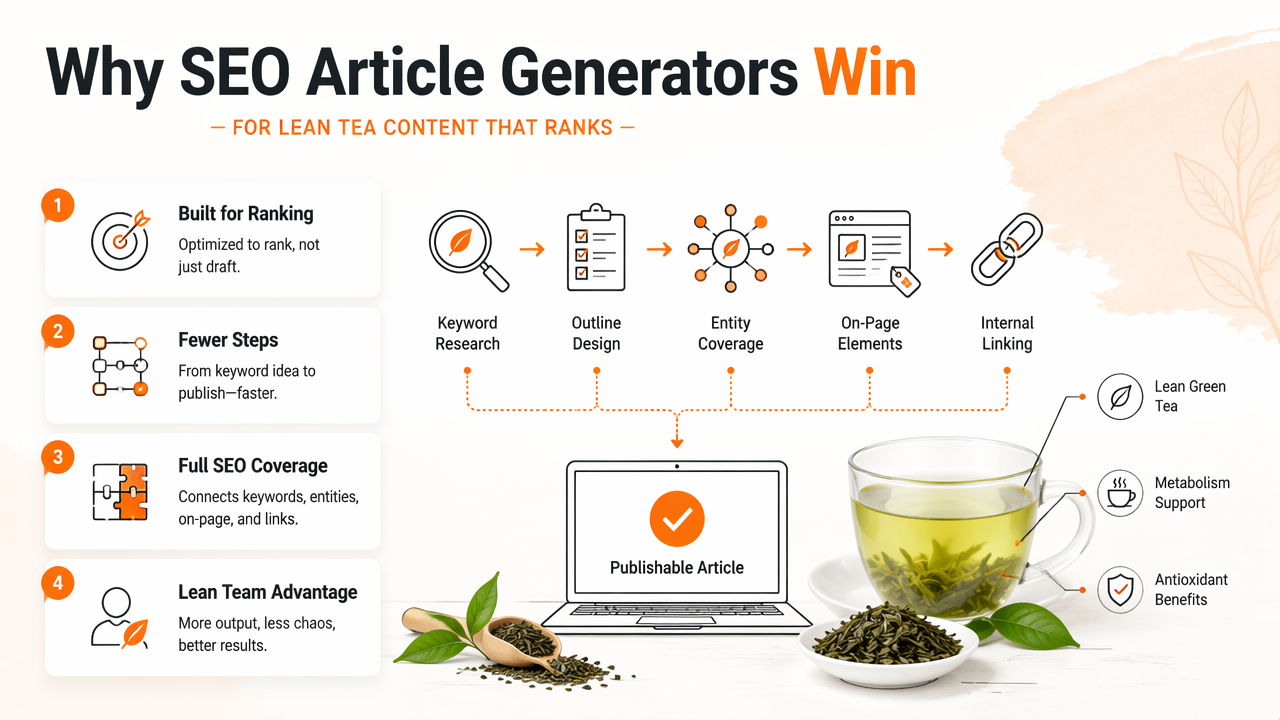
Strong generators connect keyword research, outline design, entity coverage, on-page elements, and internal linking. That matters for lean teams because search content often fails between planning and publication, not during sentence writing.
A search-led workflow usually includes:
- Pick a target query and related entities.
- Review the visible SERP pattern.
- Build headings around search intent.
- Add definitions, tables, FAQs, and examples.
- Insert internal links and metadata.
- Edit for accuracy, tone, and originality.
- Publish through a CMS or export workflow.
The Earlyseo platform fits this category because it treats article creation as an SEO workflow rather than a freeform chat session. Its related publishing workflow documentation is most useful for teams that need repeatable output, not one-off drafts.
A good generator also helps with consistency. Startups and small businesses often publish irregularly because each article requires separate keyword research, outline creation, drafting, formatting, and optimization. A generator compresses those tasks into a repeatable process.
Search-led content needs structure before style. A polished article that misses intent still has a weak chance of earning organic traffic.
Search workflow advantages
- SERP-aware outlines: headings reflect what ranking pages and searchers already signal.
- Built-in SEO fields: title tags, meta descriptions, FAQs, and slugs are less likely to be forgotten.
- Internal link prompts: related pages can be added before publication rather than patched later.
- Repeatable briefs: marketing managers can keep multiple writers aligned.
- Faster production: small teams can publish more often without rebuilding the process each time.
Where AI writing assistants still make sense
AI writing assistants make sense when flexibility, editing range, and human-led strategy matter more than built-in SEO direction. They are especially useful for rewriting, ideation, tone changes, and short-form content.
A general assistant can adapt quickly across departments. A founder may use one for investor updates, product copy, hiring posts, customer support drafts, and content snippets. That range makes assistants valuable even when they are not the best core tool for organic search.
Research by Darvishi, Khosravi, and Sadiq studied AI assistance and user agency in an education context, which is relevant because overreliance on AI can change how people plan, decide, and revise work Impact of AI assistance on student agency. In content operations, the same risk appears when a team accepts fluent text without checking strategy, claims, or fit.
General assistants have clear strengths:
- Brainstorming angles for a difficult topic.
- Rewriting dense paragraphs in simpler language.
- Creating alternate intros, CTAs, and social snippets.
- Turning interviews or notes into rough drafts.
- Summarizing long source material for editors.
They also have limits for SEO work. Without a connected keyword plan, site map, internal link context, or SERP review, the assistant may produce a good article that targets no realistic opportunity.
A practical content stack can still include both categories. The assistant handles flexible language tasks, while the generator handles the search-led article workflow and connects drafts to publishing systems through CMS integrations.
Best-fit uses for general assistants
| Use case | Better tool | Reason |
|---|---|---|
| Rewriting a founder quote | AI writing assistant | Tone control matters most |
| Creating a keyword-led blog post | SEO article generator | Search intent matters most |
| Drafting product FAQs | Either | Depends on keyword value |
| Refreshing an old article | SEO article generator | Needs optimization checks |
| Writing sales email variations | AI writing assistant | SEO is not the goal |
How to choose between speed, quality, and SEO reliability
The best choice depends on whether the main constraint is production speed, editorial quality, or reliable search alignment. Startups with no organic footprint usually benefit from SEO structure first, then editorial refinement.
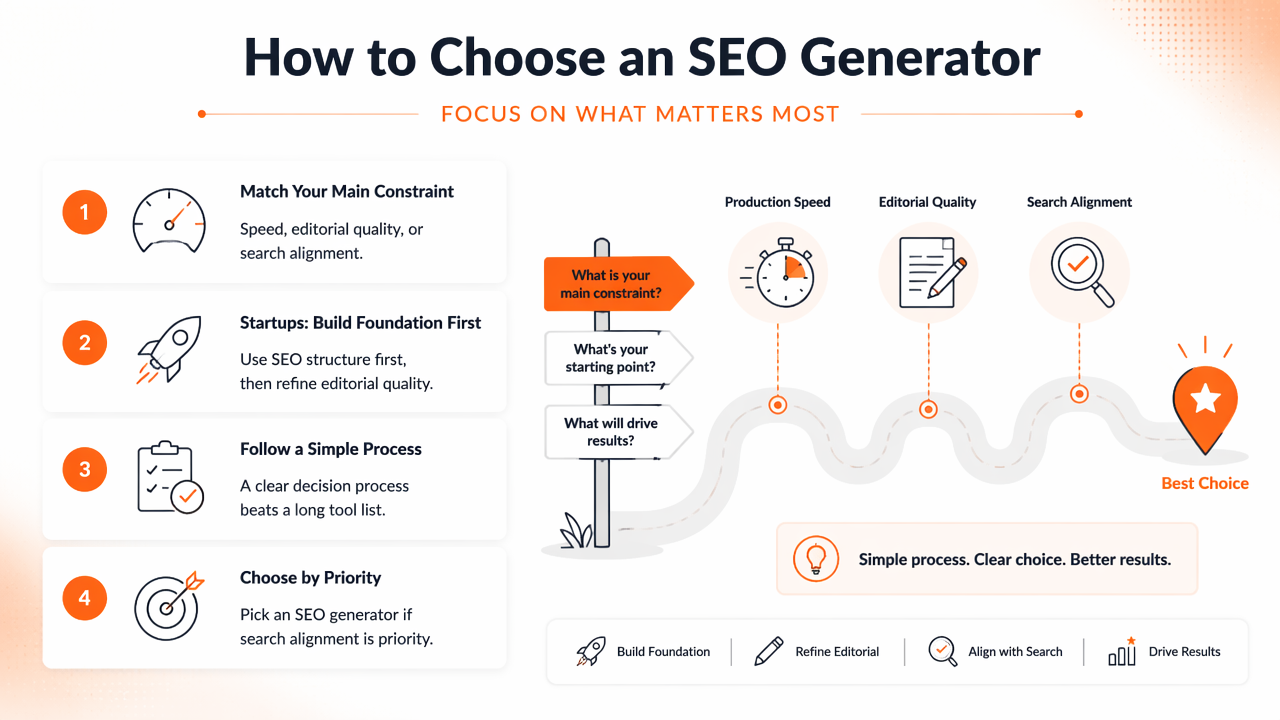
A simple decision process works better than a long tool list:
- Choose an SEO generator if the content must rank for non-branded search.
- Choose an AI assistant if the task is editing, brainstorming, or non-search copy.
- Choose both if the team needs search-led drafts plus flexible rewrites.
- Avoid judging tools only by word count, since longer drafts are not automatically better.
- Keep human review for facts, examples, claims, and brand fit.
When comparing vendors, review the workflow rather than only the output sample. Useful questions include whether the tool supports keyword research, SERP-inspired outlines, internal links, CMS publishing, and revision control.
For WordPress-heavy teams, direct publishing can reduce manual formatting work. A tool with a WordPress integration can keep the SEO workflow closer to the final CMS, which lowers friction for small marketing teams.
Modern SEO also reaches beyond classic Google rankings. AI answer engines increasingly depend on structured, crawlable, entity-rich content. The Earlyseo team addresses this through resources such as LLM discovery file guidance, which supports machine-readable site context.
Research by Chen, Liu, and Huang on large language models and personalization explains that LLM systems create new opportunities and challenges around personalized information delivery When large language models meet personalization. For content teams, that means articles need clear definitions, consistent entities, and clean structure so both search engines and AI systems can interpret them.
Decision rule: pick the tool that controls the riskiest part of the job. For SEO content, the riskiest part is usually intent and structure, not grammar.
Decision framework for lean teams
| Priority | Recommended choice | Why it fits |
|---|---|---|
| Fast blog production | SEO article generator | Reduces planning and formatting steps |
| Highest editorial polish | AI writing assistant plus editor | More room for voice refinement |
| Reliable organic growth | SEO article generator | Starts from keyword and SERP logic |
| Mixed marketing output | Both tools | Separates SEO pages from general copy |
| Local or ecommerce SEO | SEO article generator | Helps target pages, categories, and service intent |
What should startups expect next?
In 2026 and beyond, the strongest content tools will combine SEO automation, editorial controls, CMS publishing, and AI visibility features. The old split between writing software and optimization software is getting less useful.
Search is no longer only a list of blue links. AI Overviews, chat assistants, and vertical search results reward content that is clear, structured, and easy to cite. That favors articles with direct answers, definition blocks, comparison tables, author review, and accurate internal linking.
The next generation of tools will likely focus on:
- Entity coverage, not just keyword density.
- Brand voice controls tied to approved examples.
- Automated refresh suggestions for aging content.
- Better source tracking and claim review.
- Publishing workflows for WordPress, Shopify, Webflow, and custom stacks.
- Content formats designed for both SERPs and AI answer engines.
For a startup building early organic visibility, the safest approach is not mass-producing generic articles. A stronger plan is to publish fewer, better-targeted pages that answer real search intent and connect clearly to product, category, or service pages.
Earlyseo is positioned for that search-led workflow, especially when a business wants article generation, optimization, and publishing discipline in one place. More practical product details are available on earlyseo.com.
FAQ
Can an AI writing assistant replace an SEO article generator?
An AI writing assistant can replace parts of the drafting process, but it usually cannot replace the SEO planning layer. Keyword intent, SERP structure, internal links, metadata, and publication workflow still need direction. For ranking-focused content, a generator provides a more complete starting point.
Is AI-generated SEO content safe to publish?
AI-generated SEO content is safest when humans review accuracy, originality, examples, and claims before publication. Search engines do not reject content only because AI helped create it, but low-value pages, copied ideas, weak expertise, and unverified facts can still perform poorly.
Which tool is better for local businesses?
Local businesses usually benefit more from an SEO article generator for service pages, location pages, and intent-based blog posts. A writing assistant remains useful for rewriting staff bios, emails, offers, and social posts. Local SEO needs structure around services, geography, and customer questions.
Should ecommerce teams use a generator or an assistant?
Ecommerce teams often need both. A generator helps with category guides, buying guides, and search-led blog content. A writing assistant helps rewrite product descriptions, ad copy, and support content. Organic traffic growth usually depends on mapping content to categories and commercial search intent.
Conclusion
The choice in SEO article generator vs AI writing assistant is not about which tool writes prettier sentences. It is about which tool reduces the biggest risk in the content process. For search traffic, that risk is usually poor intent matching, weak structure, missing internal links, and inconsistent optimization.
A practical next step is to audit the next five planned articles. If each one already has a keyword, SERP-informed outline, internal links, metadata, and CMS path, a general assistant may be enough. If those pieces are scattered, an SEO article generator is the better foundation. For teams ready to build a repeatable search content engine, Earlyseo and earlyseo.com are worth reviewing before the next publishing sprint.