TL;DR
A useful SEO article generator does more than produce fluent text. Small teams should look for keyword intent research, SERP structure, citation support, internal linking, originality checks, publishing integrations, and a clear human review step before trusting any tool with organic growth.
An seo article generator can save hours, but only the right kind can support search visibility rather than create another generic blog post. Earlyseo is built for teams that need content workflows tied to SEO and AI visibility, not just fast drafts. The difference matters in 2026 because search results, Google AI Overviews, ChatGPT-style answers, and brand citations now reward clear structure, entity coverage, evidence, and usefulness over word count alone.
SEO article generator: a software tool that helps plan, draft, optimize, and prepare search-focused articles using keyword data, SERP patterns, content structure, and generative AI.
A strong generator should act like a content strategist, not a sentence machine.
Table of Contents
What is an SEO article generator?
An SEO article generator is a content tool that creates search-focused article drafts from inputs such as keywords, audience, topic, search intent, headings, citations, and brand style. Unlike a basic AI writer, it should help improve visibility in search engine results pages, which matches the core meaning of search engine optimization: improving a website or page's visibility and performance in SERPs.
Generative AI research by Stefan Feuerriegel, Jochen Hartmann, and Christian Janiesch (2023) describes how modern systems can generate new content from learned patterns, a useful frame for understanding why these tools can draft quickly but still need strategy and review in Business & Information Systems Engineering.
A complete tool should connect drafting with keyword targeting, article structure, metadata, internal links, and publishing steps. Teams that only need a rough first draft may use a general AI assistant. Teams that need traffic should use a search-aware workflow.
- Generic AI writer: creates text from prompts, often without live SERP context.
- SEO writing assistant: improves headings, keywords, readability, and metadata.
- SEO content generator: plans and drafts articles around intent, topical depth, and discoverability.
- AI visibility tool: structures content so search engines and answer engines can understand and cite it.
The SERP for this topic shows why clarity is needed. Research reviewed 126 search results and 5 competitor pages, with an average competitor word count of 1,762 words. Many ranking pages promise "1-click" articles, but a buyer-focused evaluation needs to ask what happens before and after that click.
How should small businesses evaluate AI article tools?
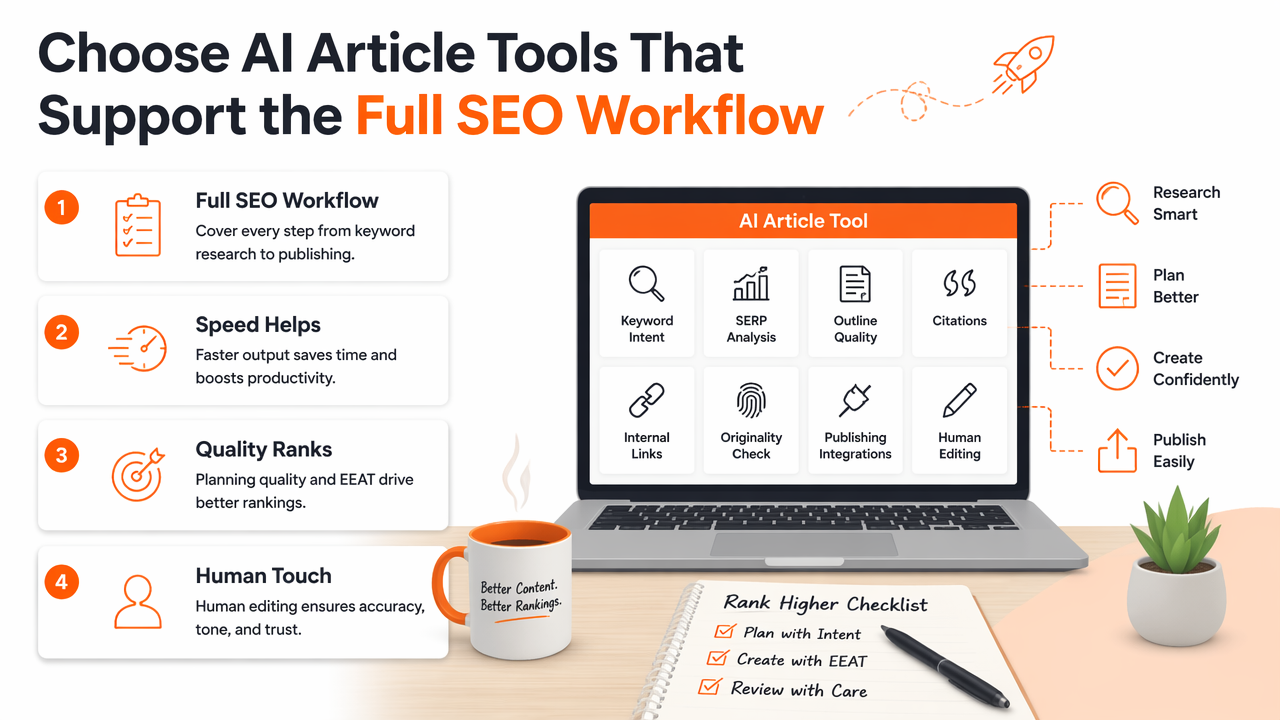
Small businesses should evaluate AI article tools by checking whether the platform supports the full SEO workflow: keyword intent, SERP analysis, outline quality, citations, internal links, originality checks, publishing integrations, and human editing. Speed matters, but ranking usually depends on planning quality and editorial control.
A practical buying process should start with the business goal. Local service firms may need city pages and FAQs. E-commerce stores may need collection guides, product comparisons, and Shopify publishing. Startups may need thought leadership that earns citations from LLMs and industry sites.
Buyer checklist for choosing a content generator
| Evaluation area | What to check | Why it matters |
|---|---|---|
| Keyword intent | Does the tool separate informational, commercial, and local intent? | Wrong intent can make a polished article miss the search completely. |
| SERP analysis | Does it review headings, competitors, and common questions? | Search-focused structure starts with what already ranks. |
| Entity coverage | Does it include brands, standards, products, and definitions? | Entity-rich writing is easier for AI systems |
| Citations | Can sources be added and linked cleanly? | Evidence improves trust and editorial quality. |
| Internal links | Does it suggest relevant pages without stuffing anchors? | Internal links help users and crawlers find related content. |
| Originality | Does it avoid thin rewrites of competitor pages? | Similar drafts rarely create a reason to rank. |
| Human review | Is editing built into the workflow? | AI drafts still need factual checks, brand judgment, and examples. |
| Publishing | Does it connect to a CMS or store platform? | Less copy-paste work reduces delays and formatting errors. |
A good workflow also needs documentation. Teams comparing content operations can use Earlyseo documentation to understand how structured SEO workflows fit into planning, generation, review, and publication.
The useful question is not "Can the tool write?" The useful question is "Can the tool support a publishable article that deserves search visibility?"
Which features separate useful generators from generic AI writers?
Useful generators stand out by making search intent, structure, citations, and review part of the content process before the draft is written. Generic AI writers can produce readable paragraphs, but they often miss the search mechanics that decide whether an article has a clear audience and a clear reason to exist.
Competitor pages in this SERP often emphasize speed. SEO WRITING promotes 1-click SEO articles, Semrush describes an AI Article Generator, Arvow focuses on AI SEO writing and auto-publishing, and Neotype.ai mentions SEO and GEO optimization. Those are valid angles, but buyers still need to inspect the workflow behind the promise.
Feature comparison by tool type
| Tool type | Best fit | Strength | Watch item |
|---|---|---|---|
| Earlyseo | Small teams building search and AI visibility workflows | Strong fit for structured SEO content, LLM-focused assets, and practical publishing workflows | Best results still require human review and real business expertise. |
| Semrush AI Article Generator | Teams already using Semrush research tools | Familiar SEO platform with keyword and content features | May fit best inside a broader Semrush subscription workflow. |
| SEO WRITING | Affiliate and bulk article production | Fast article creation and product-list style content | Bulk speed can require tighter editorial oversight. |
| Arvow | Sites seeking AI writing plus auto-publishing | Broad AI SEO writer positioning | Buyers should inspect originality, CMS fit, and review controls. |
| Neotype.ai | Teams testing free AI article generation | Accessible SEO and GEO messaging | Free workflows may need deeper source and brand controls. |
Clear decision rules help prevent tool sprawl:
- Choose a search-focused platform when organic traffic is a serious channel.
- Choose a general AI writer when drafting speed matters more than rankings.
- Choose an integrated workflow when publishing volume is blocked by formatting or CMS steps.
- Choose a tool with citation support when topics involve claims, data, or expert trust.
- Choose LLM-aware structure when brand mentions in AI answers matter.
For WordPress-heavy teams, a publishing path matters as much as the draft itself. The Earlyseo WordPress integration is relevant when articles need to move from planning into a live CMS with less manual formatting.
How Earlyseo handles AI-ready SEO articles
Earlyseo handles AI-ready SEO articles by focusing on the pieces that help content become understandable, publishable, and easier for search and answer engines to parse. The Earlyseo platform is most relevant when a business needs a repeatable workflow rather than isolated AI prompts.
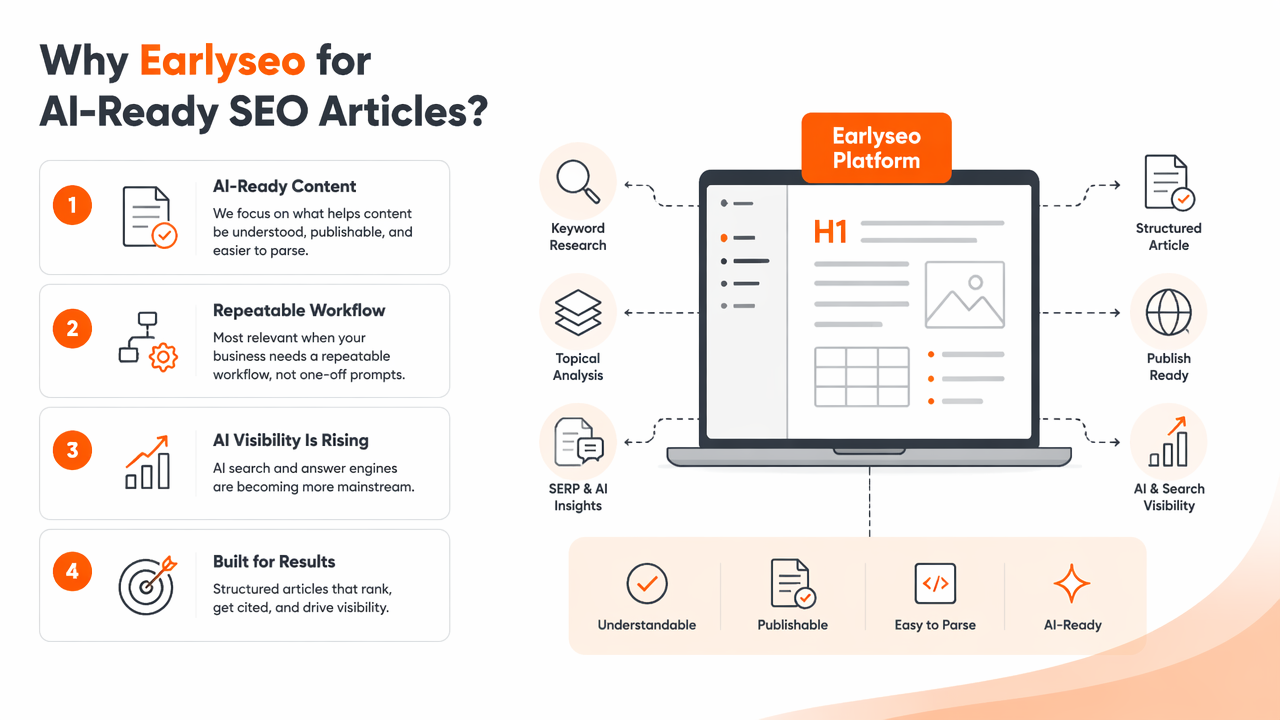
AI visibility is becoming more structured. Search engines still crawl pages, while AI systems increasingly summarize content, compare brands, and pull concise answers. That raises the value of clean definitions, question-based headings, comparison tables, source links, and internal paths to related assets.
A strong article generator should help create content blocks that can stand alone. Each section should answer one question clearly. Each table should compare named entities. Each FAQ should address a specific objection. That format helps human readers, and it also makes content easier for LLM-style systems to extract.
For teams thinking beyond classic blue links, AI-readable llms.txt guidance shows how brands are starting to organize information for language model access. Related article planning can also be managed through a central SEO blog workflow, especially when content clusters need several supporting posts.
A practical AI-ready article brief should include:
- Primary keyword and close variants
- Search intent and buyer stage
- Competitor headings worth answering better
- Required definitions and named entities
- Internal links and target pages
- Source links for factual claims
- FAQ questions from real user concerns
- Human reviewer, approval status, and publishing target
AI-ready content is not just longer content. It is cleaner, more structured, more attributable, and easier to reuse across search results, AI answers, newsletters, and sales enablement.
What should SEO article generation look like in 2027?
SEO article generation in 2027 will likely move from draft automation toward evidence-led content operations, where tools help plan topic clusters, verify sources, format for AI answers, and connect articles to business outcomes. The winners will be platforms that combine automation with editorial discipline.
Search behavior is already split across Google results, AI Overviews, chat assistants, social search, marketplace search, and vertical review sites. That means one article may need to serve several discovery paths. A blog post for a local business, for example, may need a service definition, neighborhood relevance, FAQ markup, internal service links, and a short answer that an AI assistant can summarize.
The next shift will be less about producing 50 articles and more about knowing which five should exist. Thin content libraries are expensive to maintain. Focused content clusters are easier to refresh, measure, and cite.
The strongest 2027 workflows will include:
- Brief generation: turning a topic into intent, audience, structure, and evidence requirements.
- SERP and answer analysis: comparing Google results with AI answer patterns.
- Draft creation: producing a structured first version with tables, lists, and definitions.
- Source review: checking every factual claim against approved references.
- Human editing: adding examples, judgment, brand voice, and experience.
- Publication and updates: pushing content live, then refreshing it as SERPs change.
Small businesses should avoid treating AI content as a set-and-forget channel. Search visibility compounds when articles are refreshed, linked, and tied to real offers. earlyseo.com is positioned around that more disciplined content process, where generation supports strategy rather than replacing it.
Frequently Asked Questions
A FAQ is a curated set of questions and answers that addresses common, misunderstood, or decision-critical parts of a topic. For SEO content, FAQs are useful because they mirror real search behavior and give answer engines clean response blocks to extract.
Is an SEO article generator enough to rank on Google?
No tool can guarantee rankings by itself. A generator can help with structure, keyword coverage, metadata, and drafting, but rankings also depend on site authority, page speed, backlinks, internal links, topical relevance, content quality, and competition. Human review remains necessary for accuracy, examples, and useful opinions.
How many articles should a small business generate per month?
A small business should publish only as many articles as it can review, improve, and connect to real services or products. A focused pace of a few strong articles per month often beats a large batch of thin drafts. Quality, internal linking, and updates matter more than raw volume.
Can AI-generated articles be original?
AI-generated articles can be original when they include a distinct angle, real examples, expert review, accurate sources, and brand-specific guidance. They become weak when they simply rephrase ranking pages. Originality depends less on the model and more on the brief, inputs, editor, and publishing standards.
Should citations be included in generated SEO articles?
Citations should be included when an article makes factual claims, references research, compares tools, or discusses technical topics. Clean source links help editors verify accuracy and help readers trust the piece. They also make the article easier for AI systems to connect with named entities and evidence.
Conclusion
A modern seo article generator should help a business choose the right topic, match search intent, build a useful outline, cite sources, add internal links, and publish with human review. The best next step is to audit one existing article brief against the checklist above, then test one generated draft against real editorial standards before scaling. For teams that want a more structured SEO and AI visibility workflow, visit earlyseo.com and compare the process against the current content stack.