TL;DR
LLM SEO checkers do not replace rank trackers; they measure a different layer of search visibility. Rank trackers show where pages appear in Google, while LLM checkers show whether AI systems mention, cite, or summarize a brand. Lean teams should use both when organic search and AI answers influence discovery.
AI answers have turned organic visibility into a two-channel problem: brands can rank on Google and still be absent from ChatGPT, Perplexity, Gemini, and AI Overviews. The practical question behind LLM SEO checker vs rank tracker is not which tool is better, but which one explains the visibility problem at hand. Search engine optimization: the practice of improving website and page visibility in search engine results pages, with the goal of earning more qualified organic traffic. For teams that need one place to monitor AI-readiness signals, Earlyseo gives a focused starting point without replacing classic search analytics.
Table of Contents
What is an LLM SEO checker?
An LLM SEO checker evaluates how well a brand, page, or website can be discovered, understood, and cited by large language model systems. It focuses on AI visibility signals such as brand mentions, source eligibility, answer coverage, entity clarity, structured content, and machine-readable guidance like LLMs.txt guidance.
Large language models generate answers from patterns in training data, retrieval systems, and available sources. A 2023 survey by Hadi, Al Tashi, and Qureshi reviewed LLM applications, limitations, and practical usage, which helps explain why AI visibility cannot be measured only by blue-link rankings in their LLM survey.
Core signals an LLM checker reviews
- Entity clarity: whether a company, product, author, or service is clearly described.
- Citation readiness: whether pages answer questions in short, extractable formats.
- AI answer presence: whether systems mention the brand for target prompts.
- Source consistency: whether the same facts appear across owned pages and public profiles.
- Technical access: whether crawlers can read key content, metadata, and structured pages.
Key insight: LLM visibility is less about holding position 3 for a keyword and more about becoming a trustworthy source inside generated answers.
Earlyseo fits this category when teams need a practical check of AI-facing content signals. The Earlyseo platform is especially relevant for small sites that do not yet have enough historical search data to justify a large enterprise SEO stack.
What is a rank tracker?
A rank tracker monitors where URLs appear in traditional search results for selected keywords, locations, devices, and search engines. It is built for SERP measurement, so it shows movement in Google rankings, local pack positions, featured snippets, and competitor positions over time.
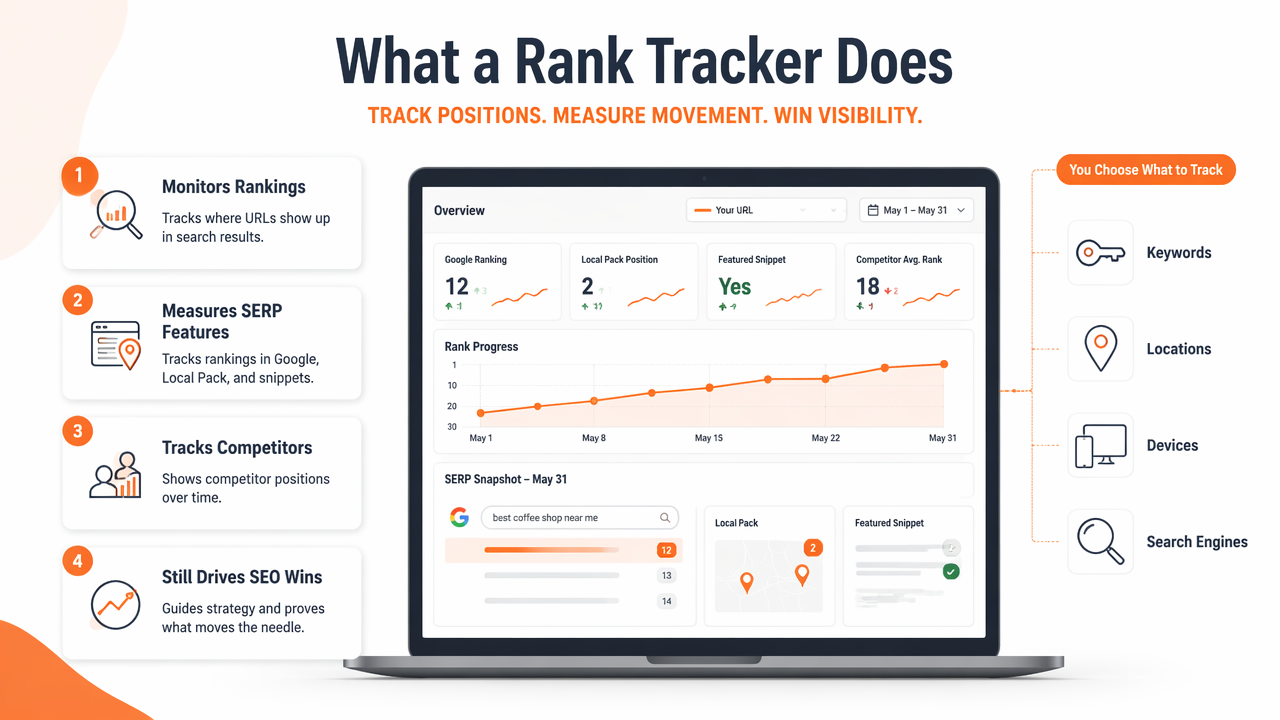
Rank tracking remains useful because Google still drives high-intent discovery for local businesses, ecommerce stores, SaaS companies, and content-led startups. It answers a narrow but vital question: whether a page moved up, down, or out of view for a query that matters.
Metrics a rank tracker usually reports
- Keyword position: the numerical placement of a page in search results.
- SERP feature ownership: appearances in snippets, local packs, images, or video results.
- Location variance: ranking differences by city, region, or country.
- Device variance: desktop and mobile ranking differences.
- Competitor movement: domains gaining or losing positions for shared keywords.
A rank tracker can flag traffic risk before analytics shows the full impact. For example, a local service page that drops from the map pack may lose calls quickly, even if total site traffic appears stable for a few days.
Rank trackers do not explain whether an AI assistant used a brand as a source. That gap matters because generated answers may mention a business without sending a traditional click, or may omit a business even when its page ranks well.
LLM SEO checker vs rank tracker: what each measures
An LLM SEO checker vs rank tracker comparison comes down to answer visibility versus search position visibility. LLM tools measure how AI systems interpret and surface a brand; rank trackers measure where pages appear in classic search results.
Practical comparison matrix
| Decision factor | LLM SEO checker | Rank tracker | Best fit |
|---|---|---|---|
| Primary question | Is the brand visible in AI answers? | Where does the page rank in SERPs? | Use both for full visibility |
| Main output | Mentions, citations, answer coverage, source gaps | Keyword positions, SERP features, local rankings | Depends on channel |
| Strongest use case | AI Overviews, ChatGPT, Perplexity, Gemini discovery | Google organic and local search tracking | Match to acquisition source |
| What it misses | Search demand, click-through trends, exact Google position | AI citations, entity understanding, prompt coverage | Neither is complete alone |
| Best cadence | Weekly or after major content updates | Daily to weekly for priority keywords | Higher cadence for volatile markets |
| Founder metric | Brand appears for buyer questions | Money pages gain or keep rankings | Track leads against both |
LLM checkers are strongest when the buyer path includes research questions, comparison prompts, and AI-generated recommendations. A B2B startup, for instance, may care whether AI tools list the product for "best lightweight CRM for agencies," even if the website ranks lower on Google.
Rank trackers are strongest when rankings map directly to demand. A plumber, dentist, Shopify store, or niche publisher still needs to know which keywords produce impressions, visits, and revenue.
What neither tool should claim alone
- No tool can perfectly measure every private AI answer. Chat sessions vary by user, context, model version, location, and retrieval source.
- No ranking report proves business impact by itself. Positions need to be tied to traffic, leads, sales, or assisted conversions.
- No AI visibility score replaces content quality. Clear answers, trusted sources, and crawlable pages still matter.
Research on hallucination in multimodal LLMs by Bai, Wang, and Xiao in 2024 examined reliability challenges in model outputs, which is a reminder that AI answer tracking needs repeated checks rather than one-off screenshots in the arXiv survey.
Best practice: treat rank tracking as the map of search placement and LLM checking as the map of answer inclusion.
How should lean teams choose the right setup?
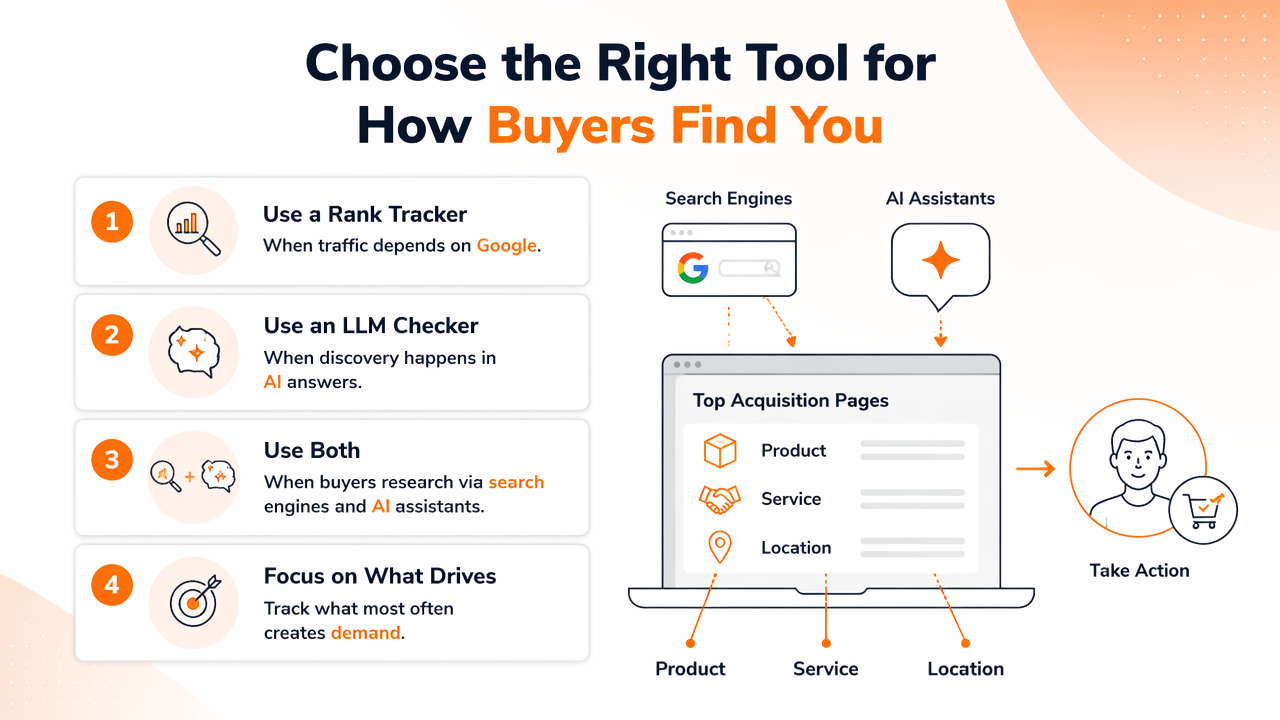
Lean teams should choose based on the channel that most often creates demand: use a rank tracker for Google-dependent traffic, use an LLM checker for AI-answer discovery, and use both when buyers research through search engines and AI assistants before taking action.
A simple selection process
- List the top acquisition pages. Product, service, category, location, and comparison pages usually matter most.
- Map each page to a buyer question. A page with a clear question is easier for both Google and AI systems to understand.
- Check Google visibility. Rank tracking shows whether the page is findable in classic search.
- Check AI answer visibility. LLM checking shows whether the brand appears when the same topic is asked as a prompt.
- Prioritize fixes by revenue impact. A missing citation for a high-intent topic matters more than a vanity mention.
Small companies often start with rank tracking because it feels familiar. That works for local SEO and ecommerce category monitoring, but it leaves a blind spot when AI answers summarize options before a searcher reaches a results page.
How Earlyseo handles this
Earlyseo helps teams package website information in ways AI systems can interpret more easily, then connect that work to practical SEO workflows. The Earlyseo docs explain setup steps for teams that want a cleaner path from site content to AI-readable signals.
For ecommerce operators, platform fit matters. A store team can pair product-page SEO work with the Shopify integration to keep AI-facing improvements closer to the catalog and content workflow.
Who should pick which option
| Team type | Better first tool | Why |
|---|---|---|
| Local service business | Rank tracker | Map packs and city keywords often drive calls |
| Early-stage SaaS startup | LLM SEO checker | AI answers often influence comparison research |
| Ecommerce store | Both | Category rankings and AI product discovery both matter |
| Content publisher | Rank tracker first | Search demand and SERP features remain core |
| Agency team | Both | Clients need proof across Google and AI surfaces |
A balanced setup does not require bloated reporting. For most lean teams, 10 to 30 priority queries, a short list of buyer prompts, and a monthly action review can reveal enough to guide content updates.
What should teams expect in 2027?
By 2027, AI visibility tracking will likely become a normal part of SEO reporting, but it will not make rank tracking obsolete. The more likely shift is blended reporting: keyword positions, AI answer presence, citation sources, and revenue outcomes in the same decision view.
AI search features are becoming more answer-led, while classic SERPs still support commercial pages, local results, product listings, and publisher content. That split means tools will need cleaner definitions for "visibility," since an AI mention, a citation link, and a number-one ranking do not carry the same value.
Metrics that will matter more
- Share of answer: how often a brand appears across repeated prompts.
- Citation quality: whether AI systems cite owned pages, directories, reviews, or competitors.
- Entity consistency: whether product names, categories, and claims match across the web.
- Prompt-to-page fit: whether content answers the exact question buyers ask.
- Revenue connection: whether AI and search visibility correlate with leads, trials, calls, or sales.
Strong teams will stop asking whether AI SEO replaces SEO. The better question is which visibility layer is missing from the current reporting stack.
Teams using earlyseo.com as part of the workflow should treat AI-readiness checks as an input to better pages, not a standalone trophy score. The practical win comes from clearer definitions, better answer blocks, cleaner technical access, and content that deserves to be cited.
FAQ
Does an LLM SEO checker replace a rank tracker?
An LLM SEO checker does not replace a rank tracker because the two tools measure different surfaces. The checker reviews AI answer visibility, brand mentions, and citation readiness. The rank tracker measures keyword positions in traditional search results. A business that depends on both Google traffic and AI-assisted research needs both views.
Which tool should a small business buy first?
A small business should start with the tool tied to its main source of leads. Local businesses that rely on city searches usually need rank tracking first. Startups and service firms that get evaluated through comparison research may benefit from an LLM checker earlier, especially when AI assistants influence vendor shortlists.
Can AI visibility be tracked accurately?
AI visibility can be tracked directionally, but not with the same fixed precision as a classic keyword position. Model versions, prompt wording, location, and retrieval behavior can change outputs. Reliable tracking uses repeated prompts, consistent test sets, citation checks, and trend monitoring instead of one isolated answer.
What is the best metric for founders?
The best founder metric is qualified visibility tied to pipeline or sales. For rank tracking, that may mean priority keyword movement for pages that convert. For LLM checking, that may mean repeated brand inclusion for high-intent buyer questions. Visibility only matters when it supports measurable demand.
Conclusion
The practical answer to LLM SEO checker vs rank tracker is simple: neither category replaces the other in 2026. Rank trackers show where pages stand in Google, while LLM checkers show whether AI systems can understand, mention, and cite a brand. A lean team should choose the missing layer first, then connect both reports to revenue-facing pages and buyer questions.
A sensible next step is to audit 10 priority keywords and 10 matching AI prompts, then fix the pages that fail both tests. For related guidance and examples, teams can review the SEO and AI visibility articles, then visit earlyseo.com when ready to turn those findings into a cleaner AI-search workflow.