TL;DR
An LLM SEO check helps a brand see whether AI tools can find, describe, cite, and compare it accurately. The fastest audit covers prompt testing, brand mentions, cited sources, competitor positioning, technical access, and content gaps before a larger AI search strategy begins.
AI search visibility now depends on more than ranking a blue link, because ChatGPT, Gemini, Perplexity, Claude, and AI Overviews often answer before a searcher clicks. An llm seo check is the early diagnostic step that shows whether a brand is visible, understood, and cite-worthy inside large language model answers. Earlyseo helps teams connect classic SEO work with AI visibility checks, especially when a founder or small marketing team needs a practical starting point rather than a giant analytics stack.
LLM SEO check: a structured audit that tests how large language models mention a brand, cite sources, compare competitors, and retrieve supporting content for commercial search questions.
Key takeaway: classic SEO asks, "Can search engines crawl and rank this page?" AI visibility asks, "Can an answer engine confidently use this brand as part of a useful answer?"
Table of Contents
What is an llm seo check?
An llm seo check is a practical audit of how AI answer engines discover, describe, cite, and compare a brand across likely customer questions. It reviews prompt results, brand facts, citation sources, competitor mentions, technical access, and missing content that may stop a model from choosing the brand in an answer.
Large language models are machine learning systems designed for natural language tasks, including generation and summarization. Research on generative AI by Stefan Feuerriegel, Jochen Hartmann, and Christian Janiesch (2023) explains the broader business use of these systems, including content generation and decision support, in Business & Information Systems Engineering.
AI search often combines model knowledge with retrieved web sources. A 2023 survey by Yunfan Gao, Yun Xiong, Xinyu Gao, and coauthors explains retrieval-augmented generation, or RAG, as a method where an LLM retrieves external information and uses it while generating an answer: Retrieval-Augmented Generation for Large Language Models: A Survey. That matters for SEO because the page, source, schema, and brand entity can influence whether retrieval systems select a site.
Core terms used in an AI visibility audit
Brand entity: the recognizable company, product, founder, location, category, and attributes that an AI system associates with a business.
Prompt set: a controlled list of questions used to test how AI tools answer across commercial, local, comparison, and problem-aware searches.
Citation source: the page, article, directory, review site, documentation page, or data source an AI tool references when generating an answer.
Answer quality: the accuracy, completeness, freshness, and commercial usefulness of what the model says about a brand.
How to run a quick AI visibility audit
A quick AI visibility audit checks the highest-risk gaps before a company spends time on full AI search optimization. The process should use repeatable prompts, record answer patterns, compare competitors, inspect cited sources, and turn findings into content or technical fixes.
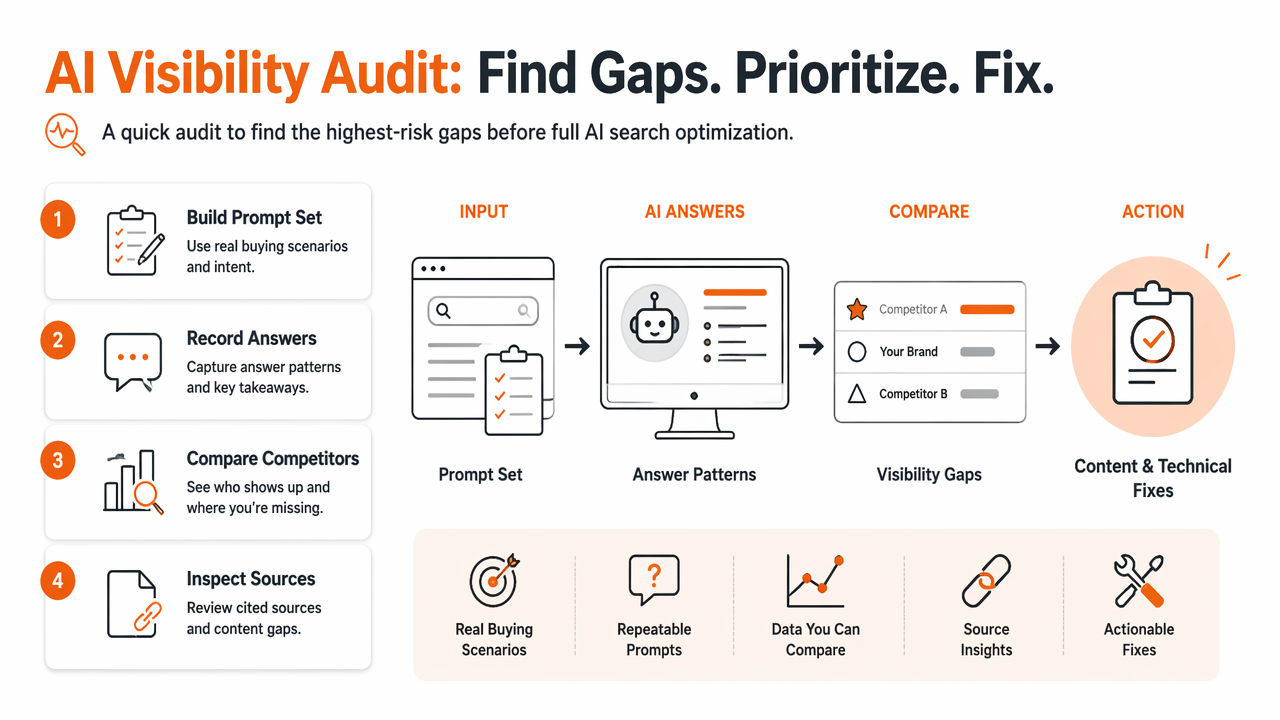
- Build a prompt set around real buying questions.
- Test the prompts in at least two AI systems.
- Record whether the brand appears, how it is described, and which sources are cited.
- Compare the same answers against direct competitors.
- Check whether pages are crawlable, specific, and updated.
- Prioritize fixes by revenue impact, not vanity mentions.
Prompt testing should include the exact terms a buyer might use, not just the brand name. A local bakery might test "best wedding cake baker in Austin," while a SaaS founder might test "best lightweight SEO tool for startups." A Shopify store might test category prompts, gift prompts, and product comparison prompts.
The Earlyseo platform fits this stage when a small team needs a guided workflow for visibility checks and content improvements. Store owners using Shopify can also review the Earlyseo Shopify integration when AI visibility work needs to sit close to ecommerce content and product pages.
Fast diagnostic checklist before a full strategy
- Brand appears: the company shows up for category, problem, and comparison prompts.
- Brand facts are correct: name, product, location, audience, pricing style, and use case match the official site.
- Sources are owned or trusted: AI answers cite the company site, documentation, strong articles, reputable directories, or credible third-party pages.
- Competitors are mapped: repeated competitor names are tracked by prompt type.
- Content gaps are obvious: missing explainers, comparison pages, local pages, documentation, or product-led pages are listed.
- Technical access is clean: important pages are indexable, crawlable, fast, and internally linked.
- Next actions are ranked: fixes are ordered by likely business value.
What should the audit measure?
An AI visibility audit should measure presence, accuracy, citations, competitor context, and content readiness. These signals show whether an answer engine can understand the business and whether the web contains enough reliable evidence to include it.
Presence alone is not enough. A brand mention with stale pricing, wrong geography, or a vague category may create weaker demand than no mention at all. Accuracy needs the same attention as rankings because AI answers can compress many source pages into one confident paragraph.
Citation analysis is the most useful bridge between SEO and AI search. If a model cites old blog posts, thin directory listings, or competitor pages, the content plan should fix the source layer first. The Earlyseo documentation is useful for teams that want to organize the technical side before running broader checks.
Measurement matrix for an LLM SEO check
| Audit area | What to inspect | Useful pass signal | Common fix |
|---|---|---|---|
| Prompt visibility | Category, problem, local, and comparison prompts | Brand appears in relevant answers | Create stronger category and use-case pages |
| Brand accuracy | Product, audience, locations, features, pricing style | AI description matches official facts | Update site copy, schema, profiles, and documentation |
| Citations | Sources cited by AI tools | Owned pages or trusted third-party sources appear | Publish clearer explainers and improve internal links |
| Competitor context | Brands named alongside the business | Comparison is fair and specific | Add honest comparison and alternative pages |
| Content gaps | Missing answers around buyer questions | Pages answer complete search intent | Build FAQ, guides, glossary, and examples |
| Technical access | Crawlability, indexation, page structure | Important pages are accessible and easy to parse | Fix robots rules, headings, schema, and speed |
Some teams add sentiment, share of answer, and citation frequency as later metrics. For an early check, simpler signals usually work better. The goal is to find whether the brand has enough clear evidence across the web to deserve inclusion.
A 2023 study on ChatGPT in higher education by Tareq Rasul, Sumesh Nair, Diane Robyn Kalendra, and coauthors reviewed benefits, challenges, and future research directions for generative AI tools in learning contexts: Journal of Applied Learning & Teaching. The same general caution applies to AI search audits: outputs need review because generated answers can vary by prompt, tool, and retrieval source.
How Earlyseo handles AI search visibility
Earlyseo handles AI search visibility by connecting content structure, technical SEO, and LLM-friendly site signals into one practical workflow. The focus is not guessing how one model works; the goal is making brand information easier for search engines and answer engines to parse, trust, and reuse.
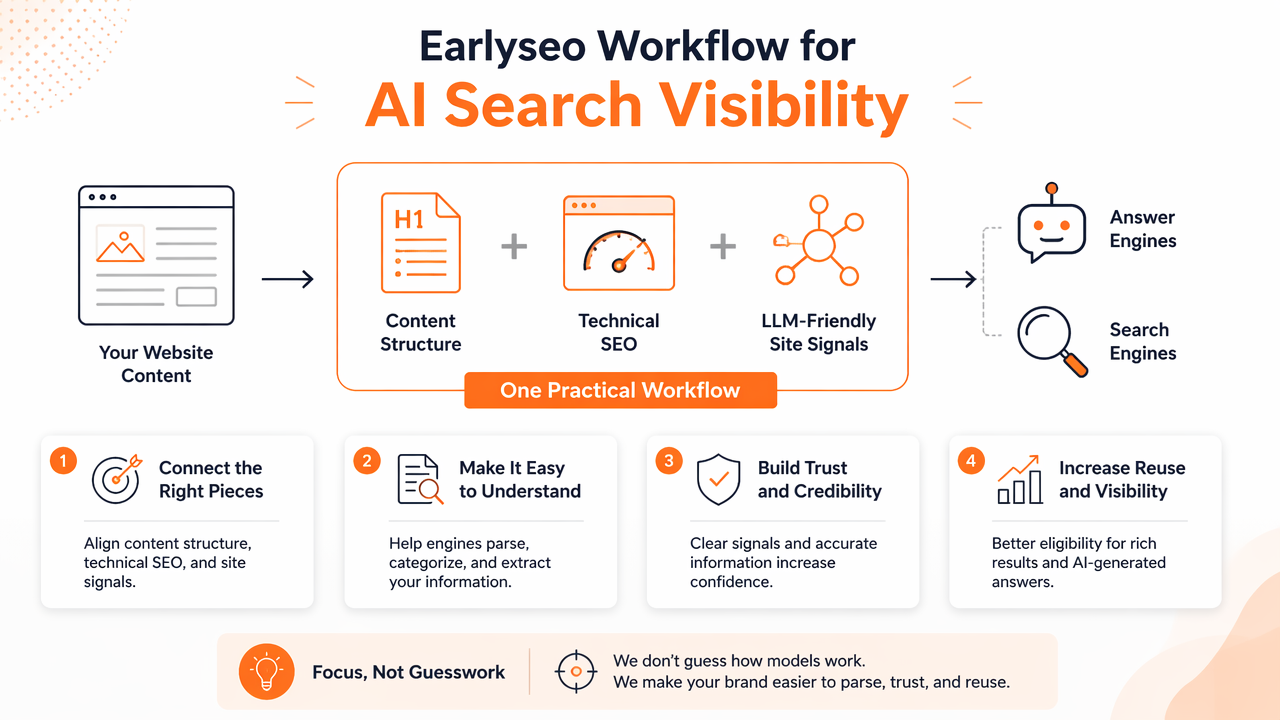
A good AI visibility workflow starts with a crawlable website, clear page purpose, and entity-rich content. It then adds supporting assets such as documentation, comparison content, product pages, FAQs, and structured internal links. For publishers and SaaS teams, an LLMs.txt setup guide can help explain how AI-focused discovery files fit into the broader technical picture.
Earlyseo versus point-solution AI visibility tools
| Approach | Best fit | Main strength | Watchout |
|---|---|---|---|
| Earlyseo | Startups, small businesses, ecommerce teams | Combines practical SEO tasks with AI visibility foundations | Still needs accurate brand inputs from the team |
| Standalone prompt trackers | Larger marketing teams | Tracks many prompts across tools | Can produce dashboards before fixes are clear |
| Classic SEO audit tools | Technical SEO teams | Finds crawl, index, and page issues | May miss AI answer quality and citation context |
| Manual spreadsheet audits | Very early founders | Cheap and flexible | Hard to repeat at scale |
Who should pick which? A founder checking early market visibility can start with a spreadsheet and a short prompt set. A growing ecommerce or SaaS team should move to a workflow that connects content changes with technical fixes. A mature brand with many categories may need prompt tracking, SEO auditing, and analytics together.
More practical reading can live on the Earlyseo blog, where related SEO and AI search topics can support the audit process. For brand recall and direct access, earlyseo.com is the simplest place to start.
Where LLM-friendly files fit
LLM-friendly files do not replace helpful content, schema, internal links, or indexable pages. They act more like a navigation aid for AI systems and crawlers that may need a cleaner path to important resources.
A site can also maintain a focused LLM.txt reference for context around this newer file pattern. The strongest setup still depends on clear pages that answer real customer questions.
FAQ about LLM SEO checks
LLM SEO checks are becoming a normal early step for brands that rely on organic discovery. These short answers cover the practical questions founders, local businesses, ecommerce teams, and marketing managers usually ask first.
How often should a brand run an LLM SEO check?
A brand should run a lightweight AI visibility check monthly and after major site, product, pricing, or positioning changes. Fast-moving categories may need more frequent checks because AI answers can shift as new pages, reviews, documentation, and third-party mentions appear.
Does an AI visibility audit replace traditional SEO?
An AI visibility audit does not replace traditional SEO because answer engines still depend on crawlable pages, clear information, links, and trusted sources. Classic SEO improves the evidence layer, while AI-focused checks reveal how that evidence is interpreted inside generated answers.
Which prompts should a small business test first?
A small business should test category prompts, local intent prompts, problem prompts, and comparison prompts. Examples include "best accountant for startups in Denver," "how to choose a wedding photographer," or "Square versus Shopify for a small store." Brand-name prompts should come after discovery prompts.
Can schema markup improve LLM visibility?
Schema markup can help clarify entities, products, reviews, locations, FAQs, and organization details, but it is not a shortcut. AI systems need consistent information across page copy, structured data, citations, and external sources. Schema works best when the visible content already answers the question well.
What is the first action after a poor audit result?
The first action is to separate accuracy issues from visibility issues. If the brand appears but facts are wrong, official pages and profiles need correction. If the brand does not appear, the priority is usually stronger category content, comparison content, documentation, and credible third-party mentions.
Conclusion
A practical llm seo check gives a clear answer to one question: can AI systems find enough trustworthy evidence to mention a brand accurately? The best first pass reviews prompts, citations, competitor context, technical access, and missing content before a larger AI search plan begins.
Founders and small teams should start with a 10-prompt audit, document every answer, and fix the highest-value gaps first. For teams ready to connect AI visibility with everyday SEO execution, Earlyseo gives a practical path from diagnosis to action. Visit earlyseo.com and run the first visibility review before the next content sprint begins.