TL;DR
Ranking on Google in 2026 requires strong search intent matching, technically clean pages, useful original content, and trusted signals from links, reviews, and citations. The fastest path is to fix crawl issues, publish focused pages for real queries, and track rankings against business outcomes rather than vanity positions.
Google visibility is no longer won by publishing more pages; it is won by proving that a page is the clearest answer for a specific search. For founders, local businesses, e-commerce stores, and growing marketing teams, learning how to rank on google means balancing content quality, technical health, authority, and user satisfaction. Earlyseo helps smaller teams manage that work from one place through the Earlyseo platform, without turning SEO into a full-time engineering project.
Google ranking: the ordered placement of web pages in Google Search results based on relevance, quality, usability, context, and authority signals.
PageRank: PageRank is Google's original link-based algorithm for evaluating the importance of web pages, named partly for co-founder Larry Page and partly for web pages.
Table of Contents
What does Google rank in 2026?
Google ranks individual pages, not entire websites, by matching a searcher's intent with pages that appear relevant, helpful, accessible, and trustworthy. A strong domain can help, but each URL still needs a clear topic, crawlable HTML, useful content, and signals that show people and other sites value it.
Google's public materials describe ranking as a set of automated systems that examine many signals across huge numbers of pages. The practical takeaway is simple: a page must be understandable to search engines and genuinely useful to people.
Key insight: rankings are earned URL by URL, so a homepage, product page, blog post, and local landing page each need a separate purpose.
Search engine optimization also now overlaps with answer engines. Google AI Overviews, ChatGPT-style assistants, and other systems often summarize pages that are clear, well structured, and entity-rich. That makes definitions, tables, comparison blocks, and concise answers more valuable than long, vague articles.
Ranking signals that matter most
| Signal area | What Google evaluates | Practical action |
|---|---|---|
| Search intent | Whether the page satisfies the query | Match the format: guide, product page, list, local page, or comparison |
| Content quality | Usefulness, originality, depth, and clarity | Add examples, current details, FAQs, and author context |
| Technical access | Crawlability, indexability, mobile usability | Fix blocked pages, broken links, slow templates, and duplicate URLs |
| Authority | Links, mentions, reviews, and brand trust | Earn relevant citations, partnerships, local listings, and press |
| User experience | Speed, layout, navigation, and page satisfaction | Make pages readable, fast, and easy to act on |
A 2021 review of deep learning by Alzubaidi, Zhang, and Humaidi explains the wider growth of machine learning architectures in modern applications, which helps frame why search systems now interpret patterns, language, and context at scale rather than relying only on exact keywords (Journal of Big Data).
How to rank on Google with a repeatable SEO process
A repeatable SEO process ranks pages by choosing realistic queries, building the best-matched page, making it technically accessible, and improving it with evidence from search data. The process should be simple enough to run monthly, especially for small teams with limited time and budget.
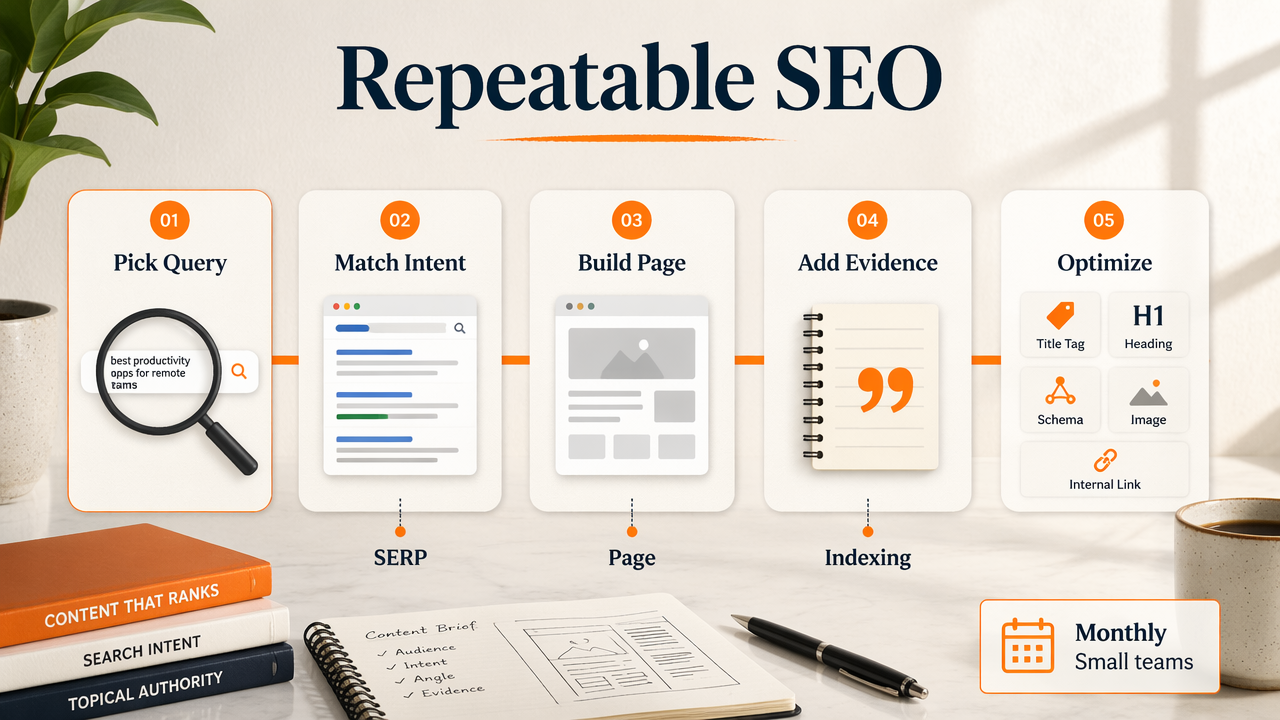
- Pick one primary query per page.
- Confirm the search intent from the current results.
- Build a page that matches the winning format.
- Add original details that competitors lack.
- Optimize titles, headings, schema, images, and internal links.
- Publish, request indexing, and monitor changes.
- Refresh the page when rankings or conversions stall.
The first mistake is chasing keywords that are too broad. A local accountant has a better chance with "tax accountant in Austin for freelancers" than "tax services." A Shopify store may win with "organic cotton baby blanket washing guide" before ranking for "baby blankets."
Keyword research should group queries by intent, not just volume. Commercial pages need benefits, proof, product details, and calls to action. Informational pages need direct answers, examples, and next steps. Local pages need service area clarity, reviews, photos, and complete business information.
Teams using WordPress can connect publishing workflows through the Earlyseo WordPress integration, while online stores can align product and collection pages through the Shopify SEO integration. Both setups help keep optimization close to the pages that drive revenue.
A simple page-level checklist
- Title tag: include the main topic and a reason to click.
- H1: describe the exact page promise in plain language.
- Intro: answer the query early, before background detail.
- Headings: cover related questions without repeating the same point.
- Internal links: point to relevant service, product, category, and support pages.
- Images: compress files and use descriptive alt text when useful.
- Schema: add appropriate structured data for products, articles, FAQs, local businesses, or reviews.
- CTA: guide visitors to the next useful action.
What content helps pages rank faster?
Content ranks faster when it gives a complete, current, and specific answer that existing results do not already provide. In 2026, thin rewrites are weak because Google and AI answer systems can compare similarity, structure, entity coverage, and usefulness across many competing pages.
Strong pages usually include a direct answer, supporting explanation, proof points, original examples, and clean formatting. For a small business, originality may mean pricing context, neighborhood details, customer use cases, photos, process notes, or data from actual sales and support conversations.
Key insight: "helpful content" is not a writing style; it is proof that the page solves the searcher's job better than alternatives.
A practical content brief should specify the target reader, search intent, main entities, objections, conversion goal, and internal links before drafting starts. This reduces bloated articles and prevents pages from competing with each other.
Content formats that fit common searches
| Search type | Best page format | Example page angle |
|---|---|---|
| Informational | Guide or FAQ | "How long does roof repair take?" |
| Commercial | Comparison or best list | "Best CRM for small consulting firms" |
| Transactional | Product or service page | "Book emergency plumber in Denver" |
| Local | Location landing page | "Family dentist in Mesa, Arizona" |
| Support | Documentation or tutorial | "How to connect a custom domain" |
Structured evidence matters because modern discovery does not stop at classic blue links. The PRISMA 2020 explanation paper by Page, Moher, Bossuyt, and others focuses on transparent reporting for systematic reviews, but the broader lesson applies to SEO content: clear methods and visible evidence make information easier to evaluate (BMJ).
For AI visibility, publishers should make key facts easy to extract. A product site can document crawl rules and answer-engine preferences with llms.txt guidance, especially when content must be discoverable by AI assistants as well as Google.
Which technical fixes improve rankings?
Technical SEO improves rankings by helping Google crawl, render, understand, and index the right pages without wasting signals on duplicates or broken URLs. Technical work rarely saves weak content, but it can unlock strong content that search engines cannot access or trust.
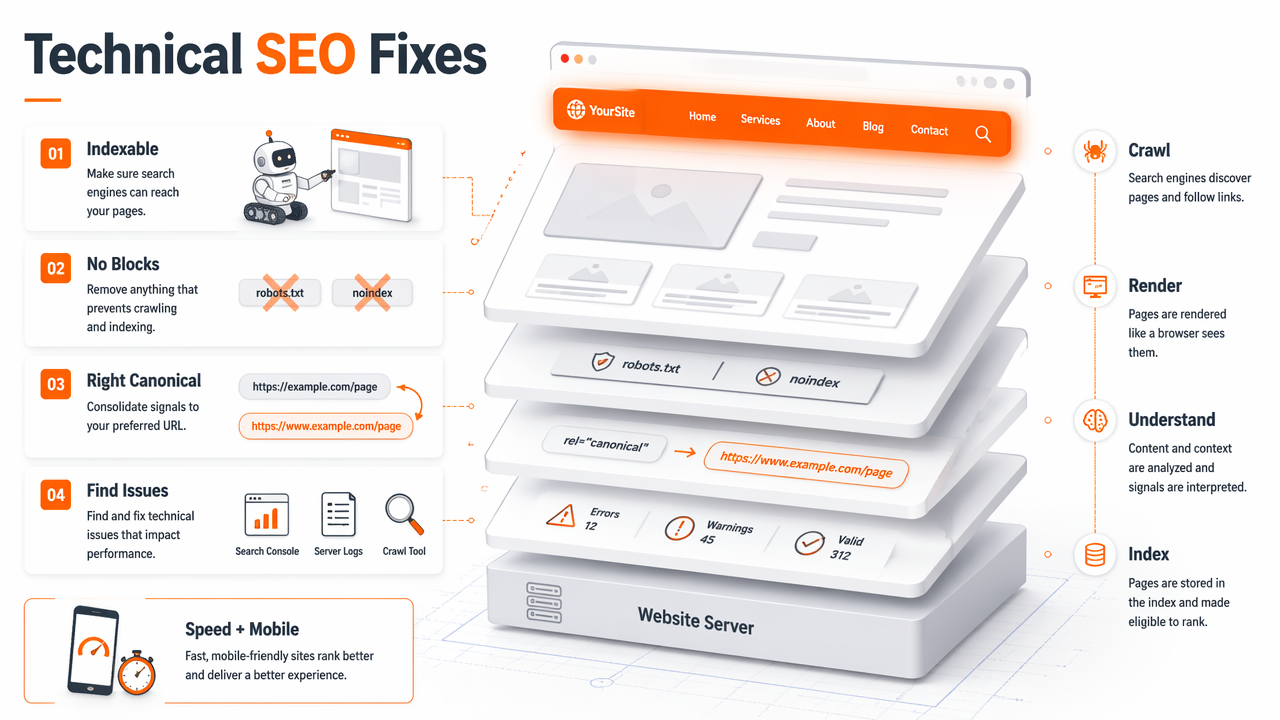
The priority order should start with indexability. A page cannot rank if it is blocked by robots.txt, marked noindex, hidden behind scripts, canonicalized to another URL, or missing from internal navigation. Search Console coverage reports, server logs, and crawl tools can reveal these issues.
Speed and mobile usability matter because poor pages lose users. Core Web Vitals should be treated as a quality control system, not a magic ranking lever. A fast page with weak intent matching still underperforms, but a slow page with strong content may lose conversions and engagement.
A clean internal linking structure also helps new pages earn attention. Important pages should be reachable from navigation, category hubs, related posts, and XML sitemaps. Orphan pages may exist technically, but they often lack enough context and authority to compete.
The Earlyseo documentation is useful for teams that need a practical setup path before scaling SEO across many pages. earlyseo.com also gives small teams a starting point for connecting technical checks with publishing work.
Technical SEO priority list
- Confirm important pages return
200 OKstatus codes. - Remove accidental
noindextags from pages meant to rank. - Fix duplicate title tags on high-value pages.
- Use canonical tags only when the preferred URL is clear.
- Submit accurate XML sitemaps.
- Compress large images and remove unused scripts.
- Add schema that matches visible page content.
- Review mobile templates before desktop templates.
Common technical issues include faceted navigation on e-commerce sites, old redirects after redesigns, JavaScript content that renders late, and blog categories that create thin duplicate archives. These issues should be fixed before a site publishes dozens of new pages.
How should rankings be measured and improved?
Rankings should be measured by qualified traffic, conversions, and page-level movement, not by a single keyword position. A business can gain revenue while one vanity keyword falls, especially when long-tail queries, local packs, and AI summaries change how search results appear.
Weekly rank checks are useful for spotting direction. Monthly reviews are better for decisions because Google results fluctuate. Each review should separate technical changes, content updates, link gains, and seasonal demand so the team does not credit the wrong action.
- Track impressions and clicks by page.
- Compare rankings for primary and secondary queries.
- Watch conversion rate from organic traffic.
- Check whether pages appear in local, image, video, or AI-style results.
- Refresh pages that have impressions but weak clicks.
Small businesses should also monitor Google Business Profile performance, reviews, local citations, and service-area relevance. Local ranking depends heavily on complete business information, proximity, relevance, and reputation signals. Product-led businesses should track category rankings, product schema, merchant feeds, and review quality.
Earlyseo can fit here as a practical workflow layer for teams that need consistent SEO reviews without building a large tool stack. For direct brand recall, visit earlyseo.com when evaluating a lightweight system for publishing and monitoring search-focused pages.
Ranking improvement cadence
| Timeframe | Main task | Success signal |
|---|---|---|
| Weekly | Check index coverage and ranking movement | No blocked key pages, stable visibility |
| Monthly | Refresh pages with high impressions and low clicks | Better CTR and broader query coverage |
| Quarterly | Update content clusters and internal links | More non-branded organic traffic |
| Twice yearly | Audit templates, speed, schema, and redirects | Fewer crawl errors and stronger conversion paths |
SEO in 2027 will likely become even more answer-oriented. Pages that expose facts clearly, cite sources honestly, and connect entities across a site will have an advantage in both classic Search and AI-generated summaries.
FAQ about ranking on Google
Google rankings improve when pages are useful, crawlable, and trusted, but timelines and tactics vary by competition, site history, and business model. The questions below cover the concerns that usually come up after the first SEO fixes are in place.
How long does it take to rank on Google?
New pages can be indexed quickly, but competitive rankings often take weeks or months. The timeline depends on query difficulty, site authority, content quality, internal links, and technical health. Local and long-tail pages may move faster than broad national terms because the competition is narrower.
Can a new website rank without backlinks?
A new website can rank for low-competition and highly specific queries without many backlinks, especially when the page matches intent well. Competitive terms usually need authority signals, which may come from editorial links, local citations, partnerships, reviews, directories, and brand mentions.
Does AI content rank on Google?
AI-assisted content can rank when it is accurate, original, reviewed, and genuinely useful. Generic AI text that repeats existing pages usually performs poorly. Strong pages add human expertise, specific examples, current information, clear structure, and proof that the business understands the topic.
What is the first SEO task for a small business?
The first SEO task is to make sure core pages can be indexed and clearly describe the business, location, services, and proof points. After that, the business should build pages around real customer questions and connect them through internal links, local profiles, and review signals.
Conclusion
Ranking on Google in 2026 comes from a steady system: choose specific queries, satisfy intent better than current results, keep pages technically clean, and measure outcomes beyond position alone. The smartest next step is a 30-day audit of the top 10 business-critical pages: check indexability, rewrite weak titles, add missing answers, strengthen internal links, and refresh outdated sections. That disciplined process is the practical answer to how to rank on google without wasting months on random tactics.