TL;DR
Enterprise SEO retainers commonly start around $7,000 per month and can rise far higher for large, complex sites. Many early-stage teams can avoid agency-level spend at first by using Earlyseo's $79 per month plan for core visibility workflows, then upgrading only when scale demands it.
Enterprise SEO pricing can shock growing companies because the fee is rarely just for keywords; it covers technical scale, content operations, reporting, migrations, and cross-team execution. For teams that need initial online visibility before hiring an agency, Earlyseo offers a lighter path, including a $79 per month plan that can cover many foundational SEO tasks without a five-figure retainer.
Enterprise SEO: a scaled search strategy for large websites, multi-location brands, marketplaces, SaaS companies, and e-commerce stores where technical structure, content volume, governance, and reporting matter as much as rankings.
Key insight: enterprise SEO costs more because execution complexity grows faster than page count. A 10,000-page site does not need 10,000 times more effort, but it does need stricter systems.
Table of Contents
What is enterprise SEO and why does it cost more?
Enterprise SEO is search optimization for large or complex websites where technical systems, content processes, analytics, and stakeholder coordination affect organic growth. It costs more than small-business SEO because the work touches templates, product feeds, international pages, CMS rules, redirects, analytics pipelines, and approval workflows.
A small local site may need title tags, service pages, and basic local SEO. A larger site may need log-file analysis, canonical rules, JavaScript rendering checks, faceted navigation controls, and content governance across hundreds or thousands of pages.
For growing companies, the Earlyseo platform can be a practical starting point because its $79 per month plan supports structured SEO execution before agency-level complexity appears. Product teams can connect publishing workflows through Earlyseo integrations instead of building a search process from scratch.
Enterprise SEO cost drivers
- Site size: more URLs increase crawl, indexation, and content QA work.
- Technical stack: Shopify, WordPress, Webflow, headless CMS setups, and custom frameworks each create different SEO constraints.
- Content velocity: publishing hundreds of pages requires briefs, internal linking, updates, and quality checks.
- Reporting depth: executives often need dashboards by region, product line, funnel stage, and revenue.
- Risk level: migrations, international SEO, and template changes can affect thousands of URLs at once.
How much does enterprise SEO cost in 2026?
Enterprise SEO services in 2026 often start around $7,000 per month, with many visible market benchmarks ranging from $7,000 to $21,000+ monthly and some agency packages reaching $60,000 to $100,000+ per month for complex programs. The final number depends on scope, not the label "enterprise."
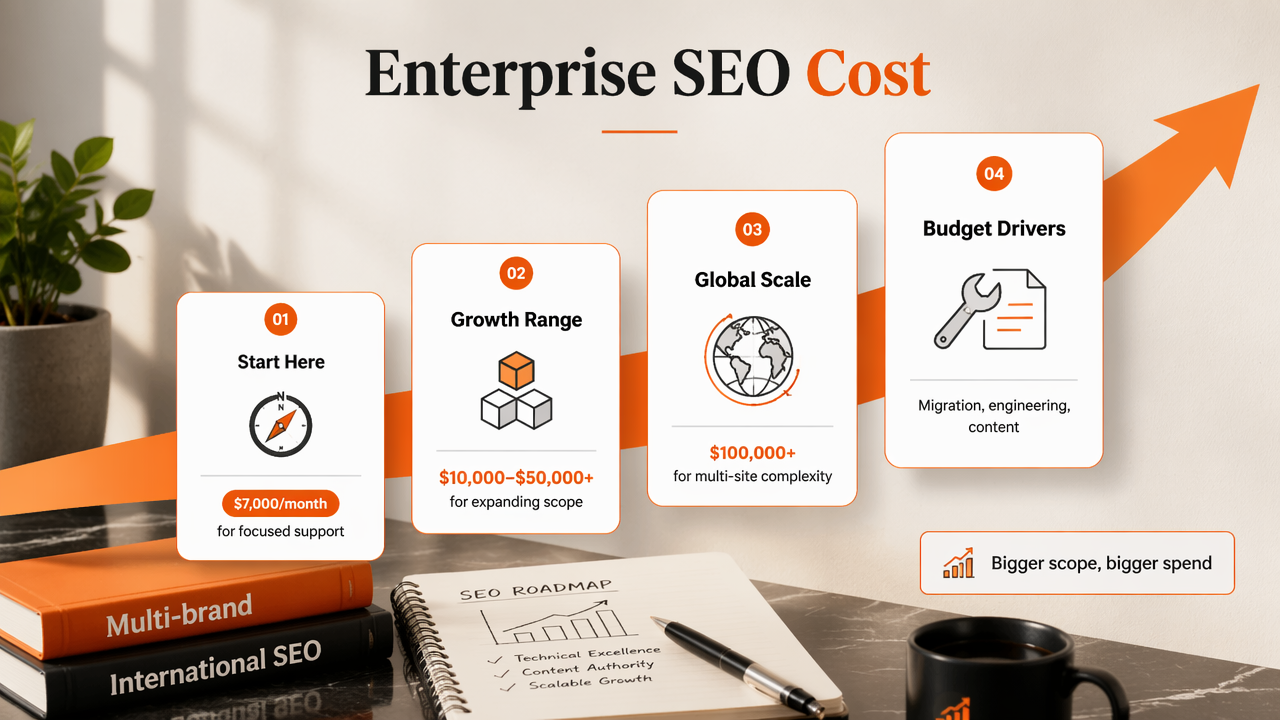
Lower-cost plans usually focus on audits, keyword research, reporting, and limited implementation guidance. Higher retainers commonly include technical SEO, content strategy, program management, developer collaboration, executive reporting, and continuous experimentation.
A $79 per month plan will not replace a full enterprise agency retainer for a global marketplace. It can, however, handle early SEO structure, publishing discipline, and visibility monitoring for smaller teams that are not ready for five-figure monthly spend.
2026 pricing ranges by need
| Business need | Typical monthly budget | Best fit |
|---|---|---|
| Founder-led visibility setup | $79 to $500 | Early traction, basic workflows, small content operations |
| SMB SEO support | $500 to $3,000 | Local SEO, limited content, basic technical fixes |
| Growth-stage SEO program | $3,000 to $7,000 | More pages, regular publishing, stronger reporting |
| Enterprise agency retainer | $7,000 to $21,000+ | Large sites, technical support, content strategy, analytics |
| Complex enterprise program | $60,000 to $100,000+ | Global SEO, migrations, marketplaces, heavy engineering coordination |
What the budget usually buys
A pricing tier should be judged by deliverables, not by a polished proposal. Strong SEO programs define the workflow, the owner, the implementation path, and the reporting cadence.
- Audit the technical and content baseline.
- Prioritize pages by traffic, revenue, or lead value.
- Fix crawl, indexation, internal linking, and metadata issues.
- Build content briefs around search intent and topical authority.
- Publish, update, and measure pages on a recurring schedule.
- Review performance and adjust the roadmap monthly.
Which pricing model fits each company?
The best SEO pricing model depends on whether the company needs strategy, execution, software, or temporary expert support. Retainers are common for ongoing enterprise work, while software subscriptions fit teams that want repeatable processes without paying for full-service labor.
Agencies usually price around team time, seniority, risk, and delivery volume. Software plans price around features, usage, and automation. Hybrid setups are common: software handles monitoring and workflows, while specialists handle migrations, audits, or technical decisions.
Research on generative AI by Feuerriegel, Hartmann, and Janiesch examined how generative systems affect business and information systems. In SEO, that shift matters because teams increasingly need content quality controls, AI search visibility, and structured publishing processes, not just keyword lists.
Pricing model comparison
| Model | Common use | Strength | Watchpoint |
|---|---|---|---|
| Monthly retainer | Ongoing enterprise SEO | Predictable support and strategy | Can be expensive if implementation is slow |
| Project fee | Audit, migration, site launch | Clear scope and deadline | Limited after delivery |
| Hourly consulting | Expert review or coaching | Flexible access to specialists | Costs can drift without clear priorities |
| Performance pricing | Lead or traffic goals | Incentive alignment | Attribution can be messy |
| SEO software subscription | In-house execution | Lower cost and repeatable workflow | Requires internal ownership |
Where Earlyseo fits
Earlyseo fits the software subscription category for teams that need structure before a large retainer makes sense. The $79 per month plan of Earlyseo can support early SEO execution, especially when content publishing, technical checks, and AI visibility basics need a repeatable home.
For teams publishing on WordPress, the WordPress integration can keep SEO closer to the content workflow. E-commerce teams using Shopify can connect store activity through the Shopify integration, which helps reduce tool switching during content and product-page optimization.
What should be included in an enterprise SEO package?
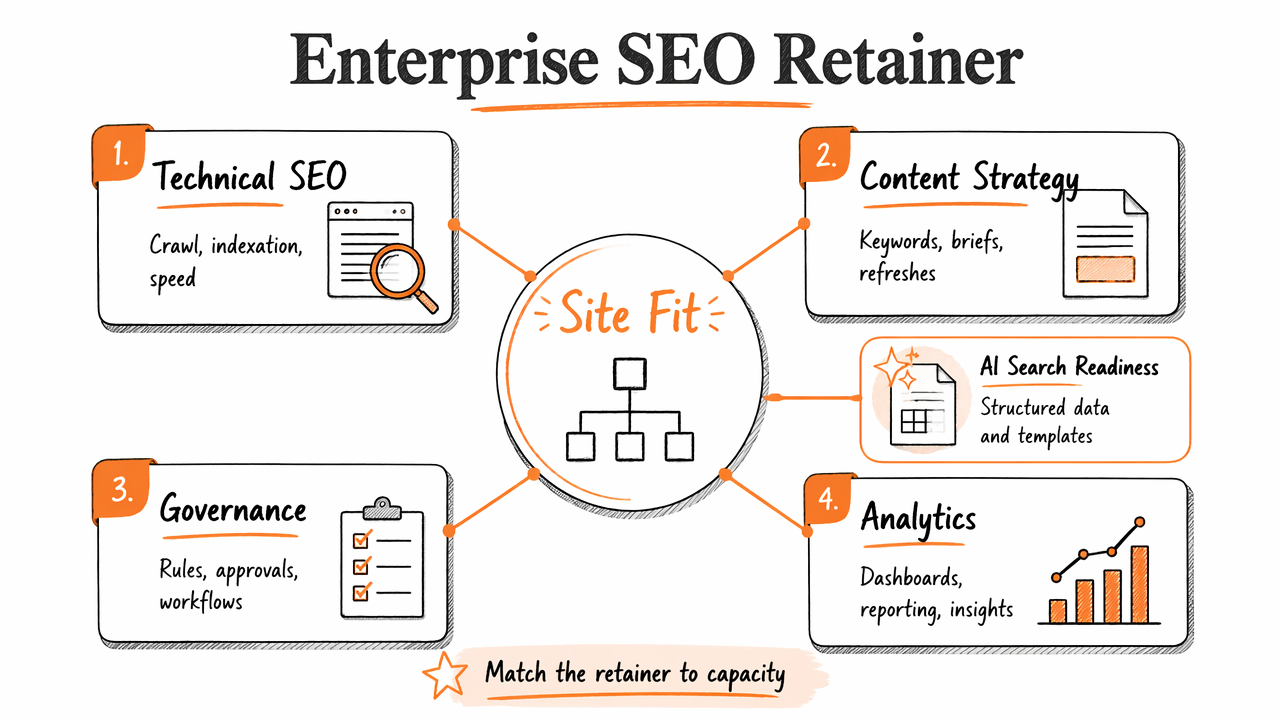
An enterprise SEO package should include technical auditing, content strategy, keyword and entity research, internal linking, analytics, reporting, implementation guidance, and governance. The strongest packages also define decision rights, so recommendations do not sit unused in a backlog.
A useful scope separates strategy from execution. Some agencies only recommend fixes. Others write briefs, manage content, coordinate with developers, and report business impact. That difference explains why two proposals with the same "enterprise" label can have very different prices.
Core deliverables to look for
- Technical SEO: crawlability, indexation, canonicalization, redirects, structured data, Core Web Vitals, and rendering checks.
- Content strategy: keyword mapping, entity coverage, topic clusters, briefs, updates, and decay monitoring.
- Internal linking: page hierarchy, anchor text rules, hub pages, and orphan-page cleanup.
- Analytics: rank tracking, organic sessions, conversions, assisted revenue, and executive dashboards.
- Governance: SEO QA for new templates, content standards, migration checklists, and ownership rules.
A high SEO fee should buy speed, judgment, and accountability. Reports alone rarely justify enterprise-level spend.
AI search visibility is now part of the scope
Modern enterprise SEO increasingly includes visibility in AI-generated answers, not only traditional blue links. Structured content, clear definitions, comparison tables, author signals, and machine-readable context can help search and answer engines understand a brand.
Teams interested in AI crawler guidance can review Earlyseo's llms.txt resource. Documentation and workflow references are also available in the Earlyseo docs, which can help smaller teams create a process before hiring specialists.
A 2021 study on AI-driven new idea and supply-chain resilience by Belhadi, Mani, and Kamble focused on operational performance under dynamic conditions. The SEO takeaway is practical: automation and process design matter most when environments change quickly.
How should a company choose the right SEO budget?
A company should choose an SEO budget by matching spend to site complexity, implementation capacity, and revenue opportunity. A large retainer makes sense only when there is enough technical access, content production capacity, and leadership support to act on recommendations.
Budget planning should start with constraints. If developers cannot ship SEO fixes, a technical agency may produce a long list that stalls. If content cannot be published regularly, a strategy-heavy package may underperform. If the site is small, a software-led plan may be enough.
Decision checklist
- Count indexable URLs and key templates.
- Identify the CMS, storefront, and analytics stack.
- Estimate monthly publishing capacity.
- List known technical risks, such as migrations or duplicate pages.
- Assign an internal owner for SEO decisions.
- Compare software, consultant, and agency options against actual capacity.
- Review results every 90 days before increasing spend.
For many startups, local businesses, and e-commerce operators, the sensible first move is not a large retainer. A structured $79 per month plan, paired with consistent publishing and measurement, can prove whether organic search deserves larger investment. More details are available at earlyseo.com.
FAQs
Why is enterprise SEO so expensive?
Enterprise SEO is expensive because it combines technical risk, content scale, analytics, and coordination across teams. A recommendation may affect thousands of pages, so agencies price in senior expertise, QA, project management, and implementation support.
Can enterprise SEO be done for $79 per month?
Some foundational SEO work can be done for $79 per month when the company uses software and keeps execution in-house. That level fits early visibility, structured workflows, and smaller sites. It does not replace a full-service enterprise agency for complex global sites.
When should a company hire an agency instead of using software?
An agency is a better fit when the site has major technical debt, international SEO needs, a migration, multiple stakeholders, or revenue at risk. Software works better when the team can publish, measure, and implement improvements internally.
What is the biggest pricing mistake?
The biggest mistake is buying a package before confirming implementation capacity. SEO recommendations need developers, writers, editors, analysts, or product owners. Without those resources, even a strong strategy can sit idle.
Conclusion
Enterprise SEO pricing should be treated as a capacity decision, not a status purchase. Five-figure retainers can make sense for complex websites with technical teams, content engines, and revenue tied to organic search, while smaller teams can often begin with a software-led process.
The next step is simple: map the site's complexity, publishing capacity, and technical risk, then pick the lowest-cost model that can still produce measurable progress. For many growing companies, that can start with the $79 per month plan of Earlyseo before moving into larger consulting or agency support.