TL;DR
Earlyseo is the better fit for small teams that want SEO planning, article creation, and publishing handled in one focused workflow. AirOps fits larger teams that need flexible AI workflow automation across content operations, but it usually requires more setup and process design.
AI SEO tools now split into two camps: focused platforms that execute organic growth tasks, and flexible workflow builders that can support many content operations. The Earlyseo vs AirOps choice comes down to that difference. Earlyseo is built around SEO content execution for teams that want blog output, search targeting, and publishing support without building a custom system. AirOps is better understood as a broader AI workflow platform for teams that want configurable processes across SEO, AEO, and content operations.
AI SEO workflow: an AI-assisted process that researches search demand, creates content briefs or articles, supports human review, and helps publish or measure content for organic visibility.
SERP research for this comparison found 650 results and an average competitor word count of 4,154 words, which signals a crowded category. A shorter, clearer answer is more useful for founders, local businesses, ecommerce teams, and lean marketing teams deciding where to invest first.
Table of Contents
What is the difference between Earlyseo and AirOps?
Earlyseo is a focused SEO content execution platform, while AirOps is a broader AI workflow automation platform that can be configured for SEO and content operations. The practical difference is setup: one is closer to an SEO publishing system, while the other is closer to a flexible operations builder.
That distinction matters because early organic growth usually fails from complexity, not lack of ideas. A founder or small marketing team often needs a repeatable path from keyword to published article. A larger team may need custom workflows, approvals, datasets, and role-based processes across departments.
Key insight: The main choice is not "which AI tool is smarter." The main choice is "how much workflow design should happen before content starts shipping?"
Side-by-side comparison for 2026 buyers
| Category | Earlyseo | AirOps |
|---|---|---|
| Core position | SEO-focused content execution | Broad AI workflow automation for content and operations |
| Best primary use | Planning, writing, and publishing SEO blog content | Building custom AI workflows for SEO, AEO, and content teams |
| Setup effort | Lower, because the workflow is more opinionated | Higher, because teams design more of the system |
| SEO research | Built around organic content planning | Depends on configured workflow and connected inputs |
| Content production | Oriented around blog posts and search visibility | Supports content production inside broader workflows |
| Publishing | Designed for regular SEO output | Depends on integrations and workflow design |
| Human review | Fits lightweight editorial review | Can support more complex approvals |
| Reporting | Focused on SEO growth visibility | Often tied to workflow outputs and analytics setup |
| Best-fit customer | Startups, small businesses, lean marketers | Larger content teams, agencies, operations-heavy teams |
How do setup effort and workflow control compare?
Earlyseo takes a guided approach to SEO execution, while AirOps gives teams more control over how AI workflows are built. Lower setup effort helps small teams publish faster, but deeper workflow control can matter when a company already has mature content operations.
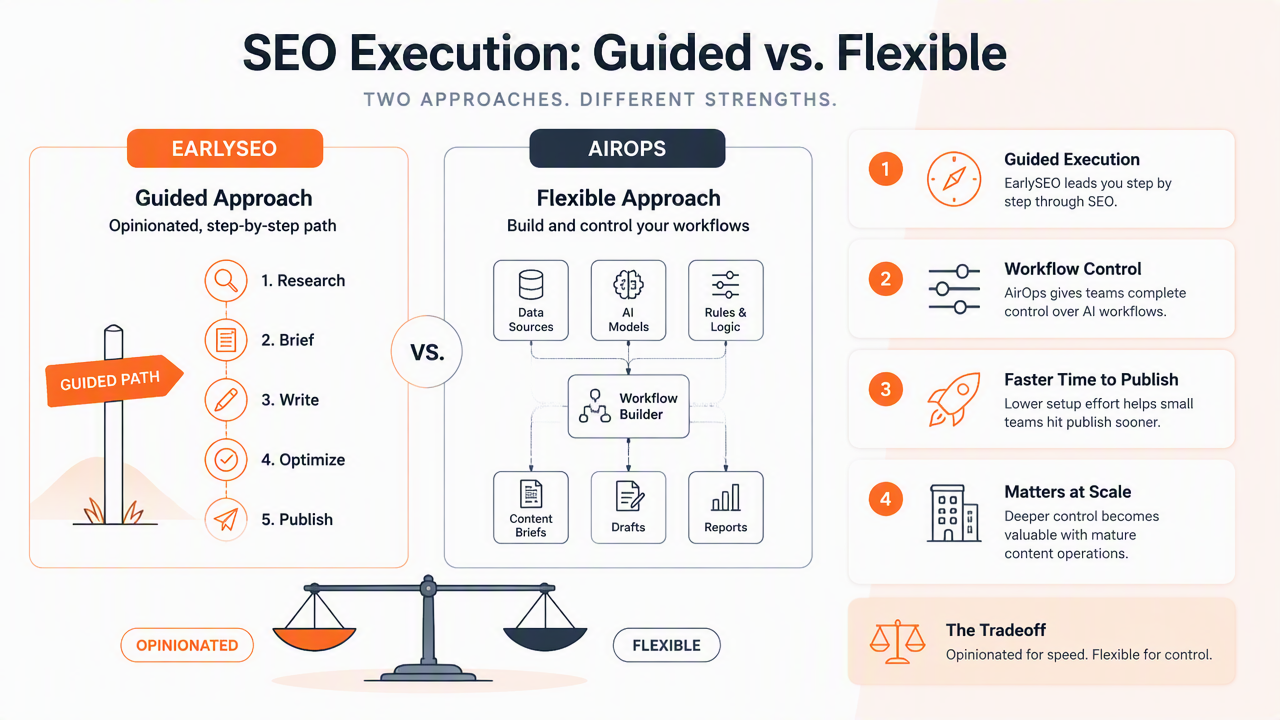
The tradeoff is familiar in software: opinionated tools reduce decisions, while flexible tools increase control. Neither model is automatically better. The right model depends on available time, process maturity, and the number of people involved in content production.
Setup factors that affect time to value
A lean team should judge setup by how many decisions must happen before the first publishable article exists.
- Define the target audience and topic area.
- Connect publishing or export systems.
- Set tone, formatting, and review rules.
- Decide how SEO research becomes a brief.
- Assign human review responsibilities.
- Track whether content is indexed, ranking, and improving.
AirOps can support more custom paths across those steps, especially for teams that want workflow logic beyond SEO articles. The cost of that flexibility is planning time. Teams may need to map inputs, approval gates, prompts, integrations, and reporting before the system feels stable.
The Earlyseo platform suits teams that prefer a more direct route: choose the SEO goal, produce content, review it, and publish consistently. That makes the tool easier to evaluate during a short trial or early growth push.
Where AirOps flexibility can make sense
AirOps is a stronger fit when SEO content is only one piece of a larger AI operations plan. For example, an agency may want workflows for client briefs, brand checks, AEO monitoring, landing page refreshes, and internal approvals.
That model works best when a team has the staff to own the system. A marketing operations manager, SEO lead, or content strategist usually needs to maintain workflow quality as priorities shift.
How do SEO research, content production, and publishing differ?
Earlyseo is designed around the full SEO article cycle, while AirOps can support SEO tasks through configurable workflows. For growing companies, the key question is whether SEO research, writing, and publishing should come as a built-in process or as a custom workflow assembled by the team.
Search behavior has changed because Google is no longer the only discovery surface. Competitor SERP data for this topic shows AI search and AEO language appearing in ranking pages, including phrases such as "AI search," "AEO," "GEO," and "content engine." That reflects how teams now optimize for classic rankings and AI citations at the same time.
Content execution checklist
A practical AI SEO system should cover the work that happens before and after writing, not just the draft.
- Topic selection: chooses themes based on business relevance and search demand.
- Brief creation: turns research into headings, intent, and coverage requirements.
- Article generation: creates structured content that can be reviewed by a person.
- Brand control: keeps tone, product language, and claims consistent.
- Publishing support: reduces copy-and-paste work across CMS tools.
- Performance visibility: shows what content is moving traffic, rankings, or visibility.
Early-stage teams often get more value from fewer moving parts. A focused tool that ships consistent content can beat a powerful platform that remains half-configured.
How Earlyseo handles SEO execution
Earlyseo handles SEO execution as a repeatable publishing workflow rather than a blank automation canvas. That makes it especially relevant for businesses that need organic traffic but do not have a dedicated SEO operations team.
Its core value is focus. The platform is framed around planning, writing, and publishing SEO-optimized blog posts, which matches the needs of founders, local service businesses, ecommerce operators, and lean marketing managers trying to build initial visibility.
AirOps, by contrast, may be better for teams that want a customizable AI content engine across many use cases. That includes teams comparing AEO analytics, AI search citation workflows, and larger content operation systems.
Which platform fits each customer profile?
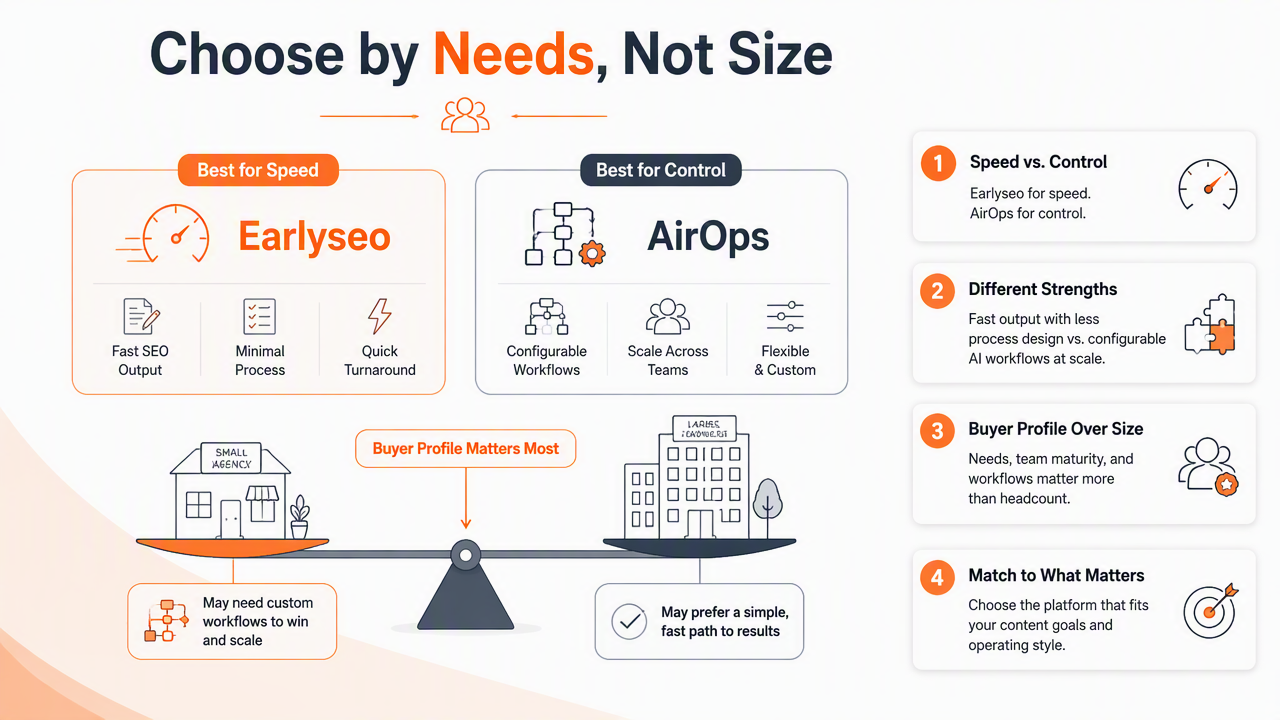
Earlyseo fits teams that want fast SEO output with less process design, while AirOps fits teams that want configurable AI workflows across a wider content operation. The buyer profile matters more than company size alone, because a small agency may need custom workflows while a larger business may still prefer a simple SEO publishing system.
Best-fit decision guide
| Team profile | Better fit | Why |
|---|---|---|
| Startup founder seeking first organic traffic | Earlyseo | Faster path from topic to published blog content |
| Local business owner new to SEO | Earlyseo | Less workflow design and fewer technical decisions |
| Ecommerce store building category support content | Earlyseo | Helpful for consistent informational articles around products |
| Marketing manager with a small team | Earlyseo | Keeps SEO production focused and repeatable |
| Agency managing complex client processes | AirOps | More room for custom workflows and approval logic |
| Enterprise content operations team | AirOps | Better suited to multi-step, cross-functional AI systems |
| AEO experimentation team | AirOps | Flexible setup for AI search and visibility workflows |
Who should pick which
Choose the focused SEO route when the main goal is publishing high-quality articles regularly, building topical coverage, and getting content into search faster. This is the more practical path when staff time is limited and organic traffic is still early.
Choose the workflow automation route when internal teams already know the exact process they want to automate. AirOps can be valuable when the organization has defined workflows, connected data sources, and people responsible for maintaining the system.
A common mistake is buying flexibility before the content strategy is clear. Broad automation can expose weak processes. Focused execution can create momentum while the strategy matures.
Reporting and human review expectations
Reporting should match the decision being made. A small business usually needs to know whether publishing is consistent and organic visibility is improving. A larger operation may need dashboards for workflow completion, content stage, AI citation performance, and team throughput.
Human review also differs. Focused SEO content needs editorial checks for accuracy, tone, and business fit. Workflow-heavy teams may require legal review, client approval, brand review, and SEO review as separate steps.
Key insight: Review quality matters more than review quantity. Extra approval layers only help when each layer has a clear job.
Frequently asked questions
A FAQ is a curated list of questions and answers that addresses important or commonly misunderstood parts of a topic. In this comparison, the FAQ clarifies buying decisions that often get blurred when AI SEO, AEO, content automation, and workflow tooling are discussed together.
Is Earlyseo vs AirOps mainly an SEO tool comparison?
Yes, but only partly. The better framing is SEO execution compared with AI workflow automation. One side focuses on getting SEO content planned, written, and published with fewer setup steps. The other side supports broader workflow design that can include SEO, AEO, editorial operations, and analytics.
Can AirOps be used for SEO content?
AirOps can be used for SEO content when a team configures workflows for research, drafting, review, and reporting. Its strength is flexibility across content operations. That flexibility is most useful when the team already has a defined process and someone responsible for maintaining workflow quality over time.
Is a focused SEO platform better for small businesses?
A focused SEO platform is often better for small businesses because it reduces setup decisions and supports faster publishing. Many small teams need a practical path to organic visibility before building complex automation. Consistent content execution usually matters more at the start than custom workflow architecture.
What should teams evaluate during a trial?
Teams should evaluate time to first publishable article, quality of SEO research, ease of editing, publishing workflow, and reporting clarity. A trial should test the real weekly process, not just sample output. The best tool is the one that keeps content moving after the first week.
Conclusion
The Earlyseo vs AirOps decision is really a choice between focused execution and flexible automation. AirOps makes sense for teams that want to design custom AI workflows across a larger content operation. Earlyseo is the warmer fit for startups, small businesses, ecommerce teams, and lean marketers that need a direct path from SEO planning to published content.
A practical next step is simple: map the current content process on one page, mark every step that slows publishing, then pick the platform that removes the biggest bottleneck. If the bottleneck is SEO content execution, visit earlyseo.com and compare the workflow against the next month of planned articles.