TL;DR
Botify fits enterprise teams that need deep crawl control, log-file analysis, and technical SEO governance across huge sites. Semrush fits growing teams that need broader SEO, content, competitor research, and AI visibility tracking with less implementation burden, while Earlyseo is a lighter execution layer for teams that need to publish and improve faster.
AI search has made SEO tooling less about rank tracking alone and more about proving whether a brand can be crawled, understood, cited, and chosen by search engines and answer engines. The practical choice in Botify vs Semrush for AI search SEO comes down to operating model: Botify is stronger for enterprise technical SEO control, while Semrush is broader for content, keyword, competitive, and AI visibility workflows. Search engine optimization: the practice of improving website and web-page visibility and performance in search results so a site can earn more relevant organic traffic. For startups and growing companies that need execution support after strategy, Earlyseo can sit alongside research tools to turn SEO insights into publishable content and repeatable operations.
Table of Contents
Botify vs Semrush for AI search SEO: the quick answer
Botify is the better fit for large, technically complex websites, while Semrush is the better fit for most startups, small businesses, and marketing teams building AI search visibility from content and competitive data.
Botify's core strength is search engine crawling, rendering, indexing, and enterprise-scale technical SEO. Semrush's strength is all-in-one visibility: keyword research, competitor analysis, content planning, backlink data, advertising research, local SEO, reporting, and newer AI visibility workflows.
Key insight: AI search SEO rewards both technical accessibility and answer-ready content, so the best platform depends on whether the main bottleneck is site infrastructure or content execution.
The research set shows a small but important SERP pattern: older comparison content focuses on market share, customer counts, or the 2022 Botify and Semrush partnership. Newer AI visibility content tends to mention Semrush as an AI visibility and SEO tracking platform, but often leaves Botify framed as an enterprise technical SEO system rather than an AI search platform.
Snapshot comparison for growing teams
| Category | Botify | Semrush | Best fit |
|---|---|---|---|
| Core strength | Enterprise technical SEO, crawl control, log analysis | Broad SEO, content, competitor, PPC, local, AI visibility | Semrush for most growing teams |
| AI search angle | Makes sites easier for crawlers and search systems to access | Tracks visibility, competitors, topics, and content opportunities | Depends on bottleneck |
| Setup effort | Higher, often needs technical SEO support | Moderate, marketing teams can start faster | Semrush |
| Reporting | Enterprise governance and technical diagnostics | Executive dashboards, campaign tracking, competitive reports | Semrush for lean teams |
| Pricing fit | Enterprise budget profile | Tiered SaaS budget profile | Semrush for startups and SMBs |
| Execution gap | Needs teams to act on findings | Needs writers/operators to ship improvements | Earlyseo can help execute |
A startup with a 200-page SaaS site rarely needs enterprise crawl governance first. A global ecommerce site with millions of URLs, faceted navigation, rendering issues, and indexation waste may need Botify before another content workflow.
What does AI search SEO change in this comparison?
AI search SEO changes the comparison because visibility now depends on crawlability, entity clarity, content usefulness, and citation likelihood across search results, AI Overviews, and chatbot-style answer engines.
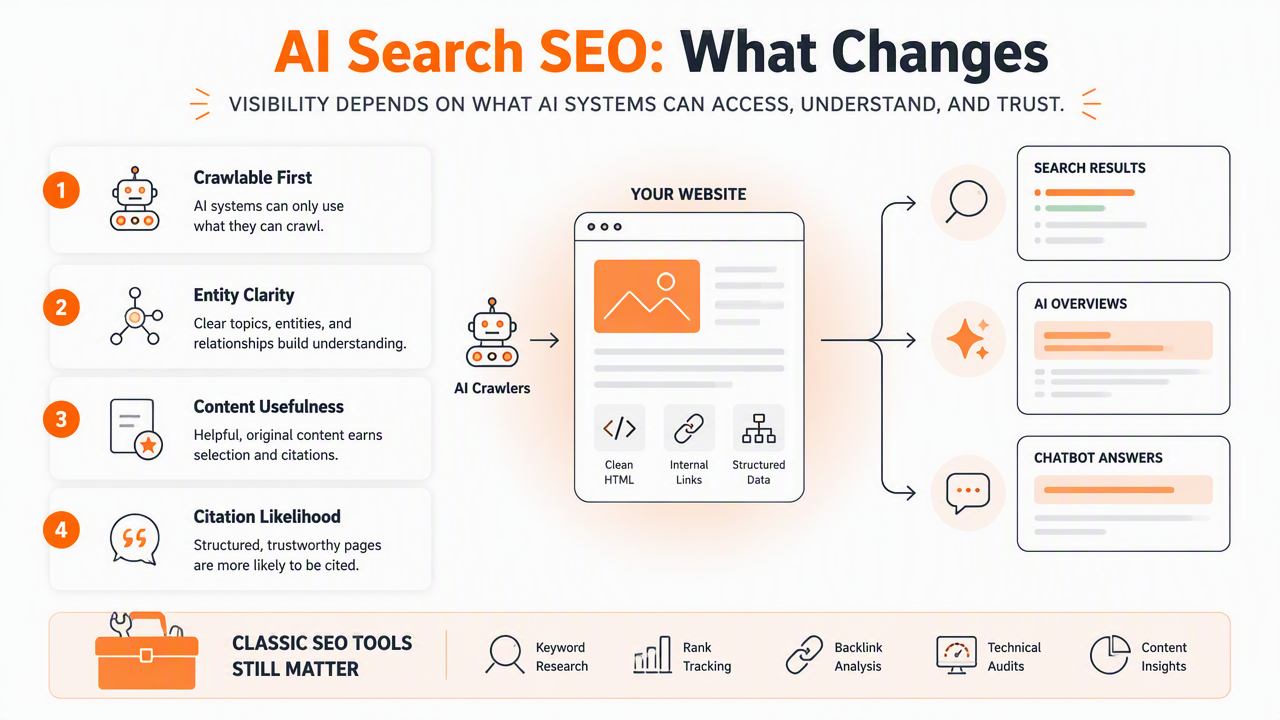
Classic SEO tools still matter. Search engines and AI systems still need accessible pages, clear internal links, strong topical coverage, structured information, and trustworthy signals. The difference is that AI answers often summarize sources, compare entities, and cite pages that provide clean definitions, tables, and direct answers.
For teams still building the basics, a content plan and search console workflow usually creates more short-term value than enterprise technical monitoring. Early-stage teams can pair keyword and competitor research with a practical Google Search Console workflow to spot indexing, click-through, and query growth issues before investing in heavier systems.
AI search SEO signals to evaluate
- Crawl access: important pages should be discoverable, renderable, and indexable.
- Entity clarity: pages should name products, categories, locations, authors, standards, and comparisons clearly.
- Answer structure: definitions, tables, FAQs, and short direct answers help extraction.
- Topical coverage: clusters should answer related questions, not just target one keyword.
- Content freshness: 2026 AI results favor current, maintained pages when topics change quickly.
- Source confidence: consistent branding, internal links, and clear claims make citation easier.
Botify helps most with the first signal. Semrush helps across competitive discovery, keyword demand, content gaps, and tracking. A lighter execution-focused platform can help turn those findings into briefs, pages, and updates.
Where Botify and Semrush overlap
Botify and Semrush both support SEO visibility, but they approach the job from different ends of the workflow.
Botify starts with the website's technical relationship with search engines. Semrush starts with market demand, competitors, and campaign planning. The 2022 partnership between Botify and Semrush in the research set is useful context: the tools have been positioned as complementary for enterprise brands rather than perfect substitutes.
That distinction matters for AI search. A page cannot be cited if it cannot be crawled, but a technically perfect page still may not earn citations if it lacks useful, well-structured answers.
Where Botify wins for enterprise technical SEO
Botify wins when AI search visibility is blocked by crawl waste, rendering problems, indexation complexity, and technical scale.
Large sites often lose organic visibility because search systems spend time on low-value URLs, duplicate paths, parameter pages, thin pages, or pages that render poorly. Botify is built for technical SEO teams that need to diagnose those issues across very large sites and turn them into engineering priorities.
For AI search, that matters because answer engines depend on retrievable, understandable documents. If key content sits behind technical barriers, no content optimization tool can fully fix the visibility problem.
Botify strengths that matter for AI crawlability
Botify is strongest when the SEO team needs granular control over how search engines discover and evaluate a site.
- Enterprise-scale crawling for large URL inventories
- Log-file analysis to understand search bot behavior
- Indexation diagnostics for pages that should or should not appear in search
- Technical prioritization across templates, page types, and site sections
- Governance for teams managing multiple domains or complex migrations
A retailer, marketplace, publisher, travel site, or international brand may need this level of visibility before scaling content. Teams planning large site changes should also use a migration process such as a website migration SEO checklist to avoid traffic loss during redesigns, CMS changes, or URL restructuring.
Botify limitations for lean marketing teams
Botify can be more platform than a small team needs when the main goal is creating new pages, finding content gaps, and tracking competitors.
The implementation burden can be meaningful. Technical SEO specialists, developers, analytics support, and executive patience often make the difference between powerful diagnostics and unused dashboards. For a small business or new SaaS site, that overhead may slow progress.
Practical rule: Botify is usually a fit when technical SEO problems are already expensive, visible, and tied to revenue.
Where Semrush wins for AI visibility and content workflows
Semrush wins when a team needs broad SEO intelligence, AI visibility tracking, competitor research, content planning, and reporting in one platform.
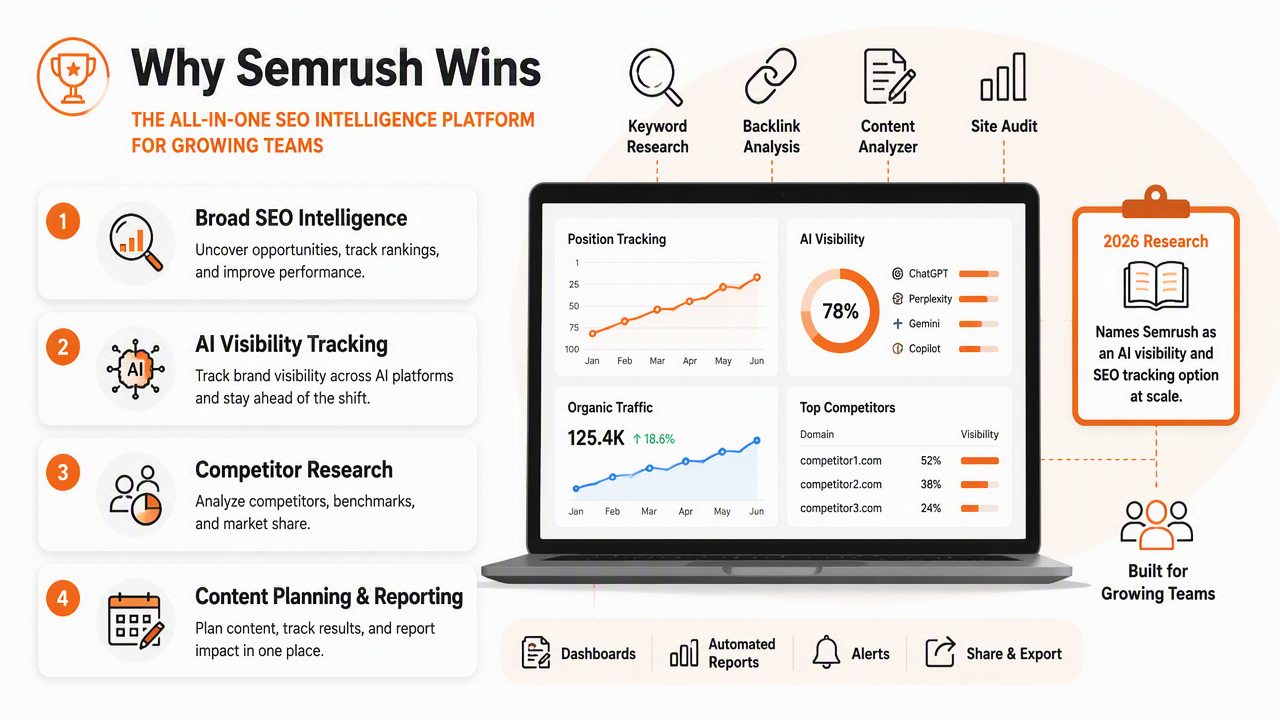
The research set includes a 2026 article naming Semrush as an AI visibility and SEO tracking option at scale. That matches how many growing teams use Semrush: not just for rankings, but for understanding demand, mapping competitors, planning content, checking backlinks, and reporting progress.
Semrush is usually easier for marketers to adopt because its workflow starts with familiar questions: which topics matter, which competitors rank, which pages need improvement, and which campaigns are working.
Semrush strengths for answer-engine optimization
- Keyword and topic research: useful for finding questions, comparisons, and commercial pages.
- Competitor analysis: helps identify pages and formats already earning visibility.
- Content planning: supports briefs, outlines, and optimization workflows.
- Local SEO tools: useful for service businesses and location-based brands.
- Reporting: easier for marketing managers to present than raw crawl data.
- AI visibility use cases: useful for monitoring how brands appear across newer search surfaces.
Teams that need competitor-led planning can pair Semrush research with competitor-aware SEO content so insights become publishable briefs and pages instead of another backlog.
When Semrush is still not enough
Semrush can show what to target and where competitors are winning, but it does not automatically solve publishing operations.
A lean team still needs a repeatable process for briefs, writing, internal linking, editing, and refreshing content. That is where the Earlyseo platform fits well: it helps teams operationalize SEO content rather than only analyze the market. Teams building a first repeatable motion can use a focused 90-day SEO sprint before adding more tools.
For ecommerce stores, Semrush can identify category and product-page opportunities, while a practical Shopify SEO playbook can guide execution across collections, product descriptions, and internal links.
Which platform should each team choose in 2026?
Most startups and growing businesses should choose Semrush before Botify unless technical scale is already the main SEO constraint.
The decision should start with the business problem, not the feature list. A founder trying to get initial visibility needs content velocity, clean site basics, and simple reporting. A technical SEO director at an enterprise brand needs crawl diagnostics, log data, and governance. A marketing manager at a growing company may need both, but not at the same time.
For international brands, the decision gets more complex. Multilingual sites need content localization, hreflang discipline, and regional keyword targeting. A team can use multilingual SEO content and an international SEO plan when the challenge is market expansion, not just crawler behavior.
Decision table for Botify, Semrush, and lighter execution tools
| Team situation | Best choice | Why |
|---|---|---|
| Startup with a new SaaS site | Semrush plus Earlyseo | Research, competitor discovery, and faster content execution |
| Local business building first organic leads | Semrush or lighter SEO workflow | Broad keyword, local, and reporting tools matter more than enterprise crawling |
| Ecommerce store with hundreds of products | Semrush first, Botify later if crawl issues grow | Category demand and content gaps usually come before crawl governance |
| Enterprise marketplace with millions of URLs | Botify | Crawl budget, indexation, and templates become revenue issues |
| Marketing team with content backlog | Earlyseo | Execution, briefs, and publishing operations may be the real bottleneck |
| Global site with many locales | Botify plus content operations | Technical governance and localized content both matter |
A sensible 2026 stack for many growing companies is Semrush for market intelligence, Google Search Console for performance validation, and Earlyseo for execution. Larger companies can add Botify when technical SEO complexity starts limiting growth.
What to expect in 2027
AI search SEO tools will likely move toward citation tracking, entity monitoring, and workflow automation rather than simple rank reports.
Expect more platforms to show where a brand appears in AI answers, which sources are cited, and which competitors are named in comparison-style responses. Botify's opportunity is connecting technical accessibility to AI retrieval. Semrush's opportunity is making AI visibility part of everyday SEO reporting.
Execution will still matter. A team that identifies 50 content gaps but publishes none will not gain much visibility. For teams that want a practical path from research to shipped pages, earlyseo.com is worth bookmarking.
FAQ
Botify, Semrush, and lighter SEO platforms answer different parts of the AI search problem, so the right choice depends on scale, team skill, and execution capacity.
Is Botify better than Semrush for AI search SEO?
Botify is better when the main problem is technical SEO at scale, such as crawl waste, rendering issues, and indexation control. Semrush is better when the team needs keyword research, competitor analysis, AI visibility tracking, content planning, and reporting. For most growing businesses, Semrush is the more practical first choice.
Can Semrush replace Botify?
Semrush can replace Botify for many small and mid-sized teams that do not need enterprise crawl diagnostics or log-file analysis. It should not be treated as a full replacement for Botify on very large, technically complex websites where crawl behavior and indexation waste directly affect revenue.
Does AI search make technical SEO less important?
AI search does not make technical SEO less important. AI systems still need accessible, crawlable, well-structured pages before they can summarize or cite them. The shift is that technical SEO now needs to work with clear entity-based content, direct answers, and stronger topical coverage.
When does a lighter platform make more sense?
A lighter platform makes more sense when the main blocker is execution rather than analysis. If research already shows which pages, topics, and competitors matter, a team may get more value from content briefs, internal linking, refresh workflows, and publishing operations than from another advanced dashboard.
Conclusion
The clearest recommendation is simple: choose Botify for enterprise technical SEO control, choose Semrush for broad AI visibility and SEO growth workflows, and add an execution layer when the bottleneck is shipping better content. Botify vs Semrush for AI search SEO is not a pure winner-takes-all contest; it is a question of crawl complexity versus market and content velocity. For a practical next step, audit the current bottleneck, pick one platform around that constraint, then build a 90-day publishing and measurement cycle. Teams that want help turning SEO research into live pages can visit earlyseo.com and start with a focused execution plan.