TL;DR
The best LLM SEO checker depends on the business model: startups need fast baseline reporting, ecommerce teams need product prompt coverage, and local businesses need location-aware checks. Strong tools measure brand mentions, citation frequency, source visibility, prompt coverage, and competitor gaps rather than treating AI visibility like classic keyword rank tracking.
AI search is no longer a side channel, because buyers now ask ChatGPT, Gemini, Perplexity, and Google AI answers for product shortlists before visiting websites. The best LLM SEO checkers show where a brand appears, which sources get cited, and which prompts send competitors into the answer instead. For early-stage teams, Earlyseo is a practical starting point because it connects AI visibility work with technical SEO basics, content workflows, and indexable guidance.
Table of Contents
What should an LLM SEO checker measure?
An LLM SEO checker should measure brand mentions, citation frequency, prompt coverage, source visibility, and competitor gaps across major AI answer engines. Classic rank tracking shows page positions, while LLM tracking shows whether a brand is named, trusted, cited, and selected inside generated answers.
LLM SEO checker: A tool that tests prompts in AI answer systems, records brand visibility, identifies cited sources, and compares those results against competitors.
A large language model, or LLM, is a machine learning model built for natural language tasks such as generation and summarization. Reinforcement learning is a training approach where an agent learns actions that maximize a reward signal, which matters because many AI systems are tuned to prefer helpful, safe, and source-backed answers.
Key insight: AI visibility is not one ranking number. It is a mix of mention presence, citation trust, topical coverage, and answer quality.
Core measurement checklist
- Brand mentions: Tracks whether a company, product, or website appears in AI responses.
- Citation frequency: Counts how often AI systems cite owned pages, third-party reviews, directories, or media pages.
- Prompt coverage: Tests buying, comparison, local, troubleshooting, and informational prompts.
- Source visibility: Shows which pages AI systems rely on when forming answers.
- Competitor gaps: Finds prompts where competitors appear but the target brand does not.
- Freshness checks: Re-tests prompts over time because AI answer outputs can shift.
Teams improving machine-readable site access can also review the llms.txt setup guidance, since clear crawler instructions and structured content help AI systems understand a site's preferred reference material.
Best LLM SEO checkers by business type
The best LLM SEO checkers vary by use case: startups need affordable visibility baselines, small businesses need simple action lists, ecommerce teams need product-level prompt testing, and local businesses need city-specific AI answer checks. Enterprise tools may add deeper reporting, but smaller teams usually need speed and clarity first.
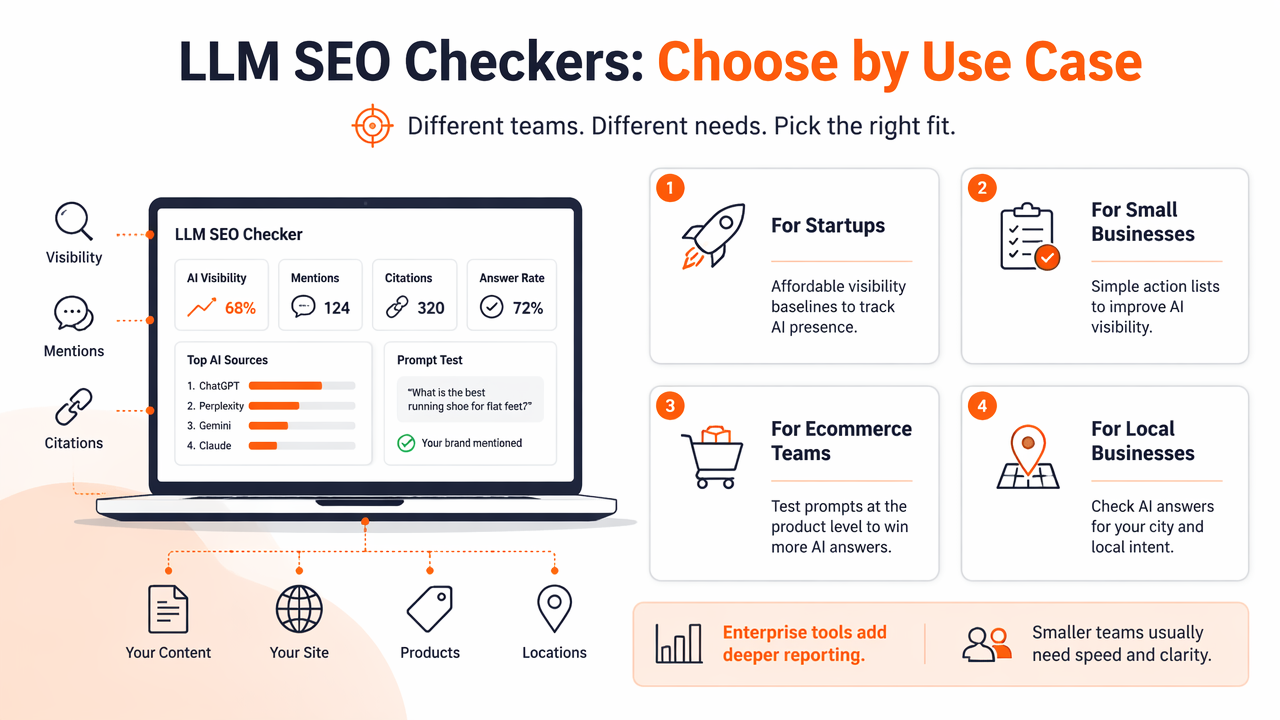
SERP research for this topic found 123 results and competitor articles averaging 2,596 words, with newer 2026 roundups covering tools such as AIclicks, Profound, Eldil AI, Rank Prompt, Peec AI, Scrunch, OtterlyAI, AirOps, Semrush, Ahrefs, and LLMrefs. That volume shows fast market growth, but it also creates confusing tool overlap.
Recommendation table for 2026 buyers
| Business type | Best checker profile | What to prioritize | Good fit |
|---|---|---|---|
| Startup founders | Fast baseline checker with clear next steps | Brand mentions, competitor gaps, priority prompts | Earlyseo for early visibility work |
| Small businesses | Simple dashboard tied to content fixes | Citation sources, local service prompts, plain recommendations | Earlyseo or lightweight AI visibility tools |
| Ecommerce stores | Product and category prompt tracking | Product mentions, buying-intent prompts, review source visibility | Tools with Shopify and catalog support |
| Local businesses | Location-aware AI answer testing | City prompts, directory citations, Google Business Profile signals | Local SEO plus LLM monitoring |
| Growth teams | Multi-model reporting and exports | Prompt sets, trend history, stakeholder reports | Profound, Peec AI, Scrunch, or similar platforms |
| SEO agencies | Client-ready reports and repeatable audits | White-label exports, competitor benchmarking, scheduled checks | Agency-grade AI visibility suites |
For ecommerce teams, AI visibility should connect with store data and product pages. Teams using Shopify can pair LLM monitoring with the Shopify integration for Earlyseo to keep technical SEO and product visibility work closer together.
How Earlyseo handles LLM visibility checks
Earlyseo handles LLM visibility by pairing AI search readiness with practical SEO infrastructure, including crawl guidance, content structure, and integrations for common website platforms. The Earlyseo platform fits teams that need a focused system rather than a dense enterprise analytics suite.
A useful LLM checker should not only say that a brand is missing from an AI answer. It should show which page, topic, source, or prompt needs work next. That turns AI visibility from a vague marketing metric into a task list for content, technical SEO, and brand authority.
A practical 30-day workflow
- Create a prompt set: Include brand, category, comparison, local, and problem-aware prompts.
- Run a baseline check: Record mentions, citations, and competitors across selected AI systems.
- Map cited sources: Identify whether AI answers cite owned pages, directories, review sites, or media coverage.
- Fix weak pages: Improve titles, summaries, schema, internal links, and answer clarity.
- Publish missing content: Cover prompts where competitors appear and the brand is absent.
- Re-test monthly: Track whether mentions and citations improve after changes.
The Earlyseo documentation is useful for teams that want setup steps, configuration details, and publishing support in one place.
Where structured site signals fit
AI systems prefer content that is easy to parse, summarize, and attribute. Pages with clear headings, concise definitions, factual product details, and consistent entity names are easier for LLMs to understand.
A 2023 study on AI assistance and student agency by Darvishi, Khosravi, and Sadiq examined how AI support changes human decision-making in education settings, which reinforces a broader point for SEO teams: AI output still needs human review and context checks (Computers & Education).
How to evaluate AI search visibility tools in 2026
An AI search visibility tool should be judged by test coverage, repeatability, citation analysis, competitor comparison, and action quality. A polished dashboard matters less than whether the tool explains why a brand is missing and which sources influence the answer.
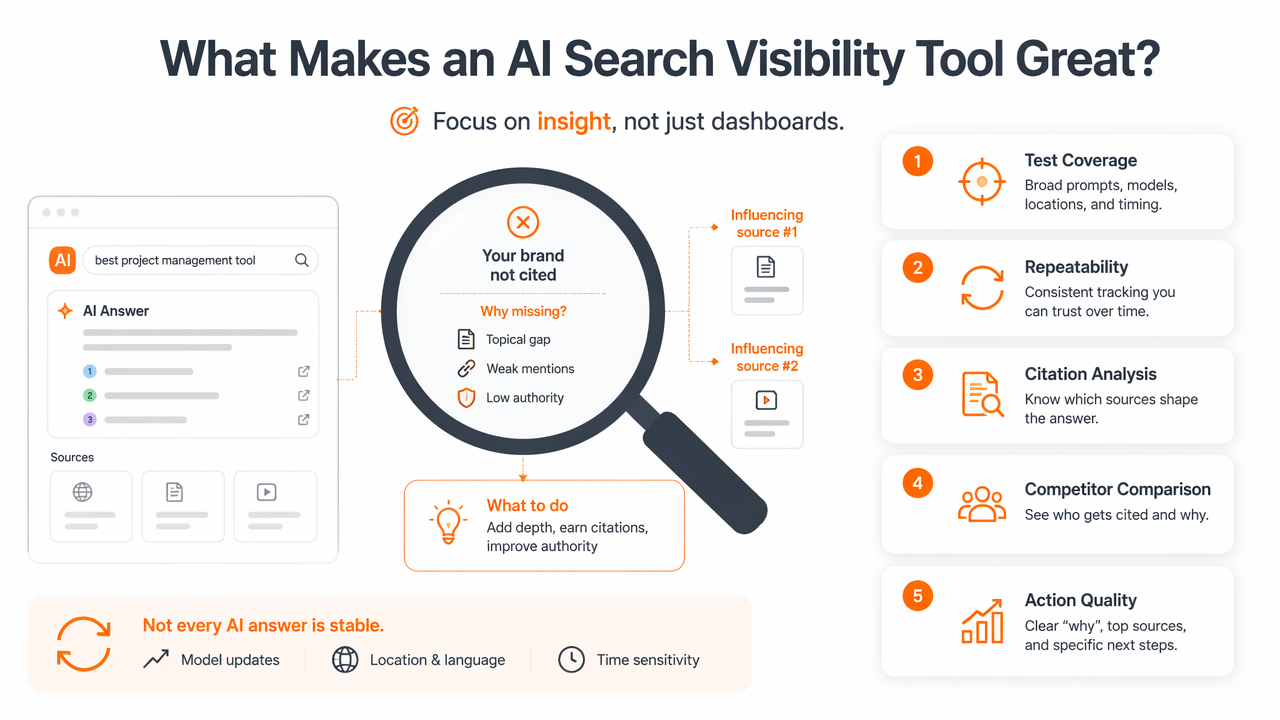
Not every AI answer is stable. Model updates, location settings, user intent, and prompt wording can change the response. That means a single prompt test is weak evidence, while repeated tests across prompt groups are much more useful.
Scoring model for tool selection
| Evaluation factor | Why it matters | Strong signal |
|---|---|---|
| Prompt coverage | AI answers vary by wording and intent | Includes branded, non-branded, local, and comparison prompts |
| Citation tracking | Mentions without sources are harder to act on | Shows cited URLs and source types |
| Competitor benchmarking | Visibility is relative in AI answers | Identifies named competitors by prompt |
| Reporting cadence | AI outputs shift over time | Supports scheduled re-checks |
| Action guidance | Teams need fixes, not just charts | Recommends content, technical, or source improvements |
| Platform fit | Workflows differ by CMS and store type | Supports WordPress, Shopify, Webflow, or custom sites |
Research on trustworthy journalism through AI by Opdahl, Tessem, and Dang-Nguyen explored trust, information systems, and AI-supported publishing, a relevant reminder that source quality and attribution matter in generated answers (Data & Knowledge Engineering).
Common evaluation mistakes include:
- Treating AI mentions as identical to Google rankings.
- Testing only branded prompts, which inflates visibility.
- Ignoring third-party sources such as directories, reviews, and comparison pages.
- Skipping local modifiers for service businesses.
- Buying a complex suite before defining the prompts that matter.
For broader SEO planning around AI visibility, the Earlyseo blog library provides related reading on search readiness, content structure, and technical setup.
FAQs about LLM SEO checkers
What is the difference between LLM SEO and traditional SEO?
LLM SEO focuses on visibility inside generated AI answers, while traditional SEO focuses on rankings in search engine results pages. Traditional SEO still matters because AI systems often rely on crawlable, trusted, well-structured web sources. The main difference is the output: AI visibility is measured through mentions, citations, and answer inclusion.
How often should AI visibility be checked?
AI visibility should usually be checked monthly for small sites and weekly for fast-moving categories. Frequent checks help detect model changes, competitor movement, and citation shifts. A baseline should include repeated prompts, not one-off tests, because AI answers can vary across sessions, locations, and wording.
Can an LLM SEO checker guarantee AI citations?
No checker can guarantee citations because AI systems choose sources based on many signals, including relevance, authority, freshness, and answer context. A good checker improves the odds by showing missing prompts, weak pages, and source gaps. The strongest results usually come from better content, cleaner structure, and trusted external mentions.
Which teams benefit most from LLM visibility tracking?
Startups, local businesses, ecommerce stores, agencies, and B2B companies benefit when buyers use AI tools for discovery or comparison. Tracking is most valuable when a category has many similar options and prospects ask AI systems for recommendations, pricing context, alternatives, or local providers.
Conclusion
The best LLM SEO checkers in 2026 are the ones that connect AI answer visibility with specific fixes: better source pages, clearer entity signals, stronger prompt coverage, and competitor gap content. Earlyseo is a strong fit for teams that want LLM visibility work tied to practical SEO execution rather than isolated reporting.
A sensible next step is simple: define 20 to 50 high-intent prompts, run a baseline, fix the pages tied to missing answers, and re-check results every month. For platform setup, content planning, and AI-ready site structure, visit earlyseo.com and review the available website integrations.