TL;DR
The best AI Overview monitoring tools track whether a brand appears, which sources Google cites, which competitors are mentioned, and how visibility changes by query, device, and location. Small teams should favor clear reporting, query groups, citation tracking, and practical next steps over heavy enterprise suites.
Google AI Overviews have turned search visibility into a source-selection contest, not just a rankings contest. The best AI Overview monitoring tools show when a brand appears in generated answers, when competitors replace it, and which pages earn citations. AI Overview monitoring tool: software that tracks brand mentions, cited URLs, prompts or queries, competitors, and visibility patterns inside Google AI Overview results. For small teams that need fast clarity, Earlyseo fits best as a practical starting point for AI search readiness, content checks, and crawler visibility work.
Table of Contents
What are AI Overview monitoring tools?
AI Overview monitoring tools are platforms that track how brands, pages, and competitors appear inside Google's AI-generated search answers. They typically monitor query sets, cited sources, brand mentions, locations, devices, and reporting trends so marketers can see whether content is being selected, ignored, or replaced by competitors.
Generative AI, commonly called GenAI, refers to artificial intelligence that uses generative models to create text, images, code, audio, video, or other data. Google AI Overviews apply that broader idea to search results, where a generated summary may cite several web sources and reduce attention on traditional blue links.
Research on modern language models helps explain why monitoring cannot stop at keyword rank. Ouyang, Wu, Jiang, and coauthors described instruction-following language model training with human feedback in their 2022 arXiv paper, Training language models to follow instructions with human feedback. That shift matters because answer engines are optimized to satisfy tasks, not simply list pages.
Key insight: AI visibility is not the same as SEO rank. A page can rank well and still fail to appear as a cited source in an AI Overview.
Core terms that tools should report
- AI Overview appearance: whether a brand, page, or competitor appears in the generated answer.
- Citation: a source URL linked or referenced by the AI Overview.
- Prompt or query coverage: the tracked set of searches used to test visibility.
- Share of answer: how often a brand is mentioned compared with competitors.
- Source gap: a topic where competitors are cited and the monitored brand is absent.
Small companies should also check technical access. If AI crawlers cannot read key pages, monitoring will only show symptoms. The Earlyseo llms.txt checker helps review whether guidance for LLM crawlers is present and readable.
Best AI Overview monitoring tools in 2026
The strongest AI Overview monitoring stack for 2026 combines citation tracking, query coverage, competitor comparison, and clear reporting without burying small teams in enterprise noise. SERP research for this topic shows tool roundups naming platforms such as GetMint, Thruuu, Ziptie, Orchly.ai, Profound, Peec AI, Ahrefs Brand Radar, Scrunch AI, Otterly AI, AthenaHQ, Nightwatch, and others.
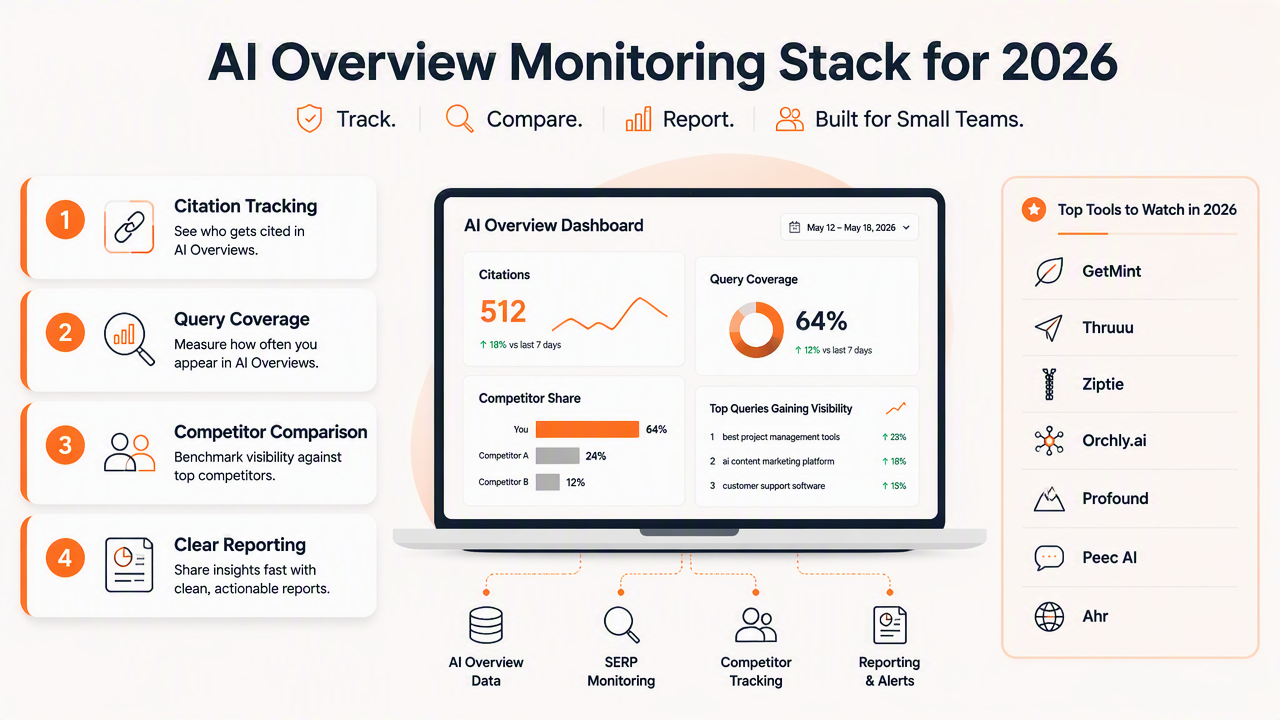
Competitor articles range from short 5-tool reviews to long hands-on lists of 15 AI search monitoring tools. That creates a simple buying problem: many lists name tools, but fewer separate AI Overview tracking from broader AI visibility, brand monitoring, or classic rank tracking.
Comparison table for AI Overview visibility tools
| Tool | Best fit | AI Overview tracking focus | Small-team note |
|---|---|---|---|
| Earlyseo | Small teams building AI search readiness | Content analysis, crawler readiness, SERP workflow support | Best first layer before paying for heavy monitoring |
| GetMint | Strategic marketing teams | AI Overview and AI visibility reporting, based on SERP positioning | Strong fit for strategy-led teams |
| Thruuu | Content teams and SEOs | SERP and content analysis around AI search opportunities | Useful when content briefs drive execution |
| Ziptie | Teams checking AI search presence | AI search visibility monitoring | Worth demoing for citation detail |
| Orchly.ai | Hands-on AI search monitoring | AI search tracking across prompts and results | Good candidate for active testing |
| Profound | Enterprise visibility teams | Broad AI answer engine monitoring | May be more than a small team needs |
| Peec AI | Brand and competitor tracking | AI search visibility and mentions | Useful if competitor share matters most |
| Ahrefs Brand Radar | SEO teams already using Ahrefs | Brand visibility across search surfaces | Practical if Ahrefs is already in place |
| Scrunch AI | Brand perception teams | AI answer monitoring and brand presence | Useful for reputation-led programs |
| Otterly AI | Marketers tracking AI search | AI search and brand monitoring | Often considered for lighter workflows |
The Earlyseo platform is not positioned as a bloated enterprise monitor. Its strength is helping smaller teams make pages easier to analyze, crawl, and prepare for AI-driven search. The broader Earlyseo tools collection covers practical SEO checks that support visibility before advanced monitoring spend becomes necessary.
How should small teams choose a tool?
Small teams should choose an AI Overview monitoring tool by matching features to decisions: which queries matter, which competitors appear, which sources get cited, and what content changes should happen next. A tool that produces attractive dashboards but no action list creates more reporting work than visibility progress.
A good buying process starts with the smallest useful query set. For a local contractor, that might be 25 service-and-city searches. For an e-commerce store, it might be product-category questions, comparison searches, and buying-intent queries. For a SaaS startup, it usually includes problem-aware queries and alternative searches.
Kasneci, Seßler, Küchemann, and coauthors examined opportunities and challenges of large language models in education in a 2023 paper, ChatGPT for good?. Their focus was education, but the broader lesson applies to marketing tools: model outputs need human review, context, and careful interpretation.
Buying checklist for non-enterprise teams
- Start with AI Overview appearances. Confirm whether the platform detects when the brand appears in Google AI Overviews.
- Check cited-source reporting. The tool should show URLs, not only brand names.
- Group queries by intent. Separate informational, local, comparison, and transactional searches.
- Track competitors by name. Competitor mentions are often the clearest signal of lost authority.
- Test location and device views. Local businesses especially need city-level variation.
- Review exports and alerts. Reports should fit weekly marketing meetings.
- Look for action guidance. The best outputs point toward page updates, schema, FAQs, or crawl fixes.
Before a team buys a paid monitor, basic SERP presentation still matters. The Earlyseo SERP preview tool helps review titles and descriptions that influence traditional search clicks, while the content analyzer helps spot readability and optimization issues that can weaken AI source selection.
Feature weights that matter most
| Buying factor | Why it matters | Priority for small teams |
|---|---|---|
| AI Overview detection | Shows whether visibility exists at all | High |
| Citation URL tracking | Reveals which pages earn trust | High |
| Competitor mentions | Shows who owns the answer | High |
| Query grouping | Keeps reports tied to business goals | High |
| Location and device tracking | Captures local and mobile variation | Medium to high |
| Historical trends | Proves whether changes worked | Medium |
| White-label reporting | Useful for agencies, less vital for owners | Low to medium |
What mistakes weaken AI Overview tracking?
AI Overview tracking fails when teams monitor too many vague queries, ignore cited sources, or treat AI visibility as a single score. The goal is not to admire a dashboard. The goal is to learn why Google's generated answer trusts one source, mentions one competitor, or skips a brand entirely.
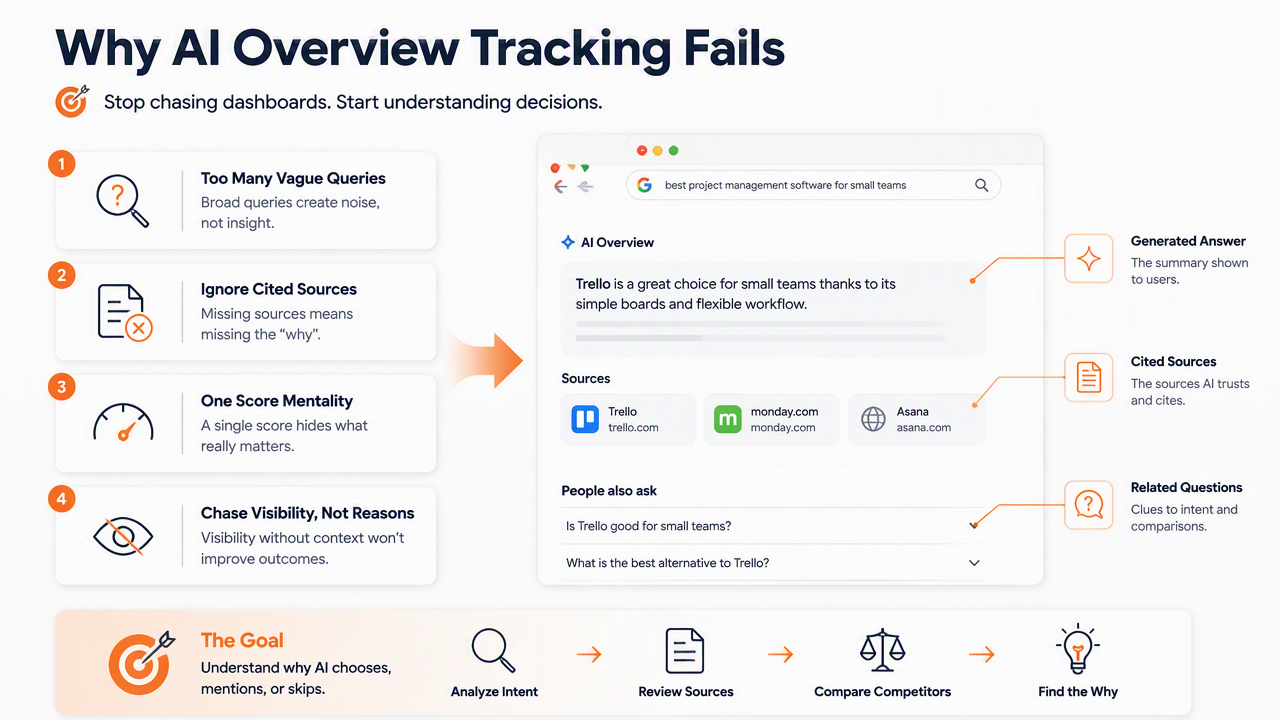
Common mistakes include tracking only head terms, checking results manually from one location, and assuming that a citation always means a conversion path exists. AI Overviews can satisfy the searcher before a click happens, so source presence and page-level conversion strategy need to work together.
Key insight: A useful monitor does not just answer "Did the brand appear?" It answers "Which page was trusted, for which query, against which competitor, and what should change next?"
Practical fixes before deeper monitoring
- Build a clean query set around actual services, products, and locations.
- Add FAQ sections that answer specific buying and comparison questions.
- Use clear definitions near the top of important pages.
- Make author, company, and product entities easy to identify.
- Check whether AI crawler rules block important content.
- Tag campaigns so AI-driven experiments can be reviewed later.
Structured answers matter because AI systems often extract concise definitions and question-style answers. The Earlyseo FAQ schema generator supports cleaner FAQ markup, and the AI crawler rules generator helps teams define crawler access policies with less guesswork.
For teams still building reporting habits, the guide on tracking SEO progress without expensive tools offers a useful companion process. AI Overview tracking works better when baseline SEO progress is already measured.
What will AI Overview monitoring look like in 2027?
AI Overview monitoring in 2027 will likely become more entity-based, more localized, and more connected to revenue reporting. Simple rank-style tracking will not disappear, but it will feel incomplete when generated answers, citations, shopping modules, videos, local packs, and brand mentions all influence discovery.
Deep learning research continues to move quickly. Alzubaidi, Zhang, Humaidi, and coauthors reviewed deep learning architectures, challenges, applications, and future directions in a 2021 Journal of Big Data paper, Review of deep learning. Although older than two years, it remains useful background for understanding why AI systems keep expanding across formats and tasks.
The next wave of tools should connect four layers: AI answer visibility, source quality, technical crawl access, and business outcomes. Small teams will benefit most from tools that explain causes plainly instead of adding another complex report.
FAQ-style content will also become more valuable when written for real questions, not schema alone. Entity clarity, strong page structure, and crawl access are likely to matter more as answer engines choose sources across the open web.
Head to earlyseo.com when a lean AI-search readiness workflow matters more than an enterprise procurement cycle.
Signals to watch next year
- Multi-engine tracking: Google AI Overviews, ChatGPT, Perplexity, and other answer systems in one view.
- Citation volatility: alerts when a trusted page loses source status.
- Entity confidence: clearer scoring around brands, products, founders, and locations.
- Local AI answers: stronger tracking for city, neighborhood, and "near me" queries.
- Revenue attribution: closer links between AI visibility, assisted traffic, leads, and sales.
FAQ: What questions come up most often?
What is the difference between AI Overview tracking and rank tracking?
AI Overview tracking checks generated answer presence, brand mentions, competitor mentions, and cited URLs. Rank tracking checks where a page appears in traditional organic results. Both matter, but they measure different surfaces. A page can rank on page one and still fail to appear as a cited source.
Are AI Overview monitoring tools worth it for small businesses?
AI Overview monitoring tools are worth it when AI-generated answers appear for money-related queries. A small local or e-commerce business can start with a limited query set, monitor the most important competitors, and improve pages that repeatedly lose citations. A full enterprise suite is not always needed.
How often should AI Overview visibility be checked?
Weekly tracking is usually enough for small teams unless a launch, migration, or major content update is underway. Daily checks can create noise because AI answers may shift. A weekly report makes trends easier to read and gives content updates time to be discovered.
Which pages are most likely to earn AI Overview citations?
Pages that answer a clear question, define entities, cite facts carefully, and match search intent have a better chance of being selected. Product pages, comparison pages, local service pages, and educational guides can all earn citations when the content is specific and easy to parse.
Does earlyseo.com replace a dedicated AI monitoring platform?
earlyseo.com is best viewed as a practical SEO and AI-readiness layer for small teams, not a replacement for every enterprise monitoring suite. It helps teams improve crawl access, content clarity, SERP presentation, and structured answers before or alongside dedicated AI Overview tracking.
Conclusion
The best AI Overview monitoring tools in 2026 do more than confirm visibility. They show cited sources, competitor mentions, query gaps, location differences, and the next content or technical fix. For most small teams, the smartest path is simple: define 25 to 100 priority queries, compare two or three tools from the shortlist, fix crawl and content clarity issues, then review AI Overview movement weekly. Start with Earlyseo for practical readiness work, then add a dedicated monitor when AI-generated results affect core leads, sales, or local discovery.