TL;DR
AI SEO automation now works best when it combines assisted publishing, entity optimization, answer-engine tracking, and scheduled refreshes. Lean teams should automate repetitive SEO operations while keeping human review on claims, strategy, and brand judgment.
Search is becoming less predictable, and AI SEO automation trends now matter because ranking is no longer limited to blue links. AI Overviews, AI Mode-style answers, chat search, and entity-based retrieval have changed how brands earn visibility. AI SEO automation: the use of artificial intelligence to plan, produce, optimize, monitor, and refresh search content at scale while humans supervise strategy, accuracy, and quality. For lean teams, Earlyseo fits this shift by turning repeatable SEO work into managed workflows rather than one-off tasks.
Table of Contents
What are AI SEO automation trends in 2026?
AI SEO automation trends in 2026 center on assisted publishing, answer-engine visibility, entity-based optimization, automated refreshes, and stronger quality controls. The winning pattern is not fully autonomous content; it is a controlled system where AI handles scale, signals, and drafts while humans guide positioning, proof, and business relevance.
Digital marketing, as defined in the research data from Wikipedia, uses digital technologies such as computers, mobile phones, and online media platforms to promote products and services. SEO automation now sits inside that broader digital marketing function, but it has become more technical because AI search systems summarize, compare, and cite sources directly.
Key insight: AI search rewards content that is easy to extract, verify, compare, and cite, not just content that contains the right keywords.
The strongest automation programs now connect five jobs that were once handled separately:
- Planning: clustering topics, mapping intent, and finding gaps.
- Production: creating briefs, outlines, drafts, metadata, and schema suggestions.
- Optimization: improving entities, internal links, headings, and answer blocks.
- Monitoring: tracking rankings, search features, AI summaries, and competitors.
- Refreshing: updating stale claims, pages, links, and product details.
A 2023 review by Gawlikowski and coauthors on uncertainty in deep neural networks is a useful reminder for SEO teams: AI systems can be powerful while still producing uncertain outputs. That matters when automation touches claims, recommendations, or technical SEO decisions.
How is AI-assisted publishing changing SEO workflows?
AI-assisted publishing is changing SEO workflows by compressing research, brief creation, drafting, internal linking, and refresh planning into shorter cycles. The main shift is from manual page-by-page execution to repeatable content operations where every article has a brief, citation plan, entity map, and review checklist before publication.
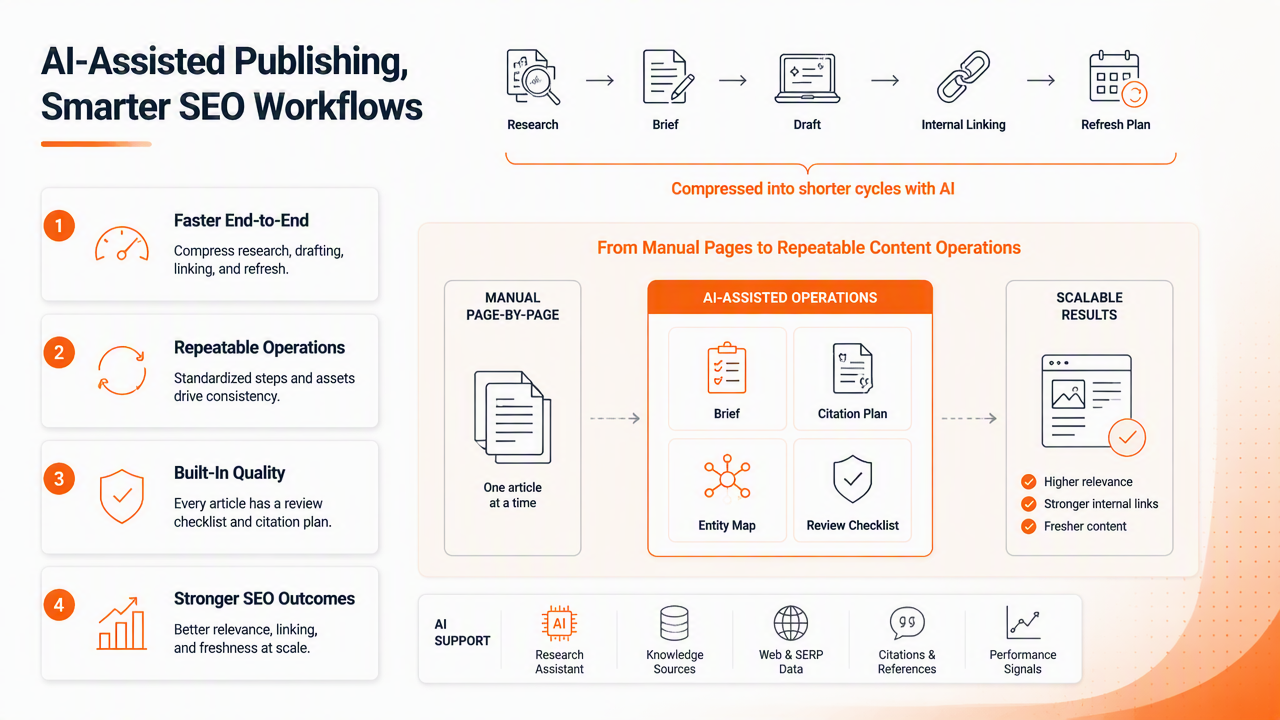
For new sites, this creates a practical advantage. A founder or small marketing team can build topic coverage faster without hiring a full editorial department. The risk is thin sameness, so automation should start with strategy, not with mass drafting.
Teams building from zero can pair automation with a focused publishing plan like a 90-day SEO sprint. That keeps output tied to priority pages, buyer intent, and measurable search demand.
Workflow comparison: manual SEO vs assisted SEO
| Workflow area | Manual SEO process | AI-assisted process | Human review needed |
|---|---|---|---|
| Topic research | Keyword lists and SERP checks | Clusters, gaps, and intent groups | Market fit and prioritization |
| Content briefs | Written from scratch | Generated from SERP, entities, and competitors | Angle, claims, and examples |
| Drafting | Slow first draft | Faster structured draft | Originality and accuracy |
| Internal links | Added after publishing | Suggested during planning | Relevance and anchor quality |
| Refreshes | Occasional audits | Scheduled update queues | Final edits and business context |
The Earlyseo platform is especially relevant where teams need SEO operations instead of isolated writing help. Its SEO operations workflows support planning, production, and updates as one process, which matches how automation is being used in 2026.
AI-assisted publishing also changes content roles. Writers spend less time building first drafts and more time verifying claims, adding examples, improving introductions, and clarifying decision sections. Editors become quality controllers, not just grammar reviewers.
Which automation workflows matter most for lean teams?
The most useful automation workflows for lean teams are competitor-aware planning, answer-engine formatting, entity optimization, multilingual scaling, and recurring content refreshes. These workflows save time because they remove repeated research and formatting work while keeping strategic choices visible to the business owner or marketing lead.
Not every automation task has equal value. The best starting point is work that happens often, follows rules, and has clear quality checks. Fully automated publishing without review looks efficient, but it often creates weak pages with little reason to be cited.
High-impact automation areas for 2026
| Trend | What gets automated | Why it matters | Best fit |
|---|---|---|---|
| Answer-engine visibility | Direct answers, FAQs, comparison tables | AI systems need extractable answers | SaaS, local, ecommerce |
| Entity optimization | Brands, products, standards, categories | Search systems connect topics through entities | B2B and expert content |
| Competitor-aware content | SERP gaps, headings, intent patterns | Reduces blind publishing | Growing sites |
| Automated refreshes | Dates, stats, links, examples, metadata | Keeps pages current | Blogs and product pages |
| Multilingual SEO | Localized briefs and page variants | Opens new search markets | International teams |
Competitor-aware automation deserves special attention. Instead of copying ranking pages, modern systems identify missing sections, weak explanations, and citation formats. Earlyseo offers competitor-aware SEO content for teams that need this analysis built into content planning.
Entity-based optimization is the second big workflow. Search and AI answer systems pay close attention to named things: companies, tools, places, standards, products, authors, and categories. A page about ecommerce SEO, for example, should clearly connect Shopify, product pages, category pages, structured data, inventory, and reviews.
For online stores, automation should support product-led search intent rather than publish generic blog posts. The Shopify SEO playbook is a useful next step for teams applying automated workflows to collections, product descriptions, and buying guides.
International growth adds another layer. Automated translation alone is not enough because search intent, examples, and terminology change by market. Teams planning global expansion should use multilingual workflows that localize search demand and page structure, such as multilingual SEO content.
How should teams control AI SEO quality and risk?
Teams should control AI SEO quality by requiring source checks, human approval, structured briefs, originality rules, and post-publication monitoring. Automation should speed up repeatable tasks, but claims, expertise, legal sensitivity, and brand positioning still need human judgment before a page goes live.
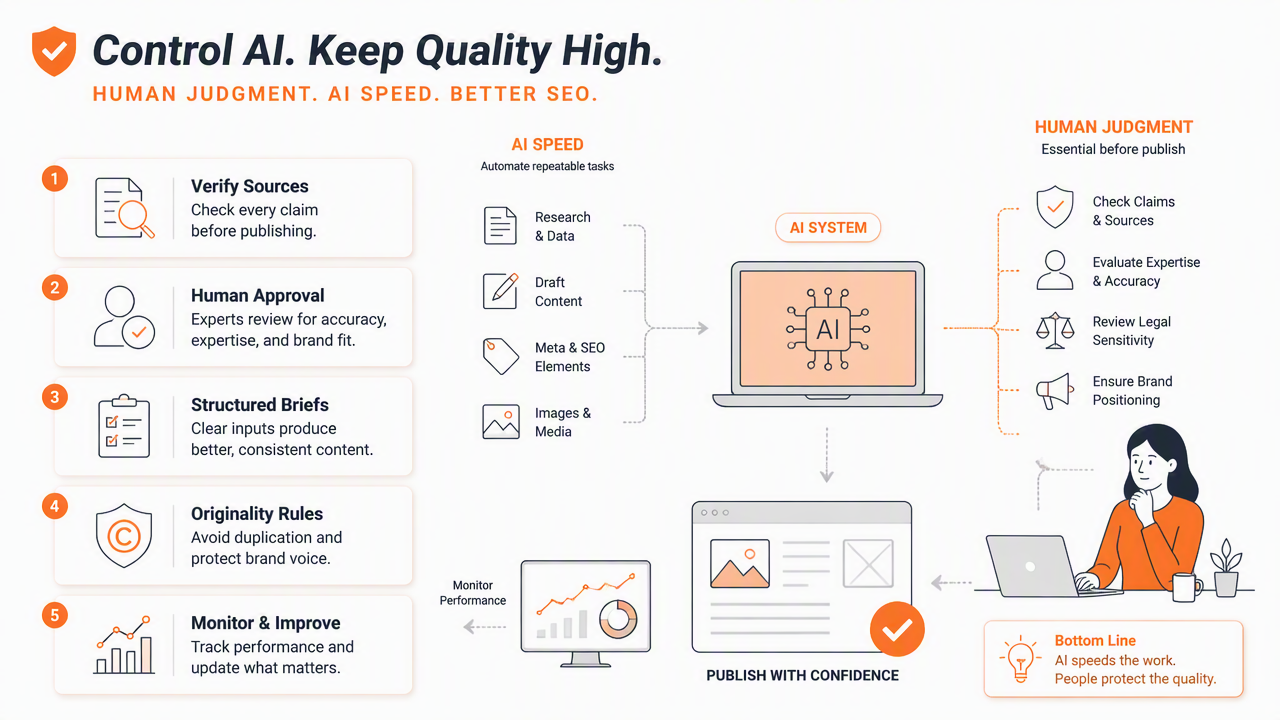
AI systems can generate confident language from uncertain signals. The 2023 review on uncertainty in deep neural networks helps explain why automated outputs need verification, especially when a model fills gaps without clear evidence. SEO teams should treat AI drafts as structured inputs, not final authority.
Research outside marketing shows the same pattern. A 2023 Nature article by Sadybekov and Katritch examined computational approaches in drug discovery, a field where AI can accelerate workflows but expert validation remains central. SEO is lower risk than healthcare or drug discovery, but the operating lesson still applies: automation works best with review gates.
Quality control checklist for automated SEO
- Verify every factual claim against an approved source or internal data.
- Check search intent before drafting, not after publication.
- Add entity coverage for brands, products, locations, and categories.
- Review internal links for relevance and natural anchor text.
- Scan for duplicate angles across similar pages.
- Refresh pages on a schedule when SERPs, products, or competitors change.
Several failure patterns show up when teams automate too aggressively:
- Publishing many near-identical pages with different keywords.
- Using statistics without dates or sources.
- Ignoring local details on local SEO pages.
- Treating AI visibility as separate from traditional organic search.
- Measuring output volume instead of qualified traffic, leads, or revenue.
The fix is a simple governance model. A content brief defines the page goal, audience, entities, sources, internal links, and conversion path. The draft follows that brief. The editor checks proof, usefulness, and differentiation. Performance data then decides whether the page needs expansion, consolidation, or a refresh.
What should happen next in 2027?
In 2027, AI SEO automation will likely move from content creation toward visibility operations across Google, AI Overviews, ChatGPT-style answers, commerce search, local results, and vertical search tools. Brands that structure content for extraction, attribution, and refresh cycles will have a better chance of being mentioned by answer engines.
The biggest change will be measurement. Rank tracking alone will feel incomplete because users may see a brand in an AI answer without clicking. Marketing teams will need to monitor mentions, citations, branded search lift, referral quality, and conversions from pages that support AI visibility.
Practical forecast: the next SEO advantage will come from maintaining accurate, entity-rich pages that machines can trust and humans still want to read.
A strong 2027 operating model should include:
- Answer-ready sections with short definitions, steps, and comparisons.
- Clear ownership for each topic cluster, product page, and local page.
- Refresh triggers based on ranking drops, SERP changes, and product updates.
- Citation hygiene using dated sources and clean outbound references.
- Business alignment so SEO pages map to leads, trials, bookings, or purchases.
Teams comparing tools should look past draft generation and ask whether a platform supports the full workflow: research, briefs, publishing, monitoring, and updates. For a practical place to review how that operating model can work, visit earlyseo.com.
Frequently asked questions
What is AI SEO automation?
AI SEO automation is the use of artificial intelligence to handle repeatable SEO tasks such as keyword clustering, content briefs, draft creation, metadata, internal link suggestions, SERP monitoring, and refresh planning. Human review remains needed for accuracy, strategy, compliance, examples, and final editorial judgment.
Can AI fully replace an SEO team?
AI can reduce manual SEO workload, but it should not fully replace strategy, editorial review, or business judgment. Search visibility depends on positioning, proof, technical health, product knowledge, and user intent. Automation handles scale best when a person still owns decisions and quality control.
How often should automated SEO content be refreshed?
Refresh frequency depends on topic volatility. Product pages, pricing pages, AI search topics, and competitive commercial pages often need more frequent review than evergreen educational pages. A practical approach is to set refresh triggers based on traffic drops, ranking changes, outdated claims, broken links, and new competitor coverage.
What is the safest first automation project for a small business?
The safest first project is usually content briefing and refresh tracking, not bulk publishing. Brief automation improves consistency without risking mass low-quality pages. Refresh tracking also protects existing traffic by flagging pages with outdated examples, weak internal links, stale metadata, or missing answer sections.
Conclusion
AI SEO automation trends point toward a practical middle path: automate the repeatable work, keep humans in charge of judgment, and build pages that both search engines and answer engines can cite. The next step is an audit of existing pages for missing definitions, weak entity coverage, outdated claims, and unclear internal links. Teams ready to turn that audit into a repeatable workflow can evaluate Earlyseo and head to earlyseo.com to plan a focused SEO operating system for 2026.