TL;DR
An AI search content audit finds pages that could earn citations in AI answers but need clearer structure, stronger proof, and better answer formats. The best process scores each page on definitions, tables, FAQs, schema, source quality, and answer completeness, then prioritizes updates that improve both AI visibility and human usefulness.
AI answers reward pages that make facts easy to extract, verify, and summarize. An AI search content audit checks whether existing pages can be understood by systems such as Google AI Overviews, ChatGPT, Gemini, and Perplexity, not just whether they rank in classic blue links. Earlyseo helps teams turn that audit into clearer briefs, stronger content updates, and search-ready pages without treating AI visibility as guesswork.
Table of Contents
What is an AI search content audit?
An AI search content audit is a structured review of webpages to see whether AI search systems can confidently cite, summarize, and trust them. It evaluates extractable answers, entity clarity, source support, structured data, comparison formats, FAQs, and topical completeness alongside traditional SEO signals such as indexing and performance.
AI search content audit: a page-level review that identifies content gaps preventing a webpage from being cited or summarized accurately by AI search engines and large language model answer systems.
A standard website audit evaluates visibility factors such as site structure, search performance, traffic patterns, and technical health. AI-focused auditing adds a new layer: whether a page provides short, direct answers that can be lifted into generated responses without confusion.
Artificial intelligence refers to computational systems performing tasks linked with human intelligence, including reasoning, learning, and problem-solving. That matters because AI search is not only matching keywords. It is interpreting entities, claims, formats, and evidence before deciding what to surface.
Key insight: pages do not need to sound robotic to be cited by AI systems, but they do need clean definitions, direct answers, trustworthy proof, and visible structure.
Search engine optimization still matters. SEO improves visibility and performance in search results, while AI visibility depends on whether a page gives machines enough context to answer a question accurately. The overlap is large, but not identical.
Audit signals that AI systems can extract
- Definitions: one-sentence explanations near the top of the page.
- Answer blocks: 40 to 60 word responses below question-based headings.
- Tables: structured comparisons for tools, steps, criteria, and tradeoffs.
- Evidence: linked sources, author context, examples, and dated claims.
- Schema: article, FAQ, how-to, product, or organization markup where relevant.
- Completeness: coverage of the actual decision a searcher needs to make.
How to run an AI search content audit
To run an AI-focused audit, score pages against extractability, proof, structure, and usefulness, then update the pages with the highest citation potential first.
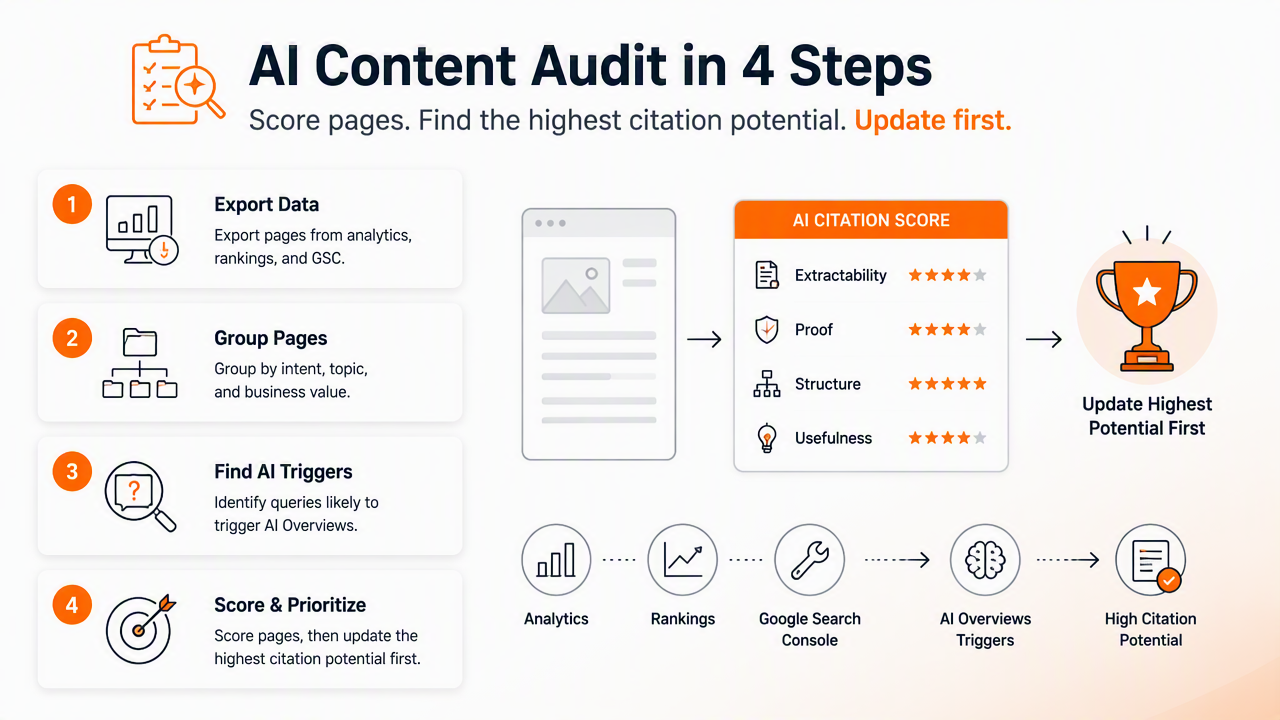
- Export pages from analytics, rankings, and Google Search Console.
- Group pages by intent, topic, and business value.
- Identify queries likely to trigger AI summaries or comparison answers.
- Score each page using a consistent citation-readiness rubric.
- Rewrite weak sections with direct answers, tables, FAQs, and sources.
- Add or validate schema markup.
- Recheck performance, impressions, and AI answer visibility.
The first pass should not start with a blank keyword list. It should start with business context: which services, products, locations, or educational topics deserve visibility because they can bring qualified demand.
For search data, the Google Search Console integration in Earlyseo can help connect query evidence with page opportunities. Teams that need a broader workflow can pair audit findings with an AI content planner so updates become a repeatable publishing system instead of a one-time cleanup.
Pages to prioritize first
- Pages ranking on page one or two but not earning AI citations.
- Informational pages that answer common buyer questions.
- Comparison pages missing tables or clear decision criteria.
- Local landing pages with weak service definitions.
- Product category pages without FAQs, proof, or buying guidance.
- Older posts with strong traffic but outdated examples or thin sources.
A good audit protects pages that already perform, improves pages with near-term upside, and removes confusion from pages that compete against each other. That order keeps the work tied to results.
Scoring rubric for citation-ready pages
A citation-ready page earns high scores when an AI system can identify the topic, extract the answer, verify claims, and understand why the page is credible. The scoring should be simple enough for editors to apply consistently, but detailed enough to expose specific fixes.
Research on large models supports the need for clarity and evidence. The GPT-4 Technical Report describes broad reasoning capabilities and limitations, while a 2023 Nature paper on large language models encoding clinical knowledge examined model behavior in a high-stakes knowledge domain. A 2021 review of uncertainty quantification in deep learning also shows why confidence, reliability, and ambiguity matter when systems interpret information.
The Earlyseo platform fits naturally after scoring because audit findings can become research-backed briefs, edits, and content updates. For teams that need stronger evidence standards, research-backed AI content helps turn claims, sources, and answer formats into a practical production workflow.
AI citation readiness rubric
| Audit factor | 0 points | 1 point | 2 points |
|---|---|---|---|
| Definitions | No clear definition | Definition exists but is buried | Short definition near the top |
| Answer completeness | Vague or partial answer | Covers the basics | Direct, complete, intent-matched answer |
| Tables | No structured comparison | Basic table with thin criteria | Useful table with decision factors |
| FAQs | No FAQ section | Generic FAQs | Real question-based FAQs with concise answers |
| Schema | Missing or invalid markup | Some markup present | Relevant schema tested and valid |
| Source quality | Unsupported claims | Some weak or old sources | Current, credible, linked sources |
| Entity clarity | Unclear people, brands, products, or places | Some named entities | Specific entities and relationships |
| Update freshness | Outdated examples | Recent edits but no date context | Current guidance with year-sensitive context |
Scores from 0 to 6 usually mean a page needs a rewrite. Scores from 7 to 11 suggest targeted improvements. Scores from 12 to 16 mean the page is close to citation-ready and may only need formatting, schema, or better sourcing.
Fix the gaps AI answers ignore
AI answer systems often skip pages that hide the answer, lack proof, or make the main idea hard to separate from surrounding copy. The fix is not longer content by default. The fix is cleaner packaging of the answer.
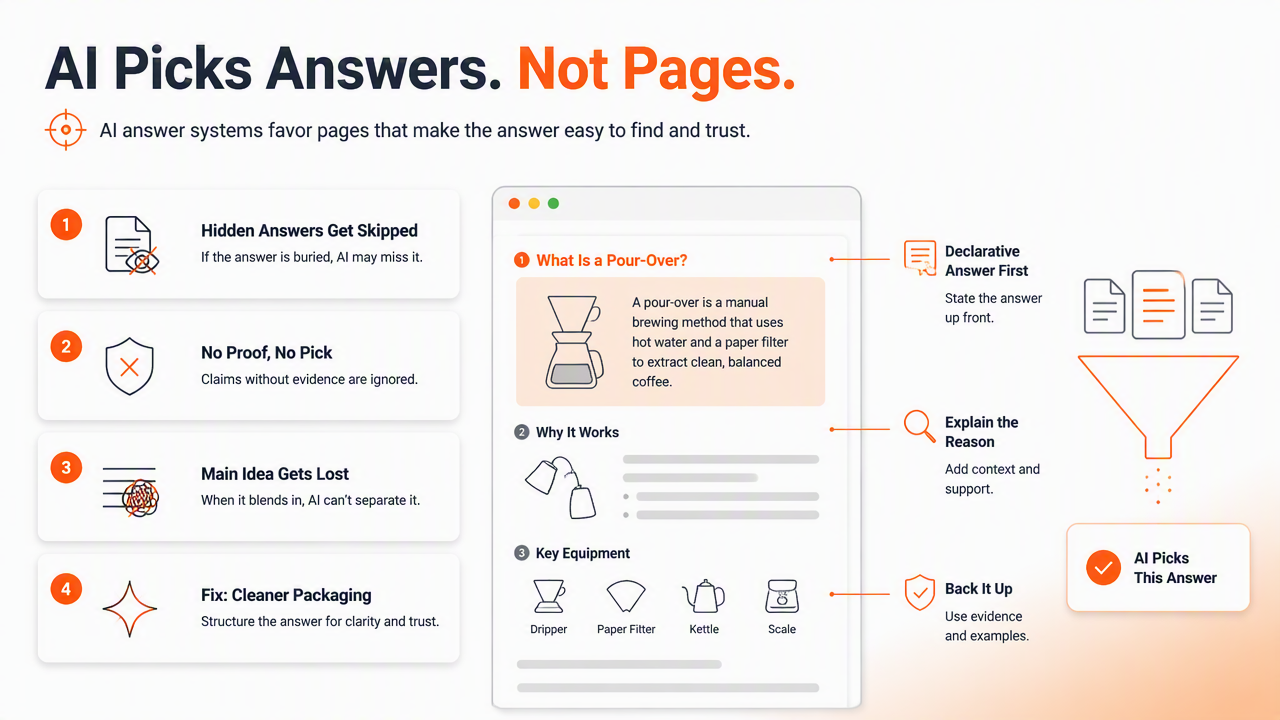
A strong page usually opens each major section with a declarative answer. It then explains the reasoning, adds examples, and supports claims with links or first-hand evidence. That pattern helps both readers and machines understand the page quickly.
Pages also need enough context to stand alone. A local service page should name the service, city, audience, qualifications, and decision factors. An e-commerce category page should explain product types, comparison points, return concerns, and buying criteria. A blog post should define terms before moving into nuance.
Key insight: the best AI visibility updates are usually editorial, not only technical. Clearer writing, better evidence, and stronger formatting often create the biggest lift.
Content upgrades that improve extractability
- Add a bold definition within the first 150 words.
- Rewrite vague introductions into direct answers.
- Convert long comparison prose into tables.
- Add examples that match real buyer or searcher scenarios.
- Replace unsupported claims with linked sources or remove them.
- Add author, review, and updated-date signals where appropriate.
- Build FAQs from real search questions, sales objections, and support tickets.
For pages that lag behind competing search results, competitor-aware SEO content can help compare missing sections, formats, and proof points. Content teams that need a human review layer can also use human-curated content service for edits that keep the page useful instead of over-optimized.
Schema should support the content, not cover for weak content. FAQ schema on shallow answers, for example, will not make a page authoritative. Technical cleanup still matters, so a beginner-friendly technical SEO audit checklist can sit beside the content rubric for crawl, indexation, and site health checks.
What to expect in 2027
AI search auditing will become more continuous in 2027 because generated answers, source inclusion, and citation patterns can change faster than traditional rankings. Static annual audits will feel too slow for brands in competitive markets.
The practical shift will be from "publish and wait" to "monitor, update, and prove." Content teams will need to check whether pages answer the newest phrasing of buyer questions, whether competitors added stronger formats, and whether claims still match current evidence.
Small businesses should not chase every AI platform separately. A better approach is building pages that any answer engine can parse: clear headings, definitions, original context, useful tables, strong sourcing, valid schema, and fresh examples. That foundation travels across search systems better than platform-specific tricks.
Earlyseo is built around that repeatable process: plan from evidence, create structured content, and improve pages as search behavior changes. For practical next steps, teams can visit earlyseo.com and turn a small batch of high-value pages into an ongoing AI visibility program.
A lightweight quarterly audit rhythm
- Month 1: score top commercial and informational pages.
- Month 2: update definitions, answer blocks, tables, FAQs, and sources.
- Month 3: validate schema, compare search visibility, and document changes.
- Quarterly: repeat the process on newly important pages and decaying content.
This rhythm keeps the audit tied to action. It also prevents teams from rebuilding context every time priorities shift.
FAQ: How often should content be audited for AI search?
High-value commercial pages should be reviewed quarterly, while evergreen blog posts can be reviewed every six to twelve months. Faster reviews make sense when a topic changes often, competitors update aggressively, or search results show more AI summaries. The goal is steady improvement, not constant rewriting.
FAQ: Does schema guarantee AI citations?
Schema does not guarantee citations in AI answers. It helps machines understand page type, entities, and structure, but weak answers and unsupported claims can still limit visibility. Schema works best when paired with clear writing, useful formatting, credible sources, and content that fully answers the search intent.
FAQ: Should every page include a comparison table?
Not every page needs a comparison table. Tables work best when a topic includes multiple options, criteria, steps, features, locations, or tradeoffs. A definition page may only need a short answer and examples, while a buying guide or tool comparison usually benefits from a table.
FAQ: Can old content earn AI citations?
Old content can earn AI citations when it is accurate, updated, well structured, and supported by credible evidence. Pages with outdated screenshots, old statistics, missing dates, or vague claims should be refreshed before citation potential is judged. Age alone is less important than current usefulness.
Conclusion
An AI search content audit should produce a ranked update list, not a vague quality report. The next action is simple: choose 10 pages with business value, score them with the rubric above, rewrite the weakest answer blocks, add proof and structured formats, then recheck visibility after indexing. For teams that want a faster path, Earlyseo can help turn those findings into publishable updates, and earlyseo.com is the best place to start.