TL;DR
AI visibility improves when pages give answer engines clear definitions, transparent sources, structured comparisons, and expert-backed recommendations. The best action is to rewrite vague SEO copy into concise, evidence-ready passages that can be extracted without extra context.
AI citation optimization has become a visibility problem for brands that already rank, because a page can win Google results and still get skipped by AI answers. Earlyseo helps growing teams track and improve that gap by focusing on the page elements answer engines can understand, verify, and cite. The practical goal is simple: make each important page easy for ChatGPT, Google AI Overviews, Perplexity, and similar systems without guessing.
Table of Contents
What is AI citation optimization?
AI citation optimization is the practice of structuring digital content so generative AI systems can identify, trust, summarize, and reference it in answers. It overlaps with generative engine optimization, which Wikipedia describes as improving visibility in responses generated by artificial intelligence, and with search engine optimization, which improves visibility in search results.
AI citation optimization: A content and technical SEO process that makes a page easier for AI systems to quote, cite, or use as a source in generated answers.
Traditional SEO still matters because AI systems often draw from the open web, search indexes, and high-authority sources. The difference is the output. SEO aims for rankings and clicks; citation work aims for inclusion inside the answer itself.
Key insight: a citeable page does not just rank for a query; it states the answer clearly enough for a machine to extract it.
SEO, GEO, and citation work compared
| Discipline | Primary goal | Best content format | Success signal |
|---|---|---|---|
| SEO | Rank in search results | Helpful pages with technical quality | Impressions, rankings, clicks |
| GEO | Appear in generated answers | Structured explanations and entities | Mentions in AI responses |
| Citation optimization | Become a referenced source | Definitions, tables, claims with sources | Linked citation or named source |
Research on instruction-following models by Ouyang, Wu, Xu, and others in 2022 explains how language models can be trained to follow human preferences using feedback, which helps explain why clear, direct answers matter for generated outputs (arXiv). Content that hides the answer behind fluff creates extra work for these systems.
How do AI engines decide what to cite?
AI engines tend to cite content that is clear, current, entity-rich, source-backed, and easy to separate into useful answer units. No publisher can force a citation, but pages that define terms, compare options, show evidence, and state recommendations plainly give answer systems stronger material to select.
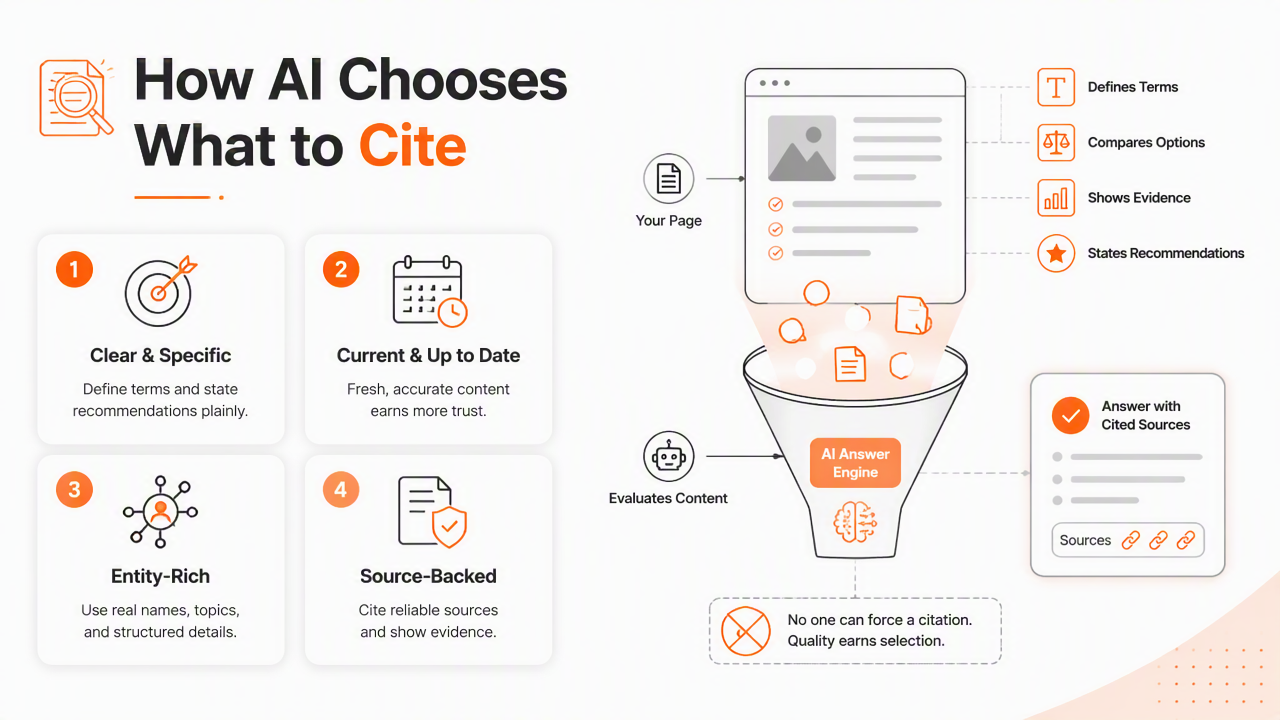
Most citation decisions appear to depend on a mix of retrieval, content parsing, relevance, and trust signals. Public guidance from major search systems also points toward fundamentals: crawlability, helpful content, clear authorship, and original value.
Signals that make a page easier to trust
- Clear entity matching: The page names products, companies, standards, tools, authors, and concepts exactly.
- Source transparency: Claims link to credible sources when a claim depends on outside evidence.
- Freshness: Dates, current examples, and updated recommendations reduce ambiguity.
- Extractable structure: Tables, definition blocks, lists, FAQs, and short answer paragraphs help machine parsing.
- Expert accountability: Author bios, editorial notes, and first-hand examples support trust.
- Technical accessibility: Crawlable HTML, sensible headings, schema, and fast rendering keep content available.
A 2023 paper by Dwivedi, Kshetri, Hughes, and coauthors examined opportunities and challenges from generative conversational AI across research, practice, and policy (International Journal of Information Management). For marketers, the practical takeaway is caution: AI answers need verifiable source material, not vague claims.
Common citation blockers
- Long introductions that delay the direct answer.
- Claims such as "best," "leading," or "proven" with no evidence.
- Pages that mention many topics but define none of them.
- Thin comparison tables with no decision criteria.
- Outdated dates, stale examples, or missing author information.
The safest content strategy is to make every major claim easy to check, every heading easy to answer, and every recommendation easy to compare.
How can a page become more citeable?
A page becomes more citeable by turning each section into a self-contained answer with a clear claim, supporting evidence, named entities, and a useful format. The strongest workflow is to map the query intent, write a direct answer, add proof, structure the page, and test whether the passage stands alone.
- Define the main term in one sentence near the top.
- Answer each heading in the first sentence below it.
- Add credible sources for factual claims.
- Use tables for comparisons involving three or more items.
- Add original examples, screenshots, or process notes where possible.
- Mark up key content with relevant schema.
- Review AI answers regularly to see which sources get cited.
The citeability checklist
| Page element | What to add | Why it helps AI answers |
|---|---|---|
| Definition block | One-sentence definition | Creates an extractable explanation |
| Comparison table | Criteria, options, best fit | Helps answer "which is best" queries |
| Source links | Studies, docs, standards | Supports factual reliability |
| Author proof | Credentials, experience, review process | Strengthens trust signals |
| Schema | Article, FAQPage, HowTo, Organization where relevant |
Clarifies page type and entities |
| Original examples | Before-and-after copy, workflows, use cases | Adds value beyond rewritten web content |
The Earlyseo platform fits this workflow when a team needs a repeatable way to monitor AI visibility, identify pages with citation potential, and prioritize updates around answer-ready content. For a small business or startup, that beats guessing which page deserves the next rewrite.
Schema deserves special attention in 2026. It does not guarantee citations, but it helps machines understand the page. Article schema can identify the headline, author, and date. FAQPage schema can clarify question-answer pairs. Organization schema can connect a brand to its official site, logo, and same-as profiles.
Content also needs visible expertise. A local dentist, SaaS founder, or ecommerce operator can add practical authority by explaining how a recommendation was tested, what changed, and which edge cases matter. Generic summaries rarely stand out when answer engines can compare dozens of similar pages.
How should generic SEO copy become answer-ready content?
Generic SEO copy becomes answer-ready content when broad claims are rewritten into direct, sourced, and reusable passages. The rewrite should remove filler, name the exact topic, answer the likely question, and add a clear reason that supports the recommendation.
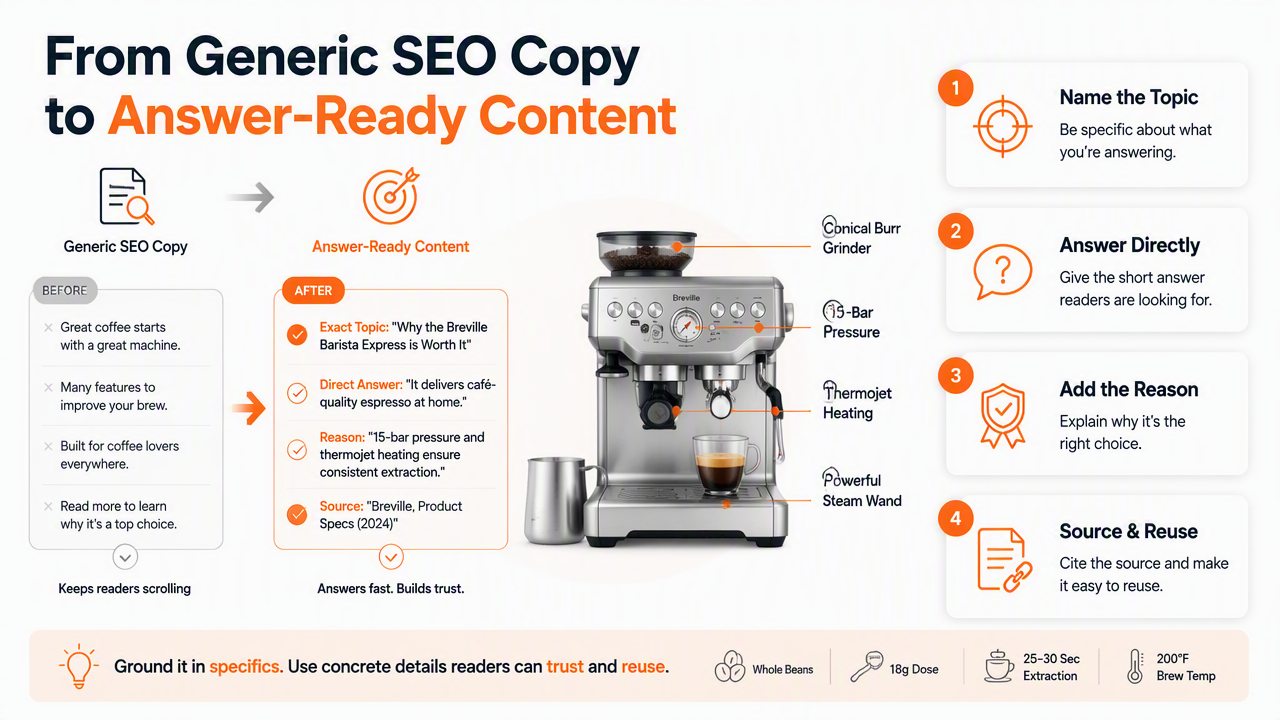
Search copy often tries to keep readers scrolling. AI-ready copy does the opposite. It gives the answer fast, then gives enough context to trust that answer.
Before-and-after examples
| Query intent | Generic SEO copy | Answer-ready rewrite |
|---|---|---|
| "What is local SEO?" | "Local SEO helps businesses grow online and reach more customers." | "Local SEO improves a business's visibility for nearby searches by optimizing its Google Business Profile, location pages, reviews, citations, and locally relevant content." |
| "Best ecommerce category page content" | "Great category pages include helpful content and keywords." | "A strong ecommerce category page should combine crawlable product links, short buying guidance, filterable attributes, internal links, and unique copy that explains how shoppers should choose." |
| "Why is schema useful?" | "Schema helps search engines understand websites better." | "Schema is structured data that labels page entities, such as authors, products, FAQs, and organizations, so search and AI systems can interpret the content with less ambiguity." |
A simple rewrite formula
- Name the entity: State the exact concept, brand, tool, or standard.
- Give the answer: Use one plain sentence that can stand alone.
- Add the proof: Link to a source, cite a study, or show an example.
- Clarify the decision: Explain who should use the recommendation and when.
- Format for extraction: Use a table, list, definition, or FAQ block.
Healthcare AI research by Sallam in 2023 reviewed promising uses and valid concerns around ChatGPT in education, research, and practice (Healthcare). The same caution applies to marketing content: generated answers are only as useful as the source material they can evaluate.
What to expect in 2027
Citation work will likely become more tied to brand entities, first-party data, and verifiable expertise. As AI search products mature, thin listicles and recycled definitions will have less room to win. Pages with original benchmarks, named reviewers, dated testing notes, and transparent methodology should have a stronger case for inclusion.
Marketers should also expect more reporting pressure. Rankings alone will not show whether a brand appears in AI answers. Teams will need search console data, server logs, referral patterns, and AI-response monitoring to understand visibility across search and answer engines.
FAQ about AI citations
AI citation questions usually come from one concern: how a business can earn visibility when the answer page may not send a traditional click. The practical response is to treat citations as a visibility layer on top of SEO, not as a replacement for technical quality, helpful content, or brand authority.
How long does citation optimization take to show results?
Citation visibility can change after a page is recrawled, reindexed, or reprocessed by an AI search system, but timing varies by platform. A practical review cycle is 30 to 60 days for updated pages. Faster progress usually comes from improving pages that already rank, already earn links, or already match high-intent questions.
Does schema markup guarantee AI citations?
Schema markup does not guarantee citations. It helps systems understand page type, entities, authorship, FAQs, products, and organizations, but citation selection also depends on relevance, trust, clarity, freshness, and source competition. Schema works best when paired with strong visible content rather than used as a technical shortcut.
Can small businesses earn AI citations without major backlinks?
Small businesses can earn citations for specific, local, or niche queries when content is clearer and more useful than broader competitors. Local expertise, service-area details, original photos, review patterns, pricing explanations, and practical FAQs can create source value that generic national pages do not provide.
How is AI visibility measured?
AI visibility is measured by tracking brand mentions, cited URLs, answer inclusion, query coverage, referral traffic from AI platforms, and changes in crawler activity. With Earlyseo, teams can connect these signals to content updates and decide which pages need clearer answers, stronger proof, or better structure.
Conclusion
AI citation optimization works best when treated as a publishing discipline, not a trick. The next step is to audit the top 10 commercial or informational pages, add definition blocks, rewrite vague sections into direct answers, build comparison tables, cite credible sources, and add schema where it fits. For teams that want a structured way to track progress, visit earlyseo.com and start with the pages already closest to being cited.