TL;DR
Most small business SEO campaigns fail because the work starts before the strategy is clear: wrong keywords, weak pages, poor technical setup, low authority, and unclear conversion paths. The fix is a simple diagnostic process that ties search intent, page quality, local trust signals, and lead actions to business goals.
Most owners do not lose at SEO because Google is mysterious; they lose because the campaign never connects rankings to revenue. That is why small business SEO campaigns fail even when blog posts get published, plugins get installed, and reports show more impressions. Search engine optimization: SEO is the practice of improving a website's visibility and performance in search engine results pages so more relevant visitors can find it. Small business: A small business is a company, partnership, or sole proprietorship with fewer employees or lower revenue than larger firms. Current ranking content from 2025 and 2026 points to the same pattern: buyer intent, technical health, local focus, and content depth matter more than activity volume.
Table of Contents
What does small business SEO failure usually mean?
Small business SEO failure means the campaign fails to create qualified traffic, trusted visibility, or measurable leads, even if some rankings improve.
A failed campaign is not always a total absence of traffic. Sometimes the site ranks for informational searches that never turn into calls, store visits, quote requests, or sales. Other times the business earns impressions but no clicks because the page title, search intent, or brand trust is weak.
Key insight: SEO should be judged by useful demand captured, not by the number of pages published.
A healthier goal is simple: rank for the terms real buyers use, satisfy the searcher better than competing pages, and make the next action obvious. The Earlyseo platform is built around that kind of practical SEO workflow, with plain guidance for teams that need visibility without turning search into a full-time department.
Common failure signals to separate
SEO problems usually fall into different buckets, and each bucket needs a different fix.
- Visibility problem: Search engines cannot find, crawl, or understand the site well enough.
- Relevance problem: Pages target keywords that do not match services, products, location, or buyer intent.
- Quality problem: Content is too thin, generic, or similar to stronger pages already ranking.
- Authority problem: The business lacks reviews, citations, links, mentions, or local trust signals.
- Conversion problem: Visitors arrive but cannot easily act.
Early diagnosis saves money because a content calendar cannot fix a crawl issue, and a technical audit cannot fix a weak offer.
Why small business SEO campaigns fail before rankings improve
Small business SEO campaigns often fail early because the campaign targets search volume instead of qualified intent.
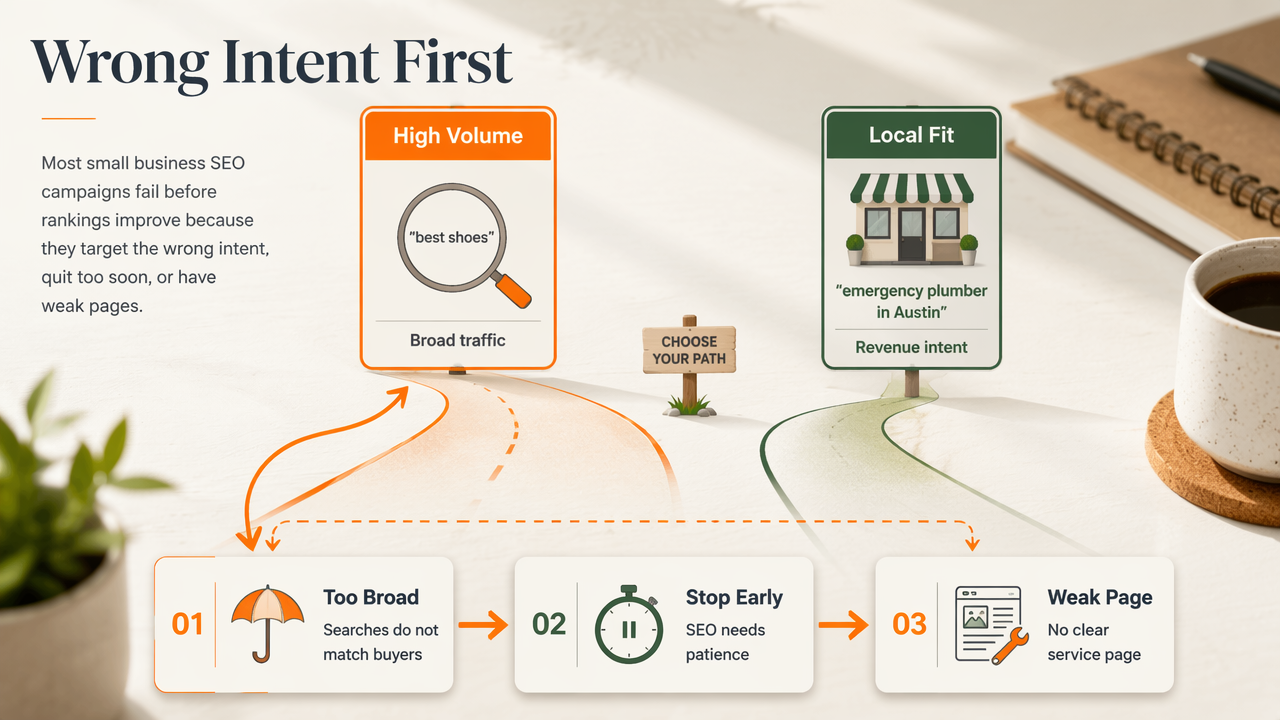
High-volume keywords look attractive, but they are often too broad for a local shop, niche service provider, or early e-commerce brand. A plumber targeting "bathroom ideas" may get traffic someday, but "emergency plumber in Austin" is closer to revenue. A Shopify store targeting "best shoes" faces national competition, while a page for "wide toe box running shoes for nurses" has clearer intent.
Many campaigns also stop too soon. SEO does not behave like paid ads, where budget can create immediate placement. Search engines need time to crawl, compare, test, and trust pages. The real issue is not patience alone; the early work must be pointed at the right market.
The early failure pattern
Most weak campaigns share a predictable sequence.
- Keyword research starts with volume, not buyer intent.
- Pages get published without a unique angle, proof, or local relevance.
- Technical basics are assumed instead of checked.
- Authority building is delayed until "after content works."
- Reports track impressions, but not forms, calls, sales, or assisted conversions.
Current competitor articles in the SERP emphasize similar causes, including weak research, poor content, unrealistic timelines, and missing local focus. The gap is that many explanations stop at "do better SEO" instead of showing how to diagnose the exact break.
The targeting mistake hurts every later step
Bad targeting makes every task look less effective. A well-written page cannot perform if it answers the wrong question. A fast website cannot convert visitors looking for something the business does not sell.
Small businesses should map keywords to offers before creating pages. Service pages should match services and locations. Product pages should match product categories, buyer concerns, and comparison searches. Blog posts should support those pages, not replace them.
For teams building a repeatable publishing process, the Earlyseo blog workflow can help turn scattered topic ideas into a clearer content pipeline.
How can small businesses diagnose the exact SEO failure point?
Small businesses can diagnose SEO failure by matching symptoms to the weakest part of the search funnel: targeting, content, technical setup, authority, or conversion.
Guessing creates waste. A business may hire a writer when the real issue is no indexation. Another may redesign the site when the real issue is no reviews, no local citations, and no proof that customers trust the brand. A quick matrix prevents that kind of expensive guessing.
Troubleshooting matrix for stalled SEO campaigns
The fastest diagnostic method is to pair the visible symptom with the most likely cause and the first corrective action.
| Symptom | Likely failure point | First fix |
|---|---|---|
| Pages indexed but no rankings | Weak targeting or thin content | Rebuild pages around buyer intent and specific offers |
| Impressions rising but clicks flat | Poor titles, weak relevance, low trust | Rewrite title tags and meta descriptions around search intent |
| Rankings exist but leads are low | Unclear conversion path | Add calls, forms, pricing cues, proof, and next-step buttons |
| Local competitors outrank the business | Low local authority | Improve Google Business Profile, reviews, citations, and local pages |
| New pages never appear in search | Crawl or indexation issue | Check sitemap, internal links, robots rules, and canonical tags |
| Blog traffic grows but sales do not | Content disconnected from services | Link educational posts to service, category, or product pages |
This table also helps an outside consultant, marketing manager, or founder talk about SEO without vague blame. The issue becomes visible, testable, and easier to assign.
Technical setup still matters in 2026
Technical SEO is not glamorous, but it decides whether strong content gets a fair chance. Small sites often fail basic checks: missing sitemap entries, duplicate titles, weak internal links, slow templates, broken canonical tags, and JavaScript that hides important content.
WordPress, Shopify, and Webflow can all rank well, but each platform needs clean setup. Store owners can start by reviewing the Shopify SEO integration, while publishers using WordPress can check the WordPress SEO integration. Platform-specific fixes are usually faster than broad "SEO best practice" checklists.
What should a 2026 recovery plan prioritize?
A 2026 SEO recovery plan should prioritize bottom-of-funnel pages, technical access, trust signals, and conversion paths before scaling content.
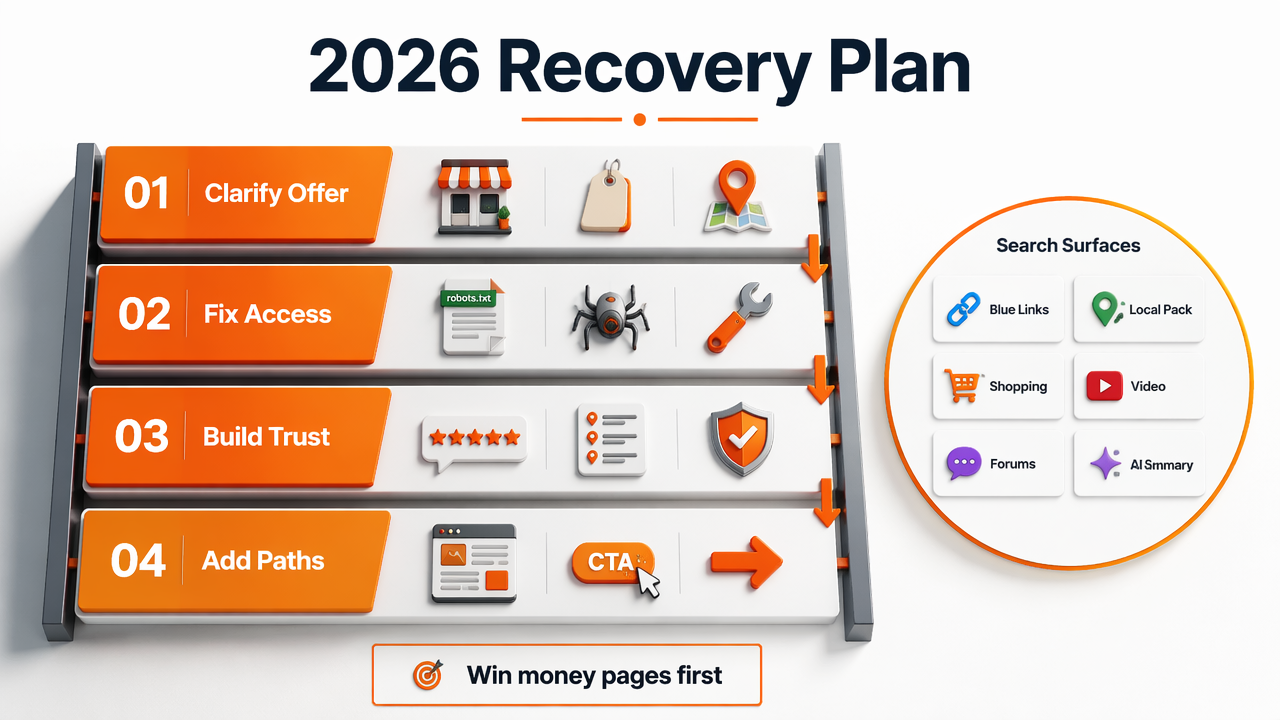
Search has become more selective because results now include classic blue links, local packs, shopping results, video, forums, and AI-generated summaries. A small business cannot win every surface at once. It should first win the searches closest to money, then expand into supporting content.
The five-step recovery order
A practical recovery plan works best in this order.
- Clarify the offer: Define the services, products, locations, and customer problems that deserve search visibility.
- Fix indexation and crawl paths: Make sure important pages are accessible, internally linked, and included in XML sitemaps.
- Upgrade money pages: Add proof, FAQs, pricing context, service details, product details, and clear actions.
- Build local and topical authority: Earn reviews, citations, partner mentions, supplier links, and useful internal links.
- Publish supporting content: Create articles that answer real pre-sale questions and point readers toward relevant offers.
The Earlyseo platform fits best after the offer and site structure are clear, because structured inputs produce better SEO outputs. Teams needing implementation guidance can use the Earlyseo documentation to connect planning, publishing, and site workflows.
What to expect in 2027
AI search will make unclear websites easier to ignore and clear websites easier Language model research is not SEO research, but it shows why source clarity matters. The ACM paper Taxonomy of Risks posed by Language Models examined risks tied to language models, which is relevant as search engines increasingly summarize information. Broader research also shows that complex systems reward structured inputs; Sadybekov and Katritch's 2023 Nature paper studied computational approaches in drug discovery, while Abubakar and coauthors examined solid waste management practices as a system-level sustainability topic.
For SEO, the practical takeaway is simple: pages need clear entities, clean structure, accurate facts, and visible proof. Businesses preparing for answer engines can also review Earlyseo's llms.txt resource for AI-facing site guidance. More resources are available on earlyseo.com.
FAQ about failed small business SEO campaigns
Small business SEO problems become easier to fix when common questions are answered directly.
How long should a small business wait before judging SEO results?
A small business should usually judge early SEO by progress signals before judging final revenue impact. Indexation, crawl health, keyword movement, click-through rate, and conversion tracking should improve first. If no technical fixes, page upgrades, or authority signals appear after several months of work, the campaign needs a diagnosis rather than more patience.
Can a small business rank without backlinks?
A small business can rank for some low-competition local or niche terms without many backlinks, but authority still matters. Reviews, citations, supplier mentions, local sponsorships, directory consistency, and internal links all help search engines trust the business. Competitive markets usually need stronger external signals.
Is blogging enough for small business SEO?
Blogging is not enough when service pages, product pages, and local pages are weak. Blog posts can answer early questions, but they should support revenue pages through internal links and topical depth. A campaign built only on blog volume often attracts readers who are not ready to buy.
Why do SEO reports look positive when leads are not improving?
SEO reports can look positive because impressions and average rankings may rise for low-intent queries. Leads improve only when the campaign targets buyer searches, earns clicks, and gives visitors a clear action. Reports should separate informational traffic from quote requests, calls, purchases, bookings, and local direction clicks.
Conclusion
The clearest answer to why small business SEO campaigns fail is not "bad algorithms" or "too much competition." The usual cause is a broken chain: weak targeting, thin pages, missing authority, poor technical setup, and unclear conversion paths. Fixing that chain starts with a simple audit, not another random batch of posts.
A strong next step is to list the top five revenue-driving services or products, check whether each has a crawlable and useful page, then compare those pages against the troubleshooting matrix above. For teams that want a guided system for turning that work into publishable actions, head to earlyseo.com and start with the setup path that matches the site platform.