TL;DR
Blogs usually win educational and comparison searches, while landing pages usually win commercial and conversion-focused searches. The strongest SEO strategy maps each keyword to intent, then connects blog posts, SEO landing pages, and conversion pages through clear internal links.
A page can rank and still fail the business goal, which is why blog vs landing pages for seo is really a question about search intent, not page format. Landing page: a single web page created for a specific marketing or conversion goal, often called a lead capture page, destination page, squeeze page, or static page. Blog post: an informational article built to answer a query, earn topical authority, and support related product or service pages. Teams using Earlyseo can plan both formats around keywords, internal links, and AI-readable page structure instead of guessing which one Google prefers.
Table of Contents
What is the difference between a blog and a landing page for SEO?
A blog post targets informational depth, while a landing page targets a focused action. For SEO, blogs usually cover questions, comparisons, and tutorials; landing pages usually explain a product, service, location, category, or campaign offer. The right choice depends on the searcher's intent and the next step expected after the click.
Blogs and landing pages can both rank. The format matters less than whether the page satisfies the query, loads well, earns links, and makes the next action obvious.
Key insight: Google does not rank a page because it is a blog or a landing page; it ranks the page that best matches intent and proves usefulness.
Core comparison table
| SEO factor | Blog post | Landing page | Best fit |
|---|---|---|---|
| Primary goal | Educate and build authority | Convert visitors into leads, trials, calls, or sales | Match to keyword intent |
| Common keywords | How, what, best, vs, guide, examples | Service, software, pricing, location, product, demo | Blog for learning, landing page for action |
| Content depth | Usually longer and broader | Usually tighter and more offer-driven | Depends on SERP expectations |
| Internal linking role | Feeds authority to money pages | Receives authority and captures demand | Use both together |
| Conversion path | Softer CTAs, related reading, newsletter, lead magnet | Direct CTA, form, booking, checkout, demo | Landing page for fast action |
| Update rhythm | Frequent refreshes as topics change | Updated when offers, proof, or positioning changes | Both need maintenance |
Which page type ranks better for different search intents?
The page type that ranks better is the one that matches the job behind the keyword. A blog post is usually stronger for learning intent, while a landing page is usually stronger for buying, booking, local, or product-specific intent.

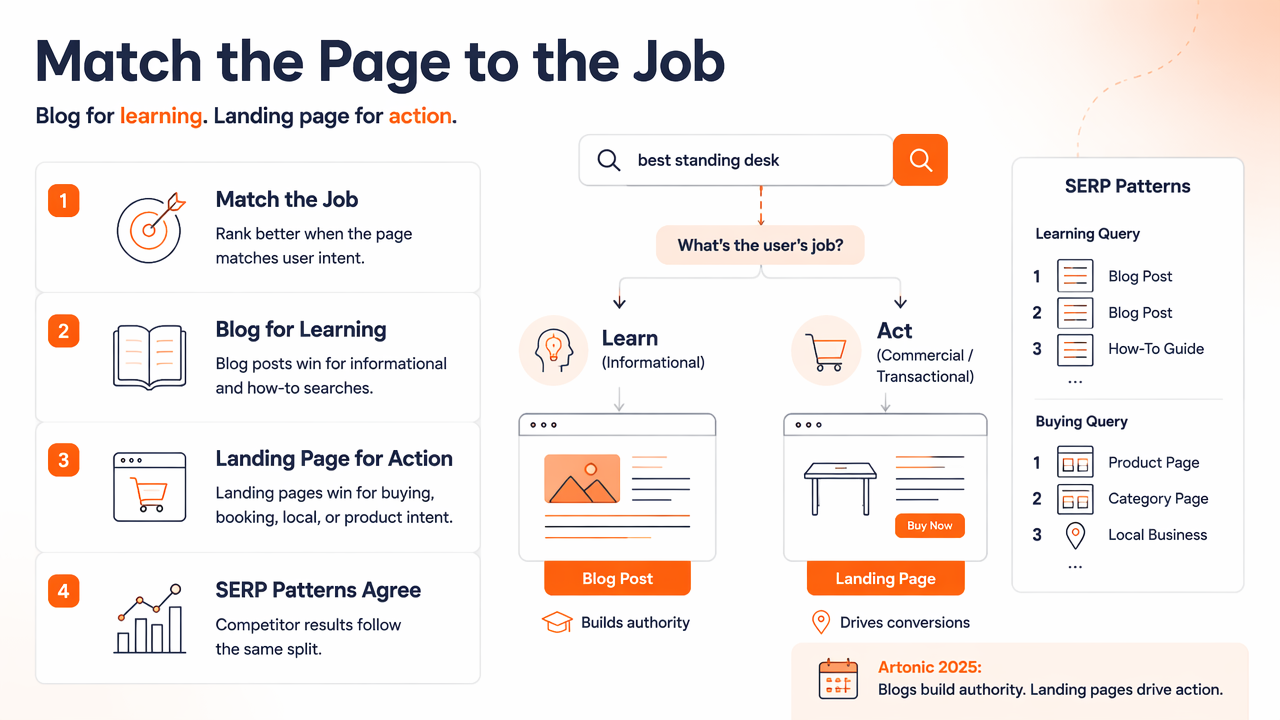
Competitor SERP patterns support this split. Artonic's 2025 article frames blogs as educational pages and landing pages as conversion pages, while Grow and Convert's ranking-focused article argues that product pages do not always convert better than blog posts for bottom-funnel searches. That difference matters for startups and local businesses because one page type rarely covers the full buyer path.
Intent-to-page mapping for 2026 SEO
| Keyword intent | Example query | Better starting format | Why it works |
|---|---|---|---|
| Informational | "what is local SEO" | Blog post | The searcher needs explanation before action |
| Comparison | "Shopify vs Webflow SEO" | Blog post or hybrid page | The query needs balanced evaluation and proof |
| Commercial investigation | "best SEO tools for startups" | Blog post | Lists and decision criteria usually satisfy the SERP |
| Transactional | "SEO audit software demo" | Landing page | The searcher is ready for a direct offer |
| Local service | "dentist SEO agency Chicago" | Landing page | Location, trust, and contact actions matter most |
| Ecommerce category | "organic dog treats" | Landing or category page | Product discovery and checkout intent dominate |
When a blog can beat a landing page
A blog can beat a landing page when the searcher needs context before taking action. Examples include comparison keywords, problem-aware searches, and technical tutorials.
Strong blog candidates include:
- "how to improve Shopify SEO"
- "blog vs landing page examples"
- "why ecommerce category pages are not ranking"
- "best content strategy for local businesses"
A blog can still convert when it includes a specific next step. Earlyseo supports this kind of content planning for teams that need topic coverage and conversion paths in the same workflow.
When a landing page should be the ranking target
A landing page should be the ranking target when the keyword signals a clear action. Service pages, product pages, location pages, software feature pages, and campaign pages usually belong in this group.
Strong landing page candidates include:
- A software integration page for a named platform.
- A local service page for one city or region.
- A product category page with buyer filters.
- A demo page for a known solution.
- A pricing or consultation page for high-intent visitors.
For ecommerce teams, platform-specific workflows matter. A Shopify store may need category landing pages first, then blog support through guides connected to Shopify SEO publishing workflows.
How should a business choose between a blog post and a landing page?
A business should choose the page type by checking the SERP, the intent, the desired action, and the amount of explanation needed before conversion. The safest framework is to start with the keyword goal, then build the page that makes that goal easiest to complete.

A common mistake is forcing every keyword into a sales page. Another mistake is publishing only blog posts and leaving high-intent visitors without a direct path to a quote, demo, store category, or booking page.
Five-step decision framework
- Read the SERP type. If results are mostly guides, choose a blog. If results are mostly product, service, or category pages, choose a landing page.
- Label the intent. Use informational, comparison, commercial, transactional, or local intent.
- Define the next action. Match the CTA to the page type, such as read more, book, buy, compare, or request a demo.
- Check proof requirements. Landing pages need trust signals, testimonials, specs, pricing cues, or local proof. Blogs need examples, definitions, and clear explanations.
- Plan internal links. Blog posts should support landing pages, and landing pages should point to helpful education where needed.
Hybrid pages often solve mixed-intent keywords
Mixed-intent keywords often need a hybrid structure. A hybrid page explains the topic like a blog, then presents a conversion path like a landing page.
This works well for bottom-funnel education, such as "best SEO software for Webflow" or "how to choose an SEO tool for a startup." The page can include a definition, comparison table, use cases, screenshots, proof, and a direct CTA.
Practical rule: if the SERP shows both articles and commercial pages, a hybrid page can cover the question and still give searchers a clear next step.
Internal linking makes both formats stronger
Internal links help search engines understand which pages are educational support and which pages are primary conversion targets. A blog about ecommerce SEO can link to a Shopify integration page, while a product page can link back to setup documentation for clarity.
For content-heavy sites, publishing related articles through the Earlyseo blog workflow can help keep topical clusters organized. For technical teams, Earlyseo documentation gives a cleaner path from planning to publishing.
How does Earlyseo handle blogs, landing pages, and AI visibility?
Earlyseo handles blogs and landing pages as connected SEO assets rather than separate content chores. The Earlyseo platform is built for teams that need rankings, internal links, and AI-friendly structure without turning every page into the same template.
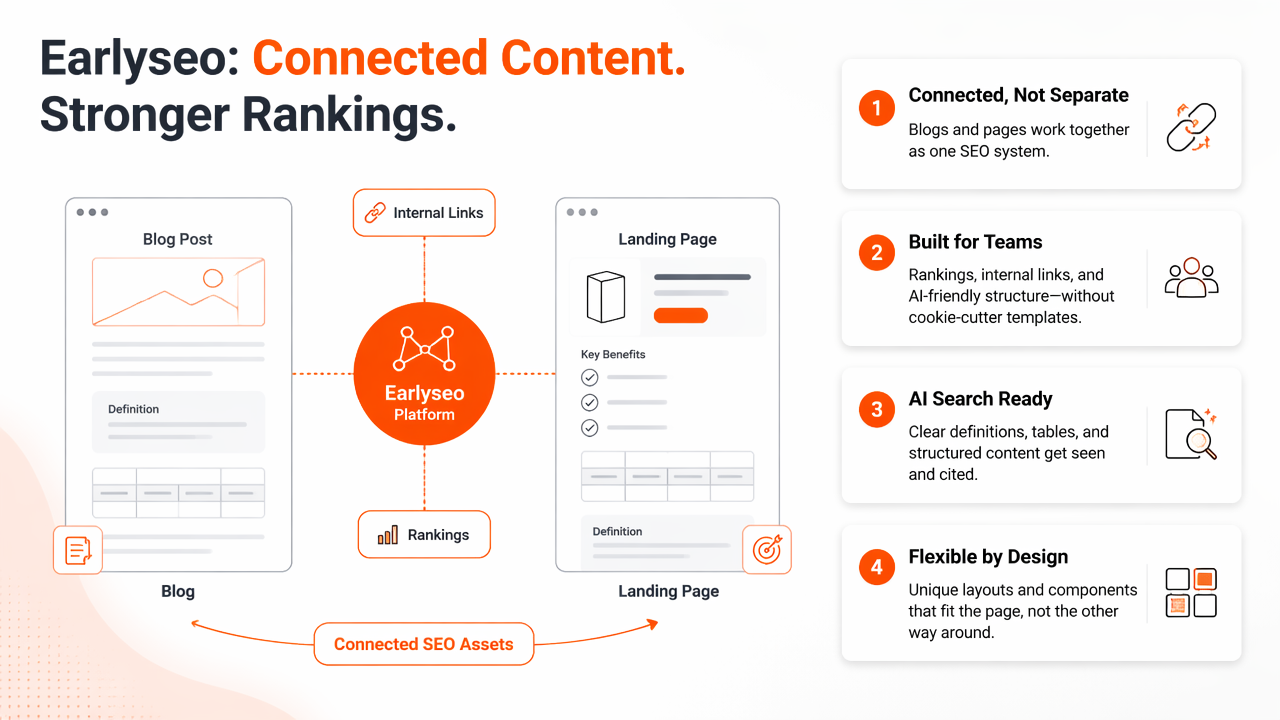
AI search has raised the value of clear definitions, tables, concise answers, and named entities. A page that explains a term clearly is easier for answer engines A page that hides the answer behind long intro copy is less useful for both readers and AI systems.
Research metadata from Nic Newman's Journalism, media and technology trends and predictions shows the long-running relationship between media, technology, and changing discovery channels. Atheer Awad, Sarah J. Trenfield, and Thomas D. Pollard's 2021 digital health technologies review also reflects how digital systems increasingly shape user access to information, even outside marketing.
AI-readable page structure checklist
| Page element | Blog post use | Landing page use | AI visibility value |
|---|---|---|---|
| Direct answer near top | Defines the topic quickly | States the offer and audience | Easier extraction |
| Definition block | Explains key terms | Clarifies product category | Strong entity signal |
| Comparison table | Helps evaluate options | Shows plan, feature, or service differences | Citable format |
| FAQ section | Captures related questions | Handles objections before conversion | Query coverage |
| Internal links | Builds topical authority | Routes visitors to action or proof | Clear site structure |
Where llms.txt fits into the strategy
As AI crawlers become more common, site owners are paying more attention to crawler guidance and machine-readable context. Earlyseo publishes guidance around llms.txt for AI visibility, which can support clearer discovery signals alongside normal SEO best practices.
That does not replace good content. It supports it. The page still needs a useful answer, logical structure, relevant internal links, and a clear reason to exist. More implementation details are available on earlyseo.com for teams building an AI-aware publishing process.
FAQ: Blog posts, landing pages, and SEO performance
Blog and landing page SEO questions usually come down to intent, conversion path, and site structure. These answers cover the common decisions that come up during a content refresh or new site build.
Are landing pages bad for SEO?
Landing pages are not bad for SEO when they satisfy search intent and provide enough useful information. Thin campaign pages with little context can struggle, but strong SEO landing pages can rank for service, product, local, and category keywords. The page needs indexable content, internal links, fast performance, and a clear purpose.
Can a blog post convert better than a landing page?
A blog post can convert better when the reader needs education before taking action. Comparison posts, use-case guides, and problem-aware articles can build trust before presenting a CTA. The conversion path should feel natural, such as a related product page, checklist, demo, consultation, or category page.
Should the same keyword have both a blog and a landing page?
The same keyword should not usually have two pages competing for the exact same intent. A better setup is one primary ranking page and one supporting page with a different angle. For example, a landing page can target "SEO software for startups," while a blog supports it with "how startups should choose SEO software."
How often should blogs and landing pages be updated?
Blogs should be updated when search intent changes, competitors add stronger examples, or facts become dated. Landing pages should be updated when offers, pricing cues, proof, product details, or customer objections change. In 2026, both formats also need cleaner answer blocks, stronger entity signals, and better internal links for AI search.
Conclusion
The best answer to blog vs landing pages for seo is not one format over the other. Blogs build reach, topical authority, and trust; landing pages capture demand and turn qualified traffic into business results. The strongest 2026 strategy uses both, with each keyword mapped to intent and each page connected through internal links.
A practical next step is to audit the top 20 organic opportunities, label each as blog, landing page, or hybrid, then refresh the pages closest to page one first. For teams planning that workflow, Earlyseo can help structure content, links, and AI-readable sections. Visit earlyseo.com to review the workflow and start with the pages most likely to move rankings.