TL;DR
Prioritize public support articles that answer recurring customer questions, then check indexability, version accuracy, and internal links. Measure qualified visits and support outcomes rather than traffic alone; private account guidance should remain private.
A customer-support article can answer a buying question long before a prospect reaches a pricing page. Effective seo search optimization for knowledge bases makes those answers discoverable without turning helpful documentation into sales copy.
Knowledge base SEO: The practice of improving public help articles so search engines can discover them, understand their answers, and surface them for relevant customer questions.
For startups, stores, and local businesses, the strongest starting point is usually a small set of recurring questions. Earlyseo offers a relevant starting point for organizing the surrounding SEO work, while subject-matter experts remain responsible for support accuracy.
Table of Contents
What makes knowledge base SEO different?
Knowledge base SEO optimizes task-specific support answers rather than broad marketing topics. A successful page helps someone complete an action, understand a policy, or resolve a problem. Its search value depends on clear intent, accessible content, accurate product details, and links that connect the answer to the wider website.
Match the page type to the customer's task
Different customer questions belong on different page types; a support article shouldn't replace every commercial page.
| Page type | Primary intent | Example topic | Useful next link |
|---|---|---|---|
| Support article | Complete a task | Reset account access | Account settings guide |
| Product page | Evaluate a solution | Subscription management features | Relevant setup documentation |
| Policy article | Understand conditions | Return eligibility | Returns request process |
| Troubleshooting article | Resolve a symptom | Checkout payment rejected | Supported payment methods |
For example, an online store can publish an answer about return eligibility and link to the relevant policy. A local service business can explain appointment preparation and link to its booking page. Neither needs a long introductory essay.
Separate public answers from private guidance
Public documentation should cover reusable information, not expose customer-specific details. Authentication, billing records, and personalized troubleshooting belong behind appropriate access controls.
Indexability: A page's eligibility to appear in a search engine's index.
Canonical URL: The preferred URL identified for duplicate or closely similar content.
Internal search: Search within a help center, distinct from visibility in Google or other external engines.
A searchable help center and a search-visible help center solve different discovery problems.
How should public support articles be prioritized and indexed?
- Select recurring customer questions with clear public value.
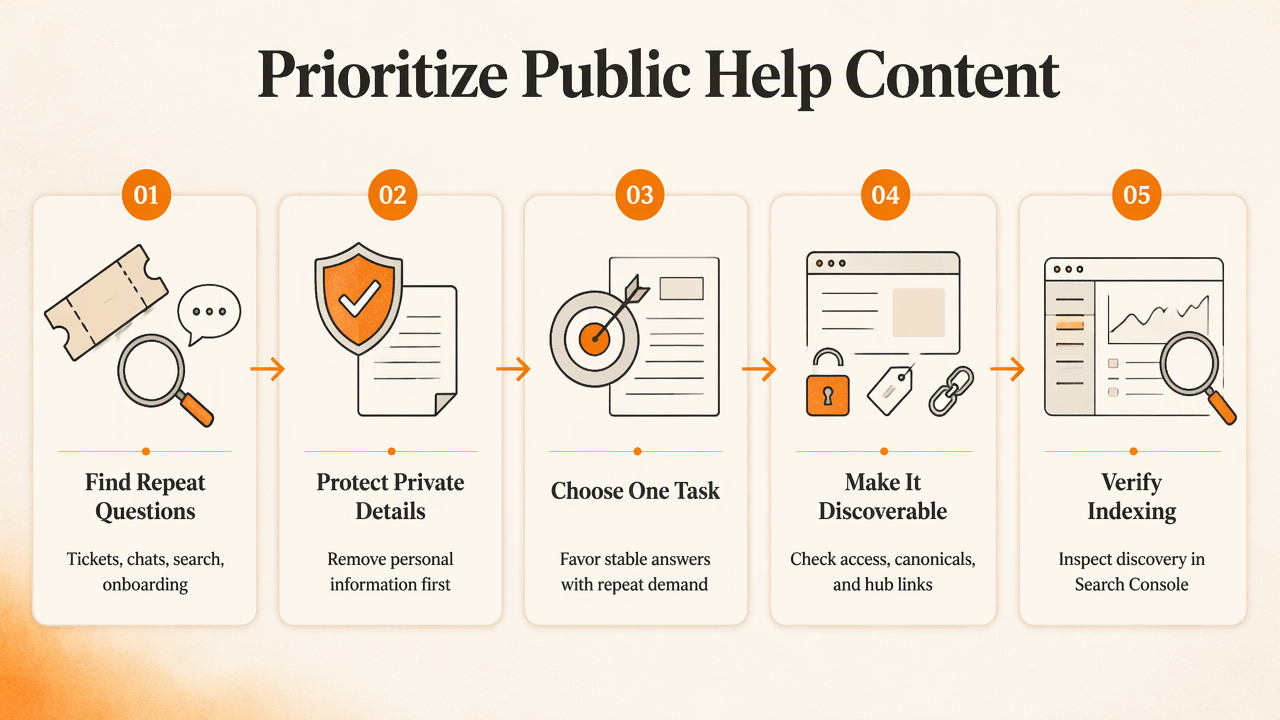
- Assign one main task to each article.
- Check that the intended URL loads without authentication.
- Review indexing directives and canonical tags.
- Add crawlable links from relevant hub pages.
- Inspect discovery and indexing in Google Search Console.
Build the first queue from support evidence
Support tickets, chat transcripts, internal-search queries, and onboarding questions provide useful topic candidates. Remove personal information before using these materials in content planning.
Prioritize questions that combine repeat demand with a stable answer. A setup requirement or shipping-policy explanation often makes a better starting point than a temporary incident update.
A simple planning record should include:
- Customer question and intended task.
- Public or private access requirement.
- Product, plan, region, and version covered.
- Article owner and technical reviewer.
- Related documentation and commercial destination.
Check the actual article URL, not just the homepage
A public help-center homepage doesn't establish that every article can be indexed. Check individual pages for unintended noindex directives, login redirects, incorrect canonical targets, and content that isn't available in rendered HTML.
A sitemap helps discovery, but it doesn't guarantee indexing. Category pages should contain descriptive, crawlable links to articles rather than rely entirely on a search box.
The Google Search Console tutorial provides a practical follow-up for inspection and performance tracking. During a help-center move, use a website migration checklist to plan redirects and preserve useful URLs.
A
robots.txtblock isn't a privacy control. Sensitive documentation requires proper access restrictions.
How should knowledge base answers be written?
- Use a question-led title that names the task.
- Answer the question immediately in plain language.
- State prerequisites and applicable versions.
- Present actions as numbered steps.
- Add exceptions and troubleshooting separately.
- Link to the next relevant task or product detail.
Use answer-first formatting without stripping context
A title such as "How can administrators export invoices?" identifies the role and task more clearly than "Invoice management." The opening answer should explain where the action happens, which permissions apply, and what result to expect.
Place a short answer before screenshots or background detail. Then use numbered instructions with exact interface labels, such as Settings and Billing, after checking those labels against the live product.
Screenshots should support the written steps, not carry the only explanation. Descriptive alt text helps communicate their purpose, while text instructions remain easier to update when an interface changes.
Make versions and limitations explicit
Version accuracy makes an answer usable: readers need to know whether a procedure applies to their product, plan, or region. Add these conditions near the answer rather than burying them below the instructions.
Useful article details include:
- Applicable product version or interface.
- Required role, plan, or permissions.
- Region-specific conditions.
- Last verified date and accountable owner.
A fresh date should reflect a real review, not an automatic timestamp change. Older instructions can remain available when customers still use that version, provided their scope is clear.
Connect documentation to commercial pages naturally
Relevant internal links help customers move between evaluation and implementation. A feature page can link to its setup guide; the guide can link back when feature availability or plan selection matters.
The internal linking strategy guide offers broader planning context. Descriptive anchors such as "supported export formats" are more useful than repeating a generic product keyword throughout an article.
How should performance and AI visibility be managed?
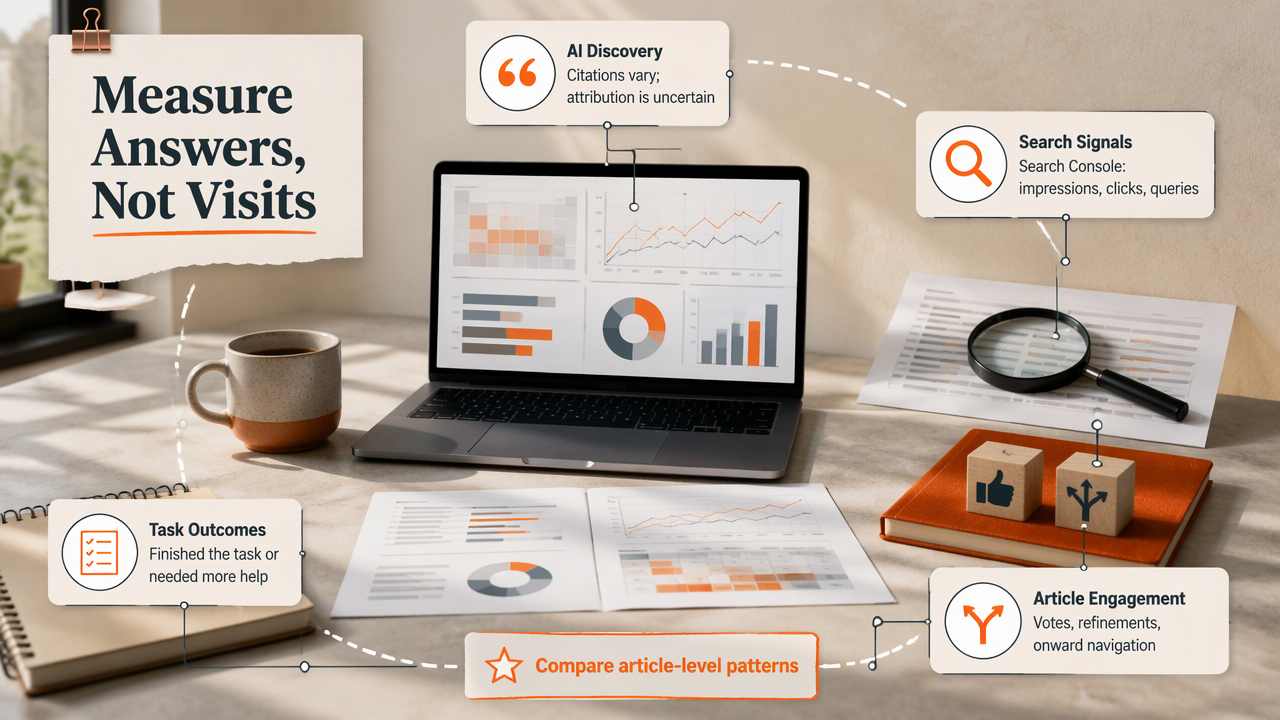
Knowledge base SEO performance should be measured through relevant search queries, article engagement, and task outcomes rather than traffic alone. Teams should review whether visitors find the right answer, complete the intended action, or need further help. AI visibility adds another discovery channel, but citation and attribution remain variable.
Track answer usefulness alongside search visibility
Google Search Console can reveal impressions, clicks, and queries for public articles. Help-center analytics can add feedback votes, search refinements, and onward navigation where those events are available.
Compare article-level patterns rather than assuming every visit prevents a support ticket. A troubleshooting page may attract customers who still need assistance.
- High impressions with weak clicks: review title clarity and intent.
- Repeated negative feedback: verify steps and missing conditions.
- Frequent search refinements: improve naming and navigation.
- Growing outdated-version traffic: clarify scope and current alternatives.
How Earlyseo handles this workflow
Earlyseo fits the SEO planning layer around public support documentation, with human reviewers keeping ownership of technical answers. Its SEO operations offering is a relevant next step for teams organizing a repeatable publishing and review process.
For translated help centers, multilingual SEO content is relevant to language-specific planning. Each language still needs accurate interface terms, local policy details, and an appropriate review owner.
Prepare for AI retrieval without promising citations
Clear, self-contained answers are a sensible foundation for AI discovery, but they don't guarantee inclusion. The 2023 survey Retrieval-Augmented Generation for Large Language Models examines retrieval-augmented generation, providing background on systems that combine retrieved information with language models.
The 2022 paper Locating and Editing Factual Associations in GPT concerns factual associations within models, not a knowledge base ranking formula. Neither source establishes a guaranteed citation tactic.
For 2027 planning, the practical priority is maintaining verifiable answers with explicit product names, conditions, and versions. Future discovery formats may change; accurate documentation remains the useful asset.
Knowledge base SEO FAQs
Knowledge base SEO decisions should preserve customer usefulness while making appropriate public answers discoverable.
Optimize the answer before expanding the article count.
Should every knowledge base article be indexed?
Only articles with appropriate public value should be considered for indexing. Account-specific instructions, private customer information, and restricted operational guidance need access controls. Public articles should offer a distinct, useful answer. Duplicate pages may need consolidation or canonical handling, while temporary notices require a deliberate publication and retirement policy.
Does a knowledge base need FAQ schema?
FAQ schema isn't a requirement for knowledge base SEO, and markup doesn't guarantee a special search appearance. The first priorities are accessible pages, accurate answers, clear headings, and useful links. Any structured data should match visible content and current search-engine eligibility rules rather than being added solely to chase enhanced results.
How often should support articles be updated?
Support articles should be reviewed when the underlying product, policy, interface, or customer question changes. High-use and high-risk answers deserve closer attention than stable background material. A scheduled review provides a backstop, but release-triggered checks are essential. Every update should verify instructions and conditions, not merely refresh the displayed date.
Conclusion
Effective seo search optimization for knowledge bases starts with a focused publishing queue. Select ten recurring public questions, verify their URLs and versions, rewrite their opening answers, and connect each article to a useful next step. For teams organizing that work with Earlyseo, earlyseo.com provides the next place to explore the platform.