TL;DR
Pay-as-you-go pricing generally suits occasional research, while subscriptions fit recurring monitoring and predictable production. Compare equivalent workloads, credit rules, and staff time before choosing; a hybrid setup can separate ongoing tracking from one-off research.
The cheapest SEO tool is the one that matches the work actually getting done. The seo marketing tools subscription vs pay as you go decision hinges on research frequency, monitoring needs, and content output, not just the advertised monthly price.
Subscription pricing: A recurring payment for access to a defined plan, usually with usage limits. Pay-as-you-go pricing: Charges tied to consumed units, such as credits, requests, or reports. Neither label guarantees unlimited access or a lower total bill.
For growing content programs, Earlyseo belongs in the evaluation as a content-focused option. The useful comparison connects payment structure to finished work: researched topics, published pages, and measurable search progress.
Table of Contents
Subscription vs pay-as-you-go: what changes?
Subscriptions buy continuing access, while pay-as-you-go pricing ties spending more closely to consumption. In SEO, the difference matters because a one-off competitor analysis and daily ranking checks create very different workloads. A subscription may also include metered credits, so the two models aren't always mutually exclusive.
Three billing models compared
| Billing model | Payment structure | Best-fit workload | Contract detail to check |
|---|---|---|---|
| Subscription | Recurring fee with stated allowances | Regular reporting and repeat research | Project, seat, keyword, and export limits |
| Pay as you go | Payment per consumed unit or credit bundle | Occasional audits and research bursts | Unit definition, minimum purchase, and credit expiry |
| Hybrid | Base fee plus metered usage | Steady monitoring with variable research | Included usage and additional-unit charges |
A monthly subscription can be a sensible purchase even when research is infrequent, provided its ongoing monitoring is useful. Conversely, usage-based access can suit a busy team when the required tasks are inexpensive to meter.
Compare equivalent outputs, not identical labels
A credit isn't a standard measure across vendors. One provider might meter requests; another might count returned records, tracked keywords, or generated reports. The buyer needs a task-level estimate before any price comparison means much.
- Occasional research: Count keyword searches, competitor checks, and exports per project.
- Recurring monitoring: Count properties, tracked keywords, locations, and refresh frequency.
- Content production: Count briefs, articles, languages, and review requirements.
Compare the cost of completing the same workload, not the cost of buying the same number of credits.
SEO software billing also differs from paid-search spending. This comparison concerns tools supporting organic visibility, rather than advertising budgets.
How should teams calculate break-even cost?
- Define the same SEO workload for both options.
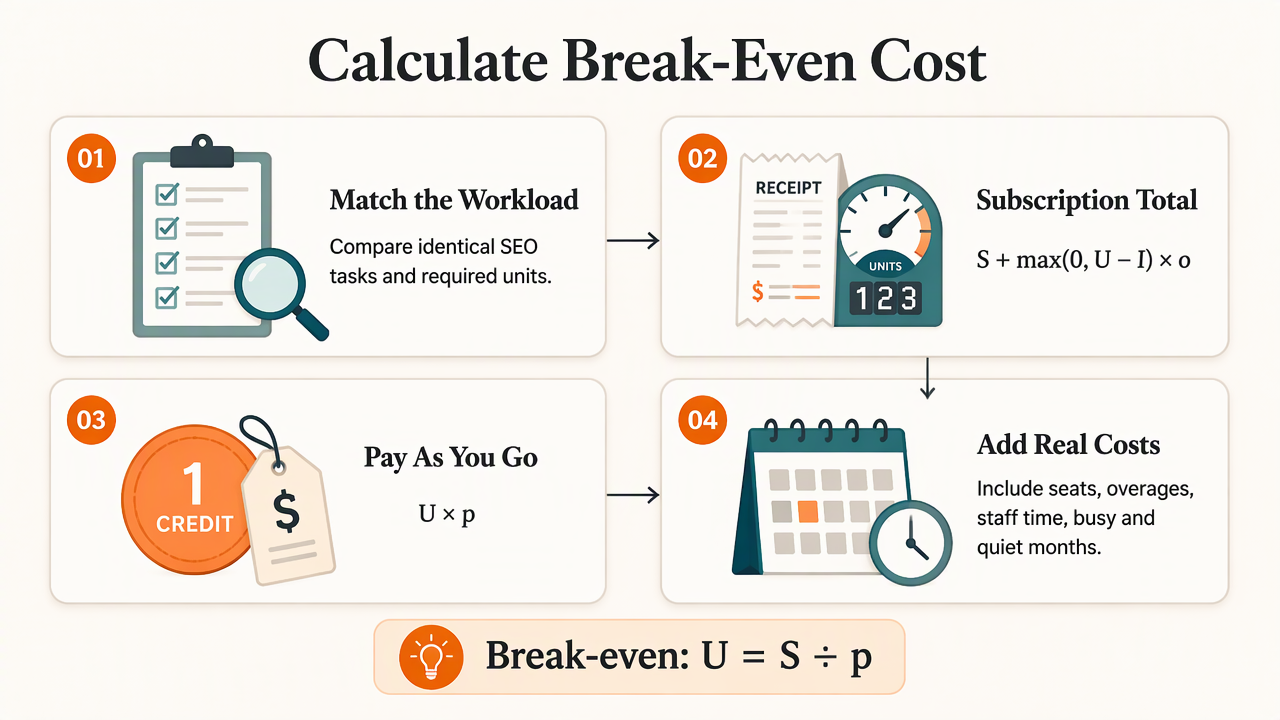
- Record the subscription fee and included allowance.
- Convert tasks into billable units using vendor rules.
- Add overages, required seats, and minimum purchases.
- Include staff time for setup and reporting.
- Compare totals across busy and quiet months.
Use a formula that includes overages
For comparable services, define S as the subscription fee, I as included units, U as required units, o as the overage rate, and p as the pay-as-you-go unit price.
- Subscription total:
S + max(0, U - I) × o - Usage-based total:
U × p - Simple break-even:
U = S ÷ p, when subscription usage stays within its allowance.
The simple formula only works when both options deliver equivalent outputs. Add separate fixed fees, taxes, or minimum top-ups where applicable. If overages require a plan upgrade instead, replace the overage calculation with that plan's actual price.
The supplied research doesn't contain verified vendor allowances, credit-consumption schedules, overage rates, or cancellation terms. A vendor-specific price comparison would therefore require checking current pricing pages and contracts.
Worked examples without invented vendor prices
These examples illustrate arithmetic, not published offers. Suppose a subscription's fee equals the cost of buying 100 equivalent units separately, and its allowance covers the workloads below.
Occasional research: At 25 units per month, metered usage costs one-quarter of the subscription fee. That favors usage pricing if both options provide the needed exports and data.
Recurring monitoring: At 150 units per month, metered usage costs one-and-a-half times the subscription fee. The subscription costs less under the stated assumptions.
Growing content program: Once usage exceeds the subscription allowance, the result depends on overage pricing. Recalculate the total rather than assuming the subscription remains cheaper. Include editing and publishing time when comparing content workflows.
Verify cancellation and credit terms
Cancellation changes the effective purchase cost. Check renewal dates, whether cancellation stops future billing or ends access immediately, and whether unused credits remain available. Annual commitments and monthly billing aren't interchangeable.
For a defined project, the 90-day SEO sprint playbook provides a useful planning frame. Estimate tool access across the full sprint, including the reporting period after publication.
Who should pick which billing model?
Occasional researchers should consider usage pricing, teams needing continuous tracking should consider subscriptions, and growing content programs should compare total production cost. The right choice follows the workflow rather than company size alone. A small local business may need steady monitoring; a larger startup may only need quarterly research.
Match the purchase to the recurring task
| Buyer and workload | Starting option | Purchase test |
|---|---|---|
| Founder researching a launch | Pay as you go | Can one purchase cover discovery and exports? |
| Local business tracking visibility | Subscription or free baseline tools | Does the plan support required locations and update frequency? |
| E-commerce team reviewing categories | Hybrid | Can research expand without disrupting monitoring? |
| Marketing team publishing regularly | Subscription or workflow platform | Does the plan cover production volume and collaboration? |
For lean teams, tracking SEO progress without expensive tools is a relevant starting point before adding a paid monitoring plan. Google Search Console can help establish an organic-performance baseline for verified properties.
Budget for the work around the tool
Total cost includes moving data, preparing reports, reviewing recommendations, and coordinating approvals. A lower software bill isn't automatically a lower operating cost. A team already committed to a reporting workflow may value continuity more than a small difference in usage charges.
Paul, Ueno, and Dennis's 2024 digital-transformation paper addresses transformation from a multidisciplinary perspective. Rizvanović, Zutshi, and Grilo's 2022 startup-growth paper examines a framework connecting digital marketing and startup growth. Neither source establishes a subscription-versus-usage pricing winner.
Choose a billing model after identifying the recurring task, the required output, and the person responsible for delivery.
How Earlyseo handles this
Earlyseo provides a content-focused option for teams evaluating SEO production alongside research and monitoring. Its listed capabilities include SEO operations, competitor-aware content, and multilingual content. Those capabilities make workflow coverage a relevant purchase criterion alongside billing structure.
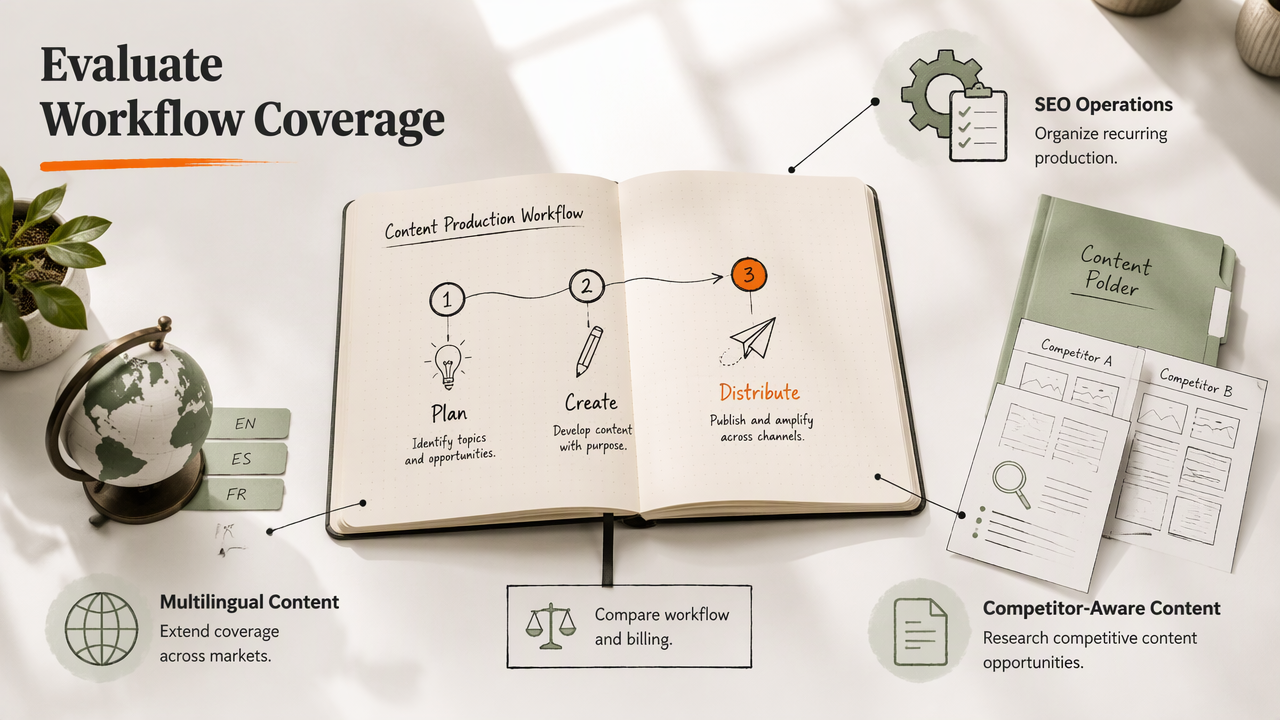
Evaluate content workflow coverage
The SEO operations feature is a relevant starting point for teams organizing recurring production. The competitor-aware SEO content feature fits evaluations centered on competitive content research. For cross-market programs, the multilingual SEO content feature adds language coverage to the buying criteria.
A useful evaluation can follow one planned page through research, drafting, review, and publication. Record the human handoffs and confirm which stages the selected plan supports. Product coverage and price should be assessed together.
Measure output before expanding access
For the Earlyseo platform, the practical benchmark is whether its workflow fits the team's publishing schedule and quality standards. Compare cost per reviewed, publishable page with the existing process, including human editing time.
- Confirm the intended monthly content volume.
- Check current plan allowances and billing terms.
- Test language and competitor-research requirements.
- Expand access after validating the workflow.
FAQ: SEO tool billing decisions
SEO tool billing decisions depend on usage frequency, equivalent outputs, and contract terms rather than the pricing label alone.
A purchase decision is strongest when the expected workload and renewal obligations are documented before payment.
Is pay-as-you-go always cheaper for small businesses?
Pay-as-you-go isn't always cheaper for small businesses. Frequent rank checks, multiple locations, or repeated exports can make usage costs add up. The comparison should use the actual monthly workload and equivalent capabilities. A subscription can be better value when its included allowance covers recurring tasks the business genuinely needs.
Can a subscription and usage-based tools work together?
A subscription and usage-based tools can work together when they serve different jobs. A team might keep continuous monitoring on a recurring plan and buy research credits for occasional campaigns. The setup works best when responsibilities are clear and both purchases support distinct outputs rather than duplicating the same research.
What should be checked before an annual commitment?
Before an annual commitment, check usage allowances, seat limits, renewal conditions, cancellation timing, export access, and any credit expiry rules. A shorter evaluation period can establish actual demand first. Annual pricing should be compared against the months of access the business expects to need, not automatically against twelve fully used months.
Conclusion
The next step is a workload-based comparison: price a normal month, a quiet month, and a production spike using current vendor terms. For content-focused teams, visit earlyseo.com to review workflow coverage, then test one representative page before committing to a larger plan.