TL;DR
Block training crawlers selectively when content protection matters, while preserving search access for pages intended to attract customers. Audit robots.txt and CDN rules separately, and measure discovery and referrals because crawler access alone doesn't guarantee citations.
Blocking AI training and blocking search discovery are different decisions. The most useful seo advice on blocking ai crawlers starts with identifying what each bot does, rather than treating every AI-related request alike.
AI crawler: An automated client that accesses web content for purposes such as model training, search discovery, or retrieval for an AI response. Those purposes require separate access decisions.
For businesses building organic visibility, Earlyseo provides a content-focused starting point for planning useful, discoverable pages. A crawler policy should support that publishing strategy while reflecting the business's content rights and security requirements.
Table of Contents
Does blocking AI crawlers affect SEO?
Blocking AI crawlers can affect SEO when the blocked crawler supports search discovery or retrieval, but blocking a training-only crawler serves a different purpose. The effect depends on the bot, the rule, and the delivery layer. A training restriction isn't automatically a search indexing restriction, and access never guarantees inclusion.
Training, indexing, and retrieval have different jobs
- Training: Content may contribute to building or improving a model. Training access doesn't create a guaranteed live citation.
- Indexing: A search system discovers and processes pages for possible inclusion in results.
- User-triggered retrieval: An assistant fetches a page in response to a person's request, potentially outside its regular search crawl.
A local electrician's public service pages usually have a different business purpose from a publisher's paid research archive. The electrician benefits from discoverability; the publisher may prioritize licensing and controlled access.
The decision should follow the content's purpose, not simply whether a bot's name contains "AI."
Access creates eligibility, not an endorsement
Allowing a crawler makes content accessible to that crawler; it doesn't compel a search engine or assistant to select, rank, or cite the page. Relevance, freshness, available evidence, and the answer's context still matter.
Crawl permission opens a door. It doesn't reserve a place in an AI answer.
Clear answers and a sound internal linking strategy help make public information easier to discover and interpret. They remain useful even when AI referral traffic is small.
Which crawler controls should businesses separate?
Businesses should separate training controls, search crawlers, and user-triggered fetchers before changing access rules. The reference below is dated November 27, 2026, for policy planning, not as evidence of a live documentation audit. Provider documentation should be checked before deployment because names, purposes, and enforcement behavior can change.
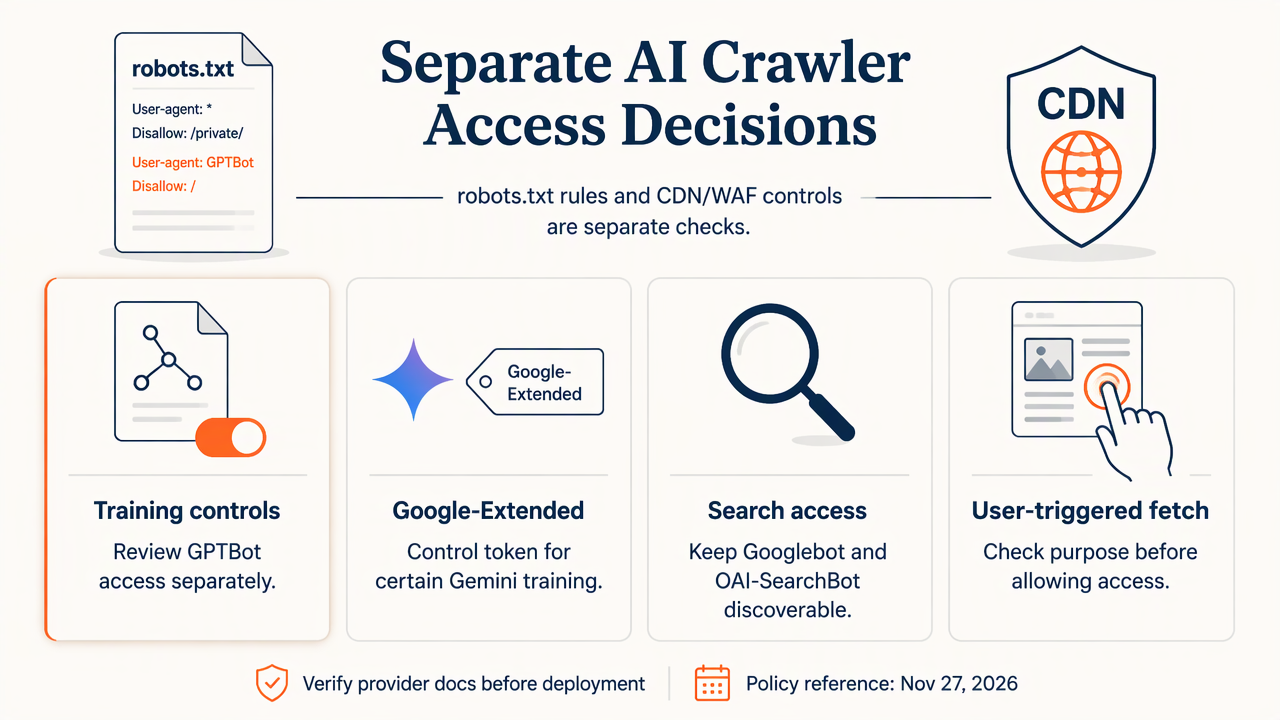
Crawler-control reference for November 2026
| Provider and identifier | Main role | Practical access decision |
|---|---|---|
Google: Googlebot |
Google Search crawling | Preserve access to public pages intended for Google discovery. |
Google: Google-Extended |
Control token for certain Gemini training and grounding uses | Evaluate separately from Google Search; it isn't a separate HTTP crawler identity. |
OpenAI: GPTBot |
Crawling content that may support model training | Restrict when training reuse conflicts with the content policy. |
OpenAI: OAI-SearchBot |
Search discovery for ChatGPT search | Preserve access when ChatGPT search visibility is desired. |
OpenAI: ChatGPT-User |
User-triggered page access | Evaluate separately; robots.txt rules may not apply to these requests. |
Google's AI search features shouldn't be confused with Gemini-specific controls. Restricting Google-Extended isn't equivalent to opting out of Google Search or its AI features.
Similarly, OpenAI's training and search identifiers represent different functions. A rule aimed at GPTBot shouldn't be treated as a blanket policy for every OpenAI request.
Choose rules by business objective
- Public marketing pages: Favor search discovery and evaluate training permission separately.
- Paid or licensed material: Use authentication and explicit rights policies rather than relying only on crawler requests.
- High-cost crawling: Investigate request volume and expensive endpoints before restricting entire providers.
For online shops, product and category pages deserve particular attention. The small-store ecommerce SEO guide provides related guidance on the pages that support organic product discovery.
How can businesses block training bots selectively?
- Inventory crawler requests and existing access rules.
- Classify each provider's training, search, and retrieval functions.
- Add targeted robots.txt directives for supported training controls.
- Configure verified CDN or firewall rules where enforcement is needed.
- Test public pages and monitor crawl responses after deployment.
Use robots.txt for cooperative crawler instructions
A selective robots.txt policy can restrict identified training uses while leaving search access unchanged. The following example addresses OpenAI's training crawler and Google's separate Gemini-related control token; it isn't a universal AI block.
User-agent: GPTBot
Disallow: /

User-agent: Google-Extended
Disallow: /
Existing groups must be reviewed before adding this example. A broad User-agent: * restriction can affect unrelated crawlers, and provider-specific groups need careful testing against the complete file.
Robots.txt isn't authentication. Sensitive customer records, unpublished documents, and paid downloads belong behind access controls. Hartmann and colleagues' 2023 survey of LLM memorization examines memorization, a separate issue from whether a current crawler follows an access instruction.
Check the CDN and origin independently
A permissive robots.txt file won't help a crawler that receives a firewall denial or browser challenge. CDN bot settings, origin rules, and application middleware should therefore be tested separately.
- Review actual status codes and challenge responses in logs.
- Verify crawler identity using provider-supported methods, rather than trusting the user-agent string alone.
- Test representative homepage, service, product, and article URLs.
- Record each change, its owner, and its intended effect.
A website migration checklist is useful when hosting or CDN changes coincide with crawler-policy updates.
What should change in crawler policies in 2027?
Crawler policies in 2027 should remain easy to revise as providers adjust retrieval methods and access controls. Businesses should schedule documentation reviews, retain change logs, and compare server activity with search performance. Stable rules need evidence, not assumptions that every future AI request will behave like today's crawlers.
Maintain a provider-by-purpose register instead of a permanent "block all AI" switch.
How Earlyseo supports crawler-aware SEO
Earlyseo fits the content-planning and SEO-operations side of a crawler-aware publishing strategy. Public pages need a defined audience, a clear question to answer, and a measurable business purpose. Those requirements give the technical team a useful basis for deciding which pages should remain discoverable.
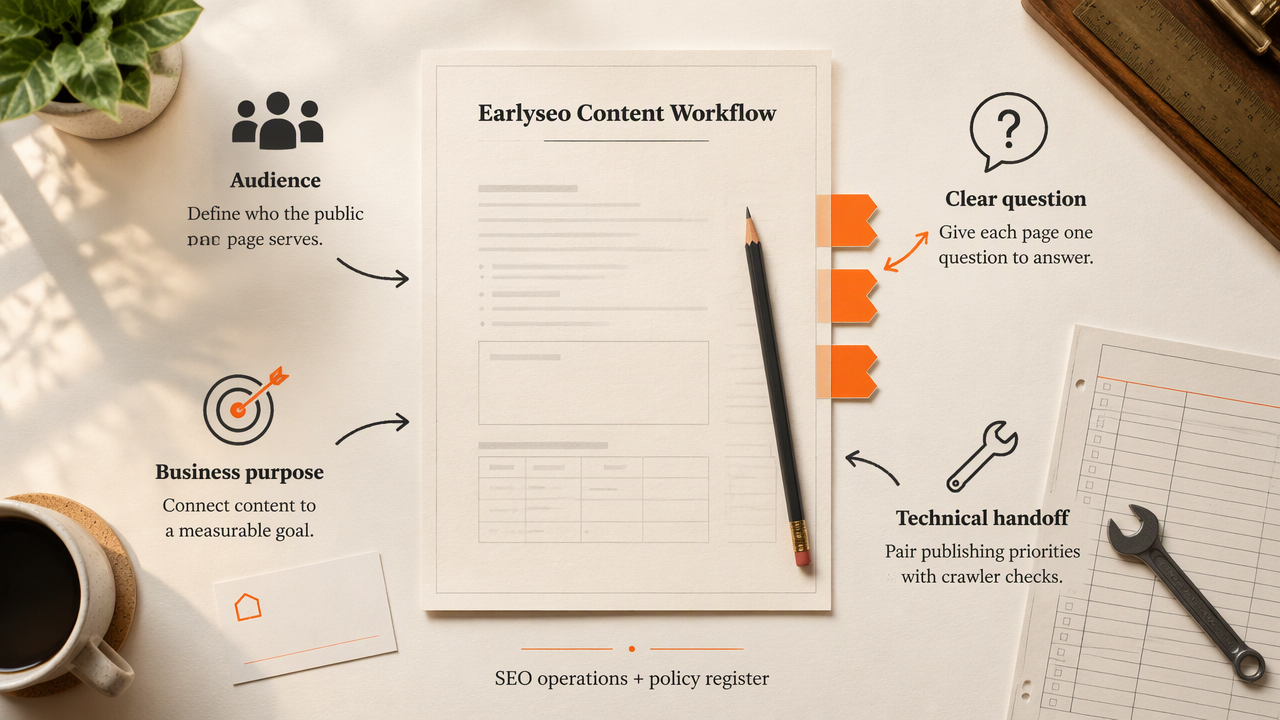
Connect publishing plans with measurable outcomes
The platform's SEO operations offering is a relevant starting point for organizing content work alongside technical checks. Teams can pair publishing priorities with a separate crawler-policy register maintained by the website administrator.
A practical measurement plan includes:
- Discovery: Whether priority pages are being crawled and indexed.
- Visibility: Whether relevant searches surface the business's pages.
- AI referrals: Visits attributable to assistants where referral data is available.
- Business value: Qualified inquiries, purchases, or other meaningful conversions.
A 90-day SEO sprint can give that review a defined schedule. Decisions become easier when content releases, crawler changes, and performance observations share a timeline.
FAQ: AI crawler access and search visibility
AI crawler policies work best when training permission, discoverability, and content security remain separate decisions.
Will blocking GPTBot remove a website from Google?
Blocking GPTBot doesn't instruct Google to remove a website. Google's crawling and indexing use separate controls. However, a broader firewall rule could accidentally affect other clients, so the implementation matters. Googlebot access, page responses, and indexing directives should be checked independently rather than assuming the intended training restriction is the only change.
Does allowing AI bots guarantee citations?
Allowing AI bots doesn't guarantee citations, rankings, or referral traffic. Accessible content still has to be relevant to the request and useful within the system's answer. Businesses should evaluate actual visibility and conversions rather than treating a successful crawler request as proof that an assistant will recommend the page.
Can robots.txt protect confidential information?
Robots.txt cannot protect confidential information because it provides crawler instructions rather than access security. Noncompliant clients may ignore it, and publicly reachable files remain exposed. Authentication, authorization, and appropriate storage controls are the right protections. Crawler rules can supplement those measures, but they shouldn't replace them for private business or customer information.
Conclusion
The strongest seo advice on blocking ai crawlers is to make purpose-specific decisions, test every enforcement layer, and review measured outcomes. Assign an owner to the crawler register and schedule the next access audit. For a coordinated content plan, businesses can explore Earlyseo at earlyseo.com and pair publishing priorities with that review.