TL;DR
Managed SEO is best when a business needs expert strategy, execution, and accountability; SEO software is best when an internal team can act on recommendations. Many growing companies should use a hybrid model: software for audits, tracking, and publishing support, plus human judgment for priorities and competitive strategy.
Most SEO failures are not caused by missing data; they come from unclear ownership. The managed SEO vs SEO software decision matters because both options can improve visibility, but they solve different operating problems. Search engine optimization, according to the standard definition, is the practice of improving website and web page visibility and performance in search engine results pages. For founders, local businesses, ecommerce teams, and lean marketing departments, Earlyseo fits the software side of that decision by helping teams act faster without turning SEO into a full-time research job.
Table of Contents
What is managed SEO vs SEO software?
Managed SEO vs SEO software compares a service-led model with a tool-led model. Managed SEO gives a business outside specialists who plan, execute, and report on search work. SEO software gives a team data, recommendations, automation, and workflows, while internal staff still make decisions and publish changes.
Managed SEO: A done-for-business service where an agency, consultant, or SEO team handles strategy, technical fixes, content planning, reporting, and often implementation.
SEO software: A platform that supports keyword research, audits, rank tracking, competitor analysis, content briefs, reporting, and technical monitoring.
Hybrid SEO: A mixed model where software handles repeatable tasks and humans handle prioritization, creativity, approvals, and higher-risk decisions.
Key insight: managed SEO buys judgment and accountability; SEO software buys speed, visibility, and repeatable process.
Competitor pages in the SERP often split the market into enterprise SEO platforms, point tools, and service providers. That framing helps larger teams, but smaller companies need a simpler question: who will actually do the work after the audit appears?
Decision table for operating models
| Factor | Managed SEO | SEO software | Hybrid model |
|---|---|---|---|
| Cost pattern | Higher monthly retainer | Lower subscription cost | Medium, split across tool and expert help |
| Time required internally | Lower day to day | Higher day to day | Moderate |
| Expertise needed | Lower internal SEO skill | Higher internal SEO skill | Medium |
| Accountability | External partner owns deliverables | Internal team owns outcomes | Shared ownership |
| Expected outcomes | Better for complex strategy and execution | Better for tracking, audits, and repeatable tasks | Best when growth matters but headcount is limited |
| Best fit | Competitive markets, migrations, technical debt | Founder-led sites, small teams, lean content ops | Ecommerce, local multi-location, growing teams |
Which option fits each business stage?
The right SEO model depends on staff capacity, technical complexity, revenue urgency, and how quickly changes can be published. A founder-led site usually needs focus and simple execution. A scaling ecommerce store often needs structured workflows, integrations, and expert review for high-impact pages.
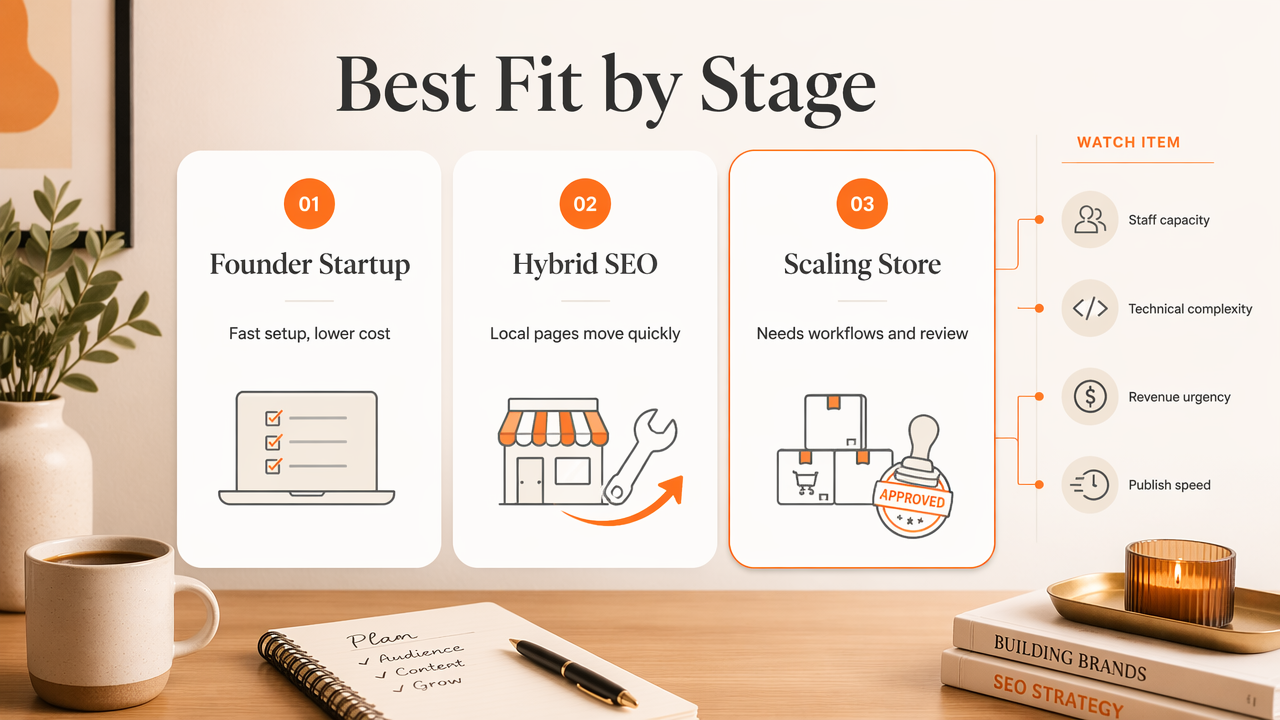
Recommendations by business type
| Business stage | Best starting model | Why it fits | Watch item |
|---|---|---|---|
| Founder-led startup | SEO software | Fast setup, lower cost, clear task lists | Strategy can become too narrow without expert review |
| Small local business | Hybrid or software | Local pages, service pages, and basics can move quickly | Reviews, listings, and local intent still need attention |
| Growing marketing team | Hybrid | Software keeps work organized while experts guide priorities | Internal publishing bottlenecks can slow gains |
| Ecommerce store | Hybrid or managed SEO | Category pages, product templates, and technical SEO need care | Site changes can affect many URLs at once |
| Enterprise team | Managed SEO plus enterprise platform | Governance, reporting, and cross-team coordination matter | Tool overlap can increase cost |
A founder-led business with one website and limited content can start with software, especially when the goal is indexing, content cleanup, and basic keyword targeting. A small business using WordPress may also benefit from a direct publishing workflow through a WordPress SEO integration, since fewer manual steps means fewer stalled tasks.
Ecommerce changes the math. A store with many product and collection pages needs cleaner templates, stronger internal linking, and ongoing monitoring. A Shopify store can reduce friction by connecting SEO work to publishing through a Shopify integration for SEO workflows. Managed help becomes more attractive when organic revenue already affects inventory, merchandising, or paid-search efficiency.
What are the cost, time, and accountability tradeoffs?
Managed SEO usually costs more because it includes human planning and execution, while SEO software costs less but requires internal labor. The real comparison is not subscription versus retainer; it is total cost of action, including meetings, approvals, writing, technical fixes, and measurement.
A tool can surface thousands of issues. That does not mean each issue deserves attention. Managed providers can reduce noise by ranking tasks according to business impact, search demand, and implementation risk.
Software, however, wins when repeatable work matters. Rank tracking, crawling, page checks, competitor monitoring, and content inventory are better handled by systems than spreadsheets.
Practical tradeoff checklist
- Pick managed SEO when the site has technical debt, a migration, a competitive niche, or no internal owner.
- Pick SEO software when an employee can publish changes, update pages, and review reports each week.
- Pick a hybrid model when budget exists for advice, but daily execution needs to stay in-house.
- Avoid buying any tool or service before naming the person responsible for implementation.
- Review outputs monthly, not daily, because SEO decisions need enough data to avoid overreacting.
A clear owner matters more than a long feature list. SEO work compounds only when recommendations become shipped pages, fixed templates, and measurable experiments.
Research on artificial intelligence is also changing buyer expectations. A 2023 paper titled Generative AI placed generative systems squarely inside business information systems research, which mirrors the direction of SEO software in 2026: more drafting, clustering, summarizing, and workflow support. Technical reviews such as Zhou, Greenspan, and Davatzikos on deep learning in medical imaging also show a broader pattern across fields: automated systems can assist experts, but expert validation still matters when decisions carry risk.
How Earlyseo handles the software side
Earlyseo is built for teams that want software-supported SEO execution without adding a heavy enterprise platform. The Earlyseo platform focuses on practical workflows: turning site and content opportunities into work that a founder, marketer, or store operator can actually ship.
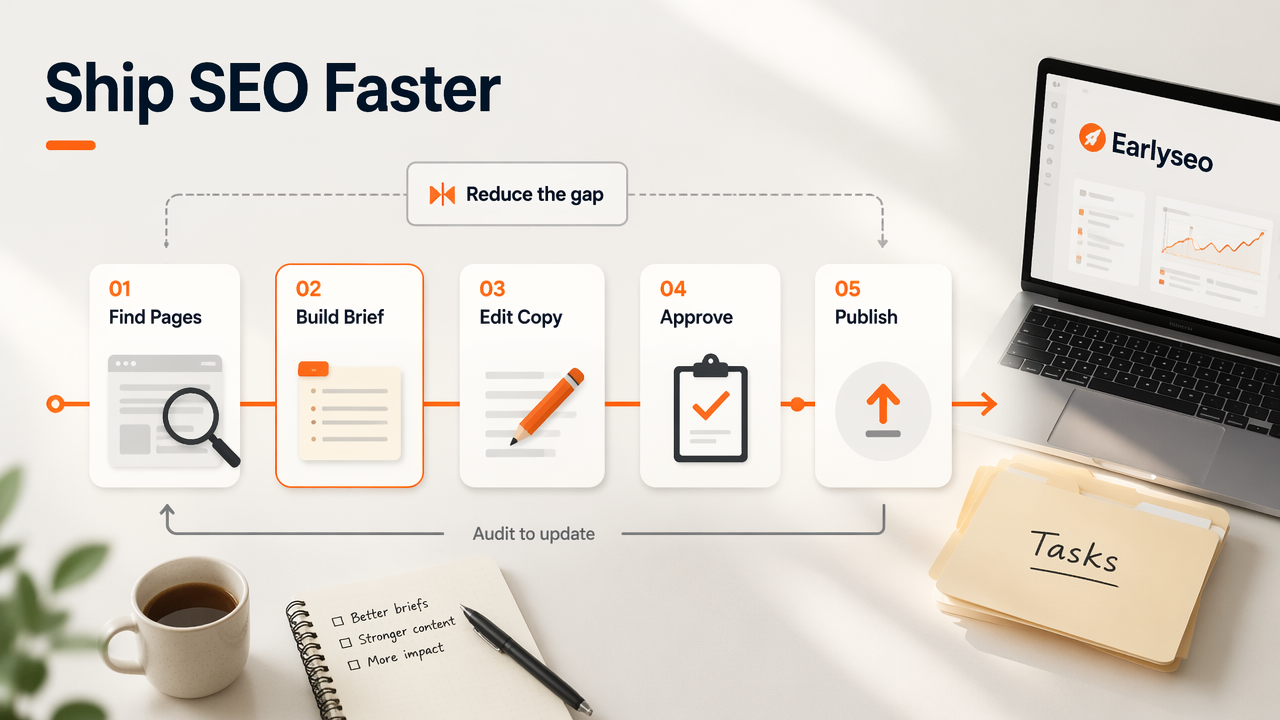
The strongest use case is not replacing expert thinking. It is reducing the time between finding an opportunity and publishing the fix. That matters for small teams because SEO momentum often dies in the gap between audit, brief, edit, approval, and update.
Workflow fit for lean teams
- Identify pages that need attention through audits, rankings, or content gaps.
- Prioritize work by business value, not only by technical issue count.
- Create or update content with a clear target query and search intent.
- Publish changes through the site's CMS or store platform.
- Track results over time and refine based on movement in search results.
Teams that want to understand setup details can use the Earlyseo documentation. Companies preparing for AI search visibility can also review the llms.txt guidance, since machine-readable site context is becoming part of the broader conversation around discoverability.
Earlyseo works best when the business already has someone who can approve edits, make page changes, or coordinate with a developer. In that case, earlyseo.com can support a lean SEO process without forcing a full managed-service relationship.
What should change in 2026 and 2027?
SEO decisions in 2026 should account for AI answers, structured content, stronger technical hygiene, and faster publishing cycles. Search is no longer only about ranking blue links; brands also need pages that answer questions clearly enough for search engines and AI systems The old split between agency and tool is getting softer. Managed providers increasingly use automation, and software platforms increasingly include guided recommendations. That pushes buyers toward outcome-based evaluation instead of feature counting.
Signals to monitor before switching models
- Organic traffic is flat, but impressions are rising.
- Important pages rank, but snippets or AI summaries favor competitors.
- Content production exists, but old pages rarely get refreshed.
- Technical issues return after each site update.
- Reporting meetings describe problems but do not produce shipped fixes.
A business should upgrade from pure software to managed SEO when risk increases. Examples include site migrations, international SEO, complex JavaScript rendering, large catalog cleanup, or aggressive competitors.
A business should move from fully managed SEO toward software support when internal staff can execute consistently. That shift can lower dependency on outside calendars and make search work part of normal marketing operations.
For 2027, the likely winner is the hybrid team: software for monitoring, briefs, structured workflows, and reporting; people for positioning, judgment, original experience, and approval. That model matches how search is changing, especially as AI summaries reward pages with clear definitions, tables, and direct answers.
FAQ: managed services, tools, and hybrid SEO
Is managed SEO better than SEO software?
Managed SEO is better when a business needs expert strategy, execution, and accountability. SEO software is better when an internal person can review recommendations and publish changes. The better choice depends on ownership, not only budget. A hybrid setup often works best once organic search becomes a meaningful growth channel.
Can SEO software replace an agency?
SEO software can replace some agency tasks, such as audits, rank tracking, reporting, and content workflow management. It usually cannot replace market judgment, technical diagnosis, brand positioning, or cross-functional leadership. A company with strong internal marketing talent may need software more than a retainer; a company without that talent may still need managed help.
When should a small business hire managed SEO?
A small business should consider managed SEO when the website has technical problems, the local market is competitive, or no employee has time to act on tool recommendations. Managed help also makes sense when revenue depends on search visibility and slow execution has become more expensive than the retainer.
What is the safest first step?
The safest first step is a focused SEO workflow with a named owner, a short list of priority pages, and a monthly review cycle. Software can help reveal the work, while a consultant or agency can validate higher-risk decisions. The goal is shipped improvements, not larger reports.
Conclusion
The managed SEO vs SEO software choice should come down to execution capacity. If a team lacks time, technical confidence, or strategic direction, managed SEO is the safer path. If a team can publish updates and follow a repeatable process, software can move faster and cost less. For many growing companies, the best next step is hybrid: use Earlyseo to organize and ship SEO work, then bring in expert help for migrations, competitive strategy, or complex technical decisions. For a practical starting point, visit earlyseo.com and map the next 10 pages that deserve SEO attention.