TL;DR
The Google Sandbox is best treated as an unconfirmed theory, not a proven Google penalty. New websites usually rank slowly because Google lacks trust signals, crawl history, topical authority, and user engagement data, so the practical fix is better indexing, stronger content, clean technical SEO, and credible links.
A new website can publish solid pages, get indexed, and still sit quietly outside the top results for weeks or months. That gap is why the phrase google sandbox for new websites myth or reality keeps attracting founders, local businesses, and e-commerce teams looking for a clear answer. Earlyseo helps newer sites build the basics that search engines can understand, from indexable pages to AI-readable content signals, through the Earlyseo platform.
Google Sandbox: an unofficial SEO theory that Google holds back new or long-inactive domains until they build enough trust, relevance, and history to rank competitively.
Key takeaway: the safest assumption is that new-site ranking delays are real, but a confirmed "sandbox penalty" is not.
Table of Contents
Is the Google Sandbox for New Websites Myth or Reality?
The Google Sandbox is partly reality as an observed delay, but still a myth as an officially confirmed ranking system. The sandbox effect has been discussed since 2004, yet its existence has not been confirmed, and available descriptions frame it as a theory about how Google ranks pages in its index.
Google has not publicly documented a specific "sandbox" filter for legitimate new websites. Still, many SEO teams see a common pattern: fresh domains get crawled, indexed, and tested slowly before earning stable rankings in competitive search results.
That distinction matters. Treating the sandbox as a penalty creates passive waiting. Treating it as a trust-building phase leads to useful work: publishing better content, improving crawl paths, earning mentions, and proving topical focus.
Myth vs. reality comparison
| Claim | Better 2026 interpretation | Practical response |
|---|---|---|
| Google has a confirmed sandbox penalty | Unconfirmed; the idea remains an SEO theory | Avoid panic and diagnose real blockers |
| New sites cannot rank at all | New sites can rank, especially for specific or low-competition queries | Target long-tail, local, and product-led terms first |
| Waiting fixes the problem | Time helps only when trust signals grow | Publish, improve, interlink, and earn references |
| Ads remove the sandbox | Paid ads do not create organic ranking authority | Separate paid traffic from SEO performance |
The best framing is simple: new domains often lack evidence. Google has less history about content quality, ownership, topical depth, user satisfaction, and link context. A delay can happen without any hidden punishment.
What Actually Slows New Sites in Google?
New websites usually rank slowly because Google has limited evidence about their quality, relevance, and reliability. Search systems need crawl data, internal structure, external references, and query-level engagement before a domain can compete against older sites with years of signals.

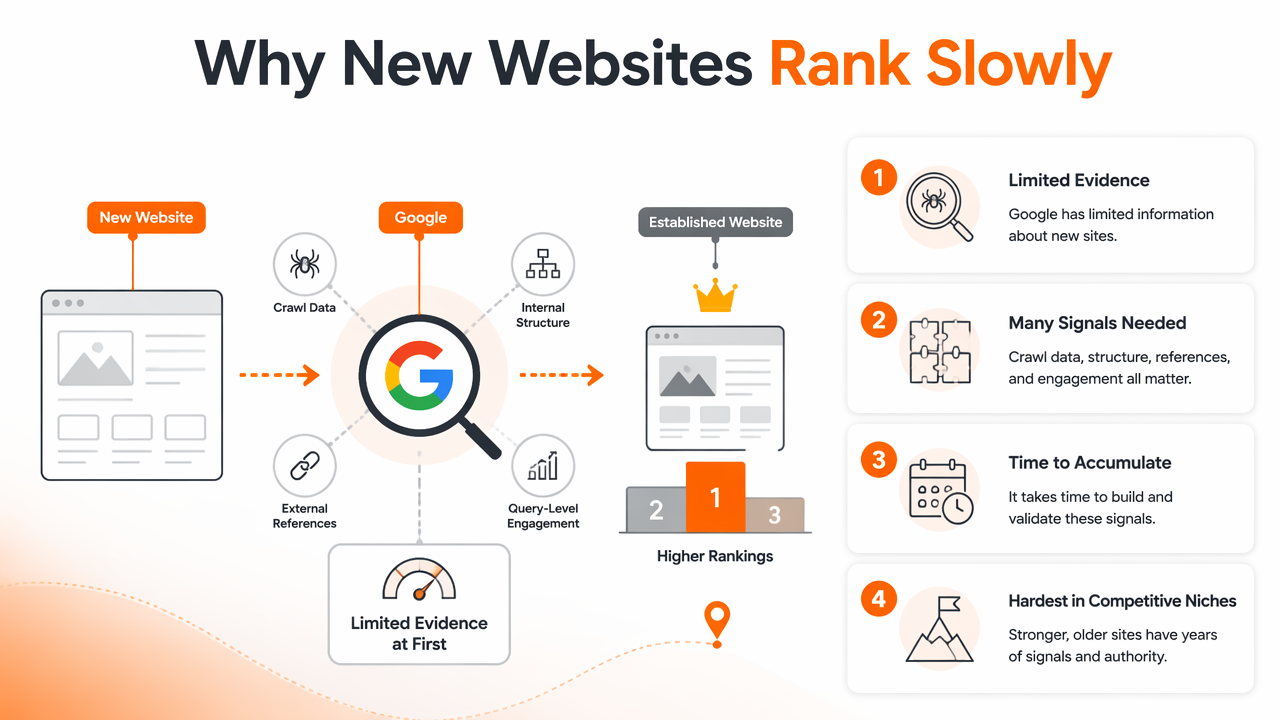
The delay is strongest in competitive categories such as finance, health, legal, software, and national e-commerce. Local service pages and narrow informational articles can move faster when intent is clear and competition is thin.
New domains also tend to ship with avoidable technical gaps. These include thin category pages, weak internal links, duplicate title tags, blocked resources, missing schema, slow templates, and content that repeats generic advice already ranking elsewhere.
Common causes behind the delay
- Low crawl history: Google has not yet learned how often the site changes or which pages matter most.
- Weak topical authority: A few isolated posts rarely prove expertise across a subject.
- Few credible references: Links, mentions, citations, and brand searches help confirm legitimacy.
- Unclear internal linking: Important pages stay buried when navigation and contextual links are weak.
- Thin or duplicated content: New pages that echo existing results give Google little reason to reshuffle rankings.
- Poor technical hygiene: Indexing errors, canonical conflicts, and slow pages reduce confidence.
Search visibility is also affected by how clearly machines can parse a website. For AI search and answer engines, structured access matters, which is why newer sites can review Earlyseo's llms.txt guidance when preparing content for LLM discovery.
A useful non-SEO analogy
The word "sandbox" is used in other fields to mean a controlled testing space. A 2023 IEEE Control Systems introduction to safety-filtering approaches by Kerianne L. Hobbs, Mark Mote, and Matthew Abate discusses runtime assurance for complex systems, where constraints help manage risk in safety-critical environments: Runtime Assurance for Safety-Critical Systems.
SEO is not the same field, but the analogy helps. Search engines can test unfamiliar pages carefully before assigning them broad visibility. That can feel like a box, even when it is simply cautious evaluation.
How Long Does the New-Site Ranking Delay Last?
A new-site ranking delay can last from a few weeks to several months, depending on competition, content quality, crawlability, links, and brand demand. No credible public source confirms a fixed sandbox length, so timelines should be treated as planning ranges rather than rules.

A narrow local site with useful service pages may gain impressions quickly. A new affiliate site in a crowded national market may need much longer because older competitors already have content depth, backlinks, and behavioral history.
Search Console data is the best early signal. Impressions without clicks can mean the site is visible but not compelling. Rankings stuck just outside strong click zones may need better titles, stronger intent matching, and richer snippets.
Planning timeline for a new domain
| Phase | Typical signal to watch | Main job |
|---|---|---|
| Weeks 1 to 4 | Indexing, crawl discovery, branded queries | Submit sitemaps, fix technical issues, publish core pages |
| Months 2 to 3 | Impressions for long-tail terms | Expand topic clusters and improve titles |
| Months 4 to 6 | First stable non-branded rankings | Build internal links and earn external mentions |
| Months 6+ | Broader query growth | Refresh winners, consolidate weak pages, scale content quality |
A new site should not measure success only by rankings. Index coverage, impressions, crawl frequency, and query diversity often improve before clicks arrive.
For sites built on common content management systems, implementation speed matters. Teams publishing on WordPress can connect SEO workflows through the Earlyseo WordPress integration, while store owners can prepare product and collection pages through the Earlyseo Shopify integration.
How Can New Websites Build Trust Faster?
New websites build trust faster by making every important page easy to crawl, clearly useful, internally connected, and supported by credible external signals. The goal is not to "escape" a sandbox; the goal is to remove uncertainty around quality and relevance.
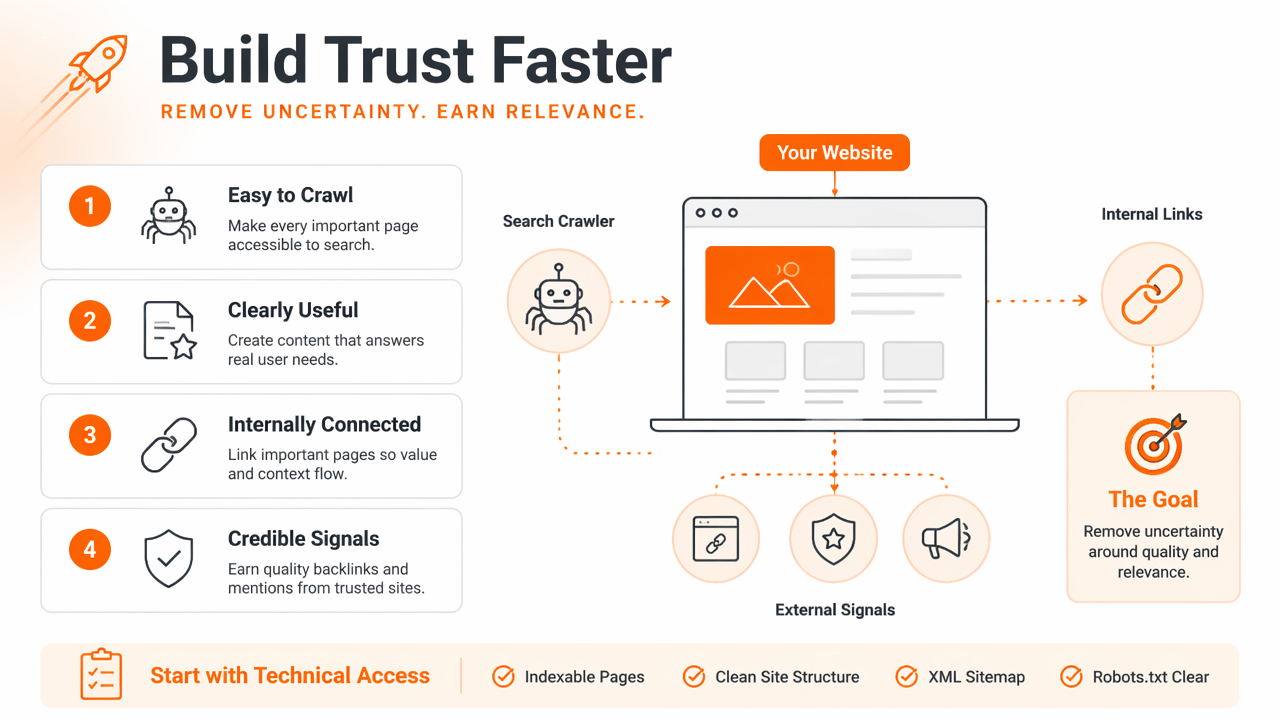
A practical plan starts with technical access. Google cannot reward pages it cannot crawl, render, canonicalize, or understand. Then content must map to real demand rather than broad topics that established publishers already own.
The Earlyseo platform fits this stage because new sites need repeatable checks, not guesswork. Founders and lean marketing teams can use guided workflows, then validate changes against search behavior over time.
Seven trust-building actions
- Publish a complete core site: home, about, contact, service or product pages, privacy terms, and clear navigation.
- Target specific queries first: long-tail, local, comparison, and problem-aware keywords usually offer faster feedback.
- Create topic clusters: connect supporting articles to commercial pages with descriptive internal links.
- Fix indexation basics: use clean canonicals, XML sitemaps, robots rules, and status codes.
- Improve click appeal: rewrite titles and meta descriptions when impressions appear without clicks.
- Earn real mentions: local directories, partner pages, niche publications, and customer stories help establish legitimacy.
- Refresh early pages: update weak pages instead of letting thin content age unchanged.
Technical work should stay documented. A shared checklist, change log, and crawl notes reduce confusion as more pages go live; the Earlyseo documentation is a useful starting point for process-driven teams.
Signals worth tracking weekly
- Pages indexed vs. pages submitted
- Queries gaining impressions
- Average position by page type
- Click-through rate for pages ranking in positions 3 to 10
- Internal links pointing to priority pages
- Referring domains and unlinked brand mentions
- Pages with no impressions after 60 to 90 days
These signals keep the discussion grounded. A site may not need more content if existing pages are poorly linked. Another site may need deeper content if rankings appear only for branded or ultra-narrow queries.
FAQ: Google Sandbox Questions for 2026
The Google Sandbox remains an unconfirmed explanation for a real pattern: new websites often need time to earn durable organic visibility. In 2026, the better question is not whether a hidden filter exists, but whether a new domain has given Google enough evidence to rank it confidently.
Does Google officially confirm the Sandbox?
Google has not officially confirmed a specific Sandbox system for legitimate new websites. The sandbox effect is best described as an SEO theory that has existed since 2004. Ranking delays can still happen, but they are better explained by limited trust signals, weak authority, crawl history, and competition.
Can a new website rank quickly?
A new website can rank quickly for narrow, local, branded, or low-competition queries. Fast ranking is harder for broad commercial terms where established domains already have authority, content depth, and links. Early wins usually come from precise intent matching and technically clean pages.
Do backlinks help a site leave the Sandbox?
Backlinks can help when they are relevant, credible, and earned from real sources. Low-quality link schemes can create risk instead of trust. New domains should prioritize useful partnerships, local citations, expert contributions, digital PR, and content that naturally deserves references.
Should new sites publish more or improve existing pages?
Both can matter, but the decision should follow data. Pages with impressions and weak clicks may need better titles or content alignment. Pages with no impressions may need stronger internal links, clearer targeting, or consolidation. New publishing works best after the core technical foundation is stable.
Conclusion
The answer to google sandbox for new websites myth or reality is balanced: the named penalty is unproven, but the slow-start pattern is real enough to plan around. New domains need time, but time alone does not create authority.
The next steps are specific: confirm indexation, strengthen internal links, publish tightly focused pages, monitor Search Console weekly, and earn real-world references. For teams that want a structured way to build early organic visibility, head to earlyseo.com and start with the checks that prove a new site is ready to be discovered.