TL;DR
Buyer intent keywords usually include signs of budget, urgency, comparison, location, or a specific product need. The best process is to collect seed terms, inspect SERPs, score intent by funnel stage, then map each keyword to a page built for conversion, not just traffic.
High rankings do not matter much when the query comes from someone who only wants a definition. Learning how to identify buyer intent keywords for SEO means separating casual research from searches that signal money, timing, comparison, or service demand. Buyer intent keyword: a search query that suggests a person or company is close to evaluating, contacting, booking, or buying. Tools such as Earlyseo help growing teams turn these terms into publishable SEO pages, while earlyseo.com gives lean teams a practical place to manage the process.
Table of Contents
What are buyer intent keywords in SEO?
Buyer intent keywords are search queries that show a person is evaluating a purchase, comparing options, looking for a provider, or trying to complete a transaction. They usually contain modifiers such as best, pricing, near me, for Shopify, agency, alternative, demo, discount, or buy.
Buyer intent is not the same as search volume. A keyword with 90 searches per month can create more revenue than a 9,000-search informational phrase if the searcher needs a vendor now.
Key insight: commercial value comes from intent clarity, not from traffic size alone.
Academic research also supports the broader idea that digital signals affect purchase behavior. A 2022 paper in Frontiers in Psychology examined how social media marketing activities influence customer intentions, which reinforces why marketers should read intent signals across channels, not only inside keyword tools.
Common intent modifiers by business type
- Startup software: "best CRM for startups", "project management tool pricing", "Notion alternative for agencies"
- Local business: "emergency plumber near me", "family lawyer free consultation", "dentist open Saturday"
- Ecommerce store: "buy trail running shoes", "organic dog food subscription", "Shopify SEO app"
- Service company: "hire B2B content agency", "managed IT services quote", "book office cleaning"
A search for "what is local SEO" usually signals learning. A search for "local SEO agency pricing" signals evaluation. A search for "local SEO consultant near me" signals service need and location urgency.
How to identify buyer intent keywords for SEO
To identify buyer intent keywords for SEO, start with seed terms, expand them with commercial modifiers, inspect the live search results, score each keyword by purchase signal, and map the best terms to landing pages, comparison pages, product pages, or local service pages.
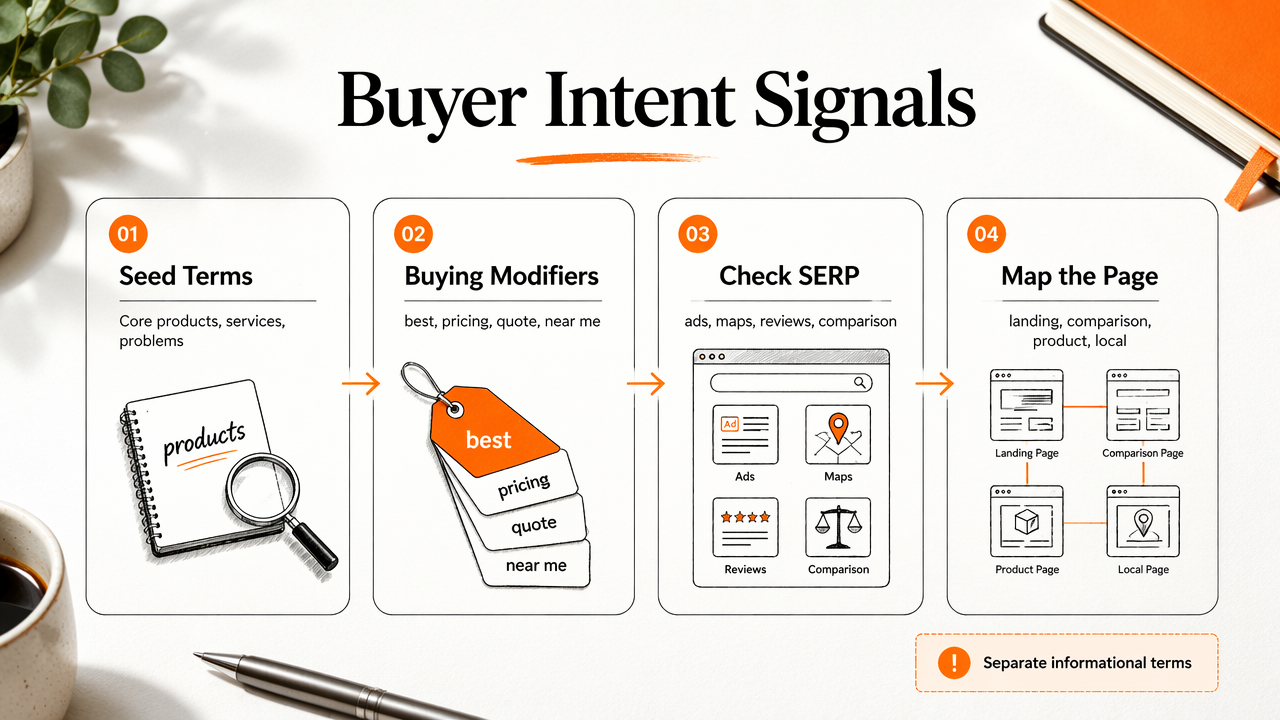
- List core products, services, categories, and customer problems.
- Add buying modifiers such as best, pricing, quote, near me, buy, reviews, alternative, and for [industry].
- Check the SERP for ads, product pages, maps, review sites, and comparison articles.
- Separate informational terms from commercial and transactional terms.
- Prioritize keywords that match existing offers and sales capacity.
- Build or improve the page most likely to satisfy the query.
SERP research for this topic found 162 results and 5 analyzed competitors, with an average competitor article length of 2,502 words. Most ranking pages explain definitions and examples, but fewer show a scoring system that fits startups, local firms, ecommerce stores, and service providers.
SERP clues that reveal buying intent
Search results often reveal intent faster than keyword tools. A query has stronger buying intent when Google shows:
- Sponsored ads at the top of the page
- Google Business Profile map results
- Product grids, shopping results, or category pages
- Review roundups such as "best X" lists
- Vendor comparison pages
- Pricing pages, booking pages, or quote forms
For publishing workflows, the Earlyseo documentation can help teams connect keyword selection with repeatable content operations instead of treating research as a one-time spreadsheet task.
AI search adds a new intent layer
Organic search is no longer only ten blue links. AI summaries and answer engines favor clear definitions, structured comparisons, and pages that directly answer user tasks. Research on instruction-following language models, including the 2023 paper Self-Instruct: Aligning Language Models with Self-Generated Instructions, shows why direct, well-structured answers matter for machine-readable content.
For AI search visibility, buyer intent pages should include concise definitions, comparison tables, decision criteria, and product-specific sections. Site owners can also study Earlyseo's llms.txt guidance for making important content easier for AI systems to interpret.
How should buyer intent keywords be scored by funnel stage?
Buyer intent keywords should be scored by how clearly they show problem awareness, solution evaluation, vendor comparison, or transaction readiness. A simple 1 to 5 score keeps teams from chasing broad traffic while ignoring terms that lead to calls, demos, carts, and quote requests.
A practical scoring model should include three checks:
- Commercial modifier: Does the phrase include pricing, best, buy, quote, demo, near me, or alternative?
- SERP evidence: Do search results show vendors, ads, maps, product pages, or comparison content?
- Business fit: Can the company serve the searcher immediately with a relevant offer?
Buyer intent scoring table
| Score | Funnel stage | Keyword pattern | Example | Best page type |
|---|---|---|---|---|
| 1 | Informational | What is, how does, guide | "what is inventory software" | Educational blog |
| 2 | Problem aware | Fix, improve, reduce, ideas | "reduce inventory errors" | Problem guide |
| 3 | Solution aware | Software, service, tool, provider | "inventory software for retail" | Feature or category page |
| 4 | Commercial | Best, pricing, reviews, comparison | "best inventory software for small business" | Comparison page |
| 5 | Transactional | Buy, book, quote, demo, near me | "inventory software demo" | Landing page |
A startup may prioritize score 4 terms such as "best accounting software for SaaS" because buyers want proof before booking a demo. A local electrician may prioritize score 5 terms such as "emergency electrician near me" because the need is immediate.
Examples for startups, local companies, ecommerce, and services
- Startup: "project management software pricing" beats "team productivity tips" when demo pipeline is the goal.
- Local business: "roof repair estimate Austin" beats "types of roof damage" when phone calls matter.
- Ecommerce: "buy waterproof hiking jacket" beats "how to layer for hiking" when product sales matter.
- Service company: "outsourced bookkeeping services for restaurants" beats "bookkeeping basics" when qualified leads matter.
For stores running on Shopify, keyword maps should connect commercial terms to collections, product pages, and buying guides. The Earlyseo Shopify integration is relevant when ecommerce teams need SEO publishing tied to store infrastructure.
How should pages be optimized for buyer intent?
Buyer intent pages should answer the commercial question quickly, prove fit with details, remove friction, and give the searcher a clear next action. The page should match the query type: comparison intent needs alternatives, local intent needs location proof, and transactional intent needs pricing, availability, or booking.
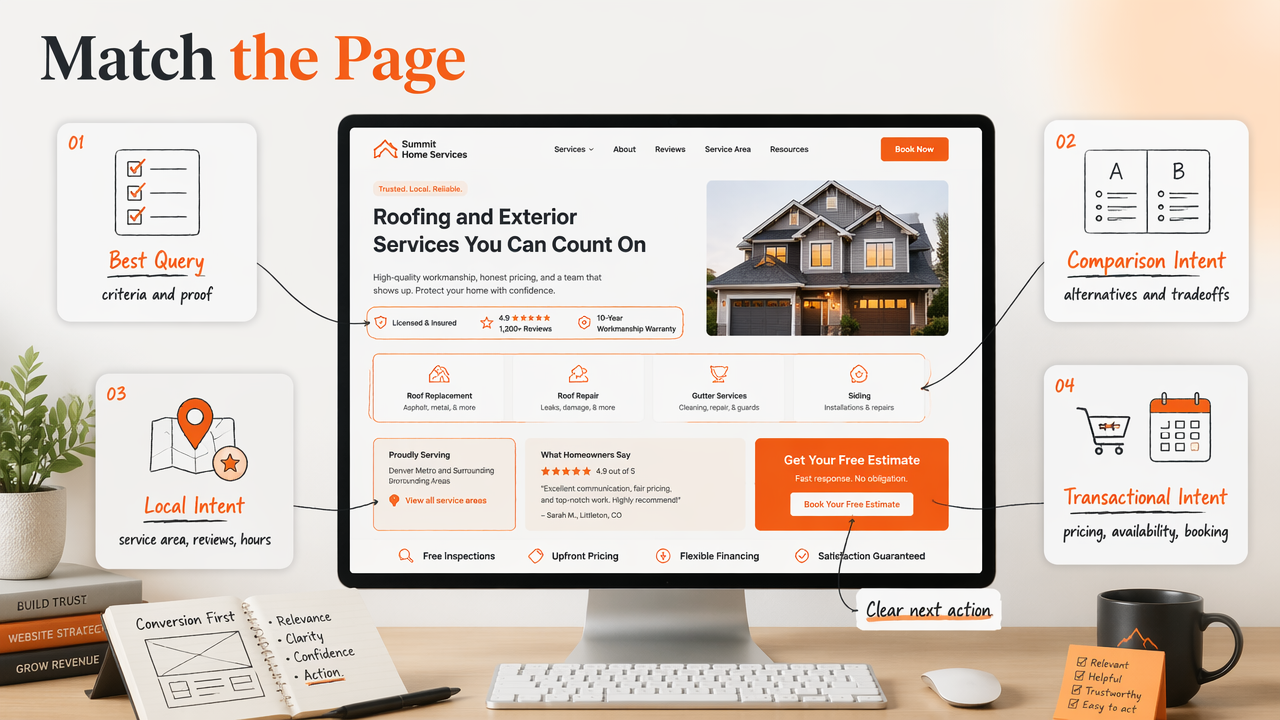
For conversion-focused SEO, the content format matters as much as the keyword. A "best" query needs criteria and tradeoffs. A "pricing" query needs cost context. A "near me" query needs service area, reviews, hours, and contact options.
Strong buyer-intent SEO does not push every visitor to the same page. It matches the page format to the decision the query implies.
Optimization checklist for commercial pages
Use this checklist when building pages around high-intent terms:
- Put the primary offer and audience in the H1 or opening copy.
- Add proof points such as use cases, industries, integrations, locations, or product specs.
- Include pricing guidance when the query contains cost language.
- Use comparison tables for "best", "vs", and "alternative" searches.
- Add FAQs that answer objections without sales fluff.
- Place calls to action near decision points, not only at the bottom.
- Track rankings, clicks, conversions, and assisted revenue.
The Earlyseo platform is useful when a team needs to produce many intent-matched pages without losing structure. Related publishing ideas can be planned from the Earlyseo blog resources, then refined into pages for commercial, local, or ecommerce searches.
Common mistakes that weaken buyer-intent targeting
Some pages fail because they attract the right query but answer the wrong job. A "pricing" page that avoids cost discussion feels incomplete. A "near me" page with no local proof feels generic. A comparison page that only praises one product feels less trustworthy.
Spamdexing should also be avoided. Based on the common definition, spamdexing means deliberately manipulating search engine indexes through tactics such as excessive phrase repetition or artificial relevance signals. Repeating buying modifiers across a page can make content worse for readers and search systems.
FAQ about buyer intent keyword research
Buyer intent keyword research works best when SEO, sales, and customer data are reviewed together. Search terms show what people ask, while CRM notes, call logs, support tickets, and product analytics show which questions appear before money changes hands.
What is the fastest way to find high-intent SEO keywords?
The fastest method is to combine seed terms with buying modifiers, then verify intent in the live SERP. Terms showing ads, maps, product listings, review pages, comparison content, or pricing pages deserve closer review. Search Console data can also reveal existing queries that already bring visitors with commercial behavior.
Are long-tail keywords better for buyer intent?
Long-tail keywords often show clearer intent because they include context such as audience, location, product type, or urgency. "CRM" is broad, while "best CRM for real estate agents pricing" shows category, audience, and evaluation stage. Lower volume can still be valuable when the query fits a profitable offer.
How many buyer intent keywords should a page target?
One page should focus on one primary intent, plus close variants that share the same search goal. A pricing page can target pricing, cost, and plan-related phrases. A comparison page should not also try to rank for broad educational queries if that makes the content unfocused.
How often should buyer intent keywords be reviewed?
Buyer intent keywords should be reviewed at least quarterly, and more often in fast-moving categories such as SaaS, ecommerce, finance, and local services. New competitors, AI search summaries, seasonal demand, and pricing changes can shift which pages deserve updates or new content.
Conclusion
The most reliable way to learn how to identify buyer intent keywords for SEO is to treat every keyword as a business signal, not just a traffic opportunity. Start with offers, add commercial modifiers, inspect the SERP, score intent from 1 to 5, then build the page type that matches the decision stage.
Earlyseo can support that workflow by turning keyword plans into structured, search-ready pages for startups, ecommerce stores, local firms, and service companies. For the next step, pick 20 existing keywords, score them with the table above, and move the top 5 into a publishing or optimization queue. More practical SEO workflows are available on earlyseo.com.