TL;DR
The best startup SEO partner should deliver technical fixes, keyword strategy, content execution, analytics, and AI search readiness within the first 90 days. Early-stage teams should prioritize services tied to revenue paths, not vanity traffic, and avoid contracts that hide deliverables or promise instant rankings.
The best SEO services for startups are the ones that turn limited budget, limited authority, and limited time into measurable search visibility. Search engine optimization: SEO is the practice of improving a website's visibility and performance in search engine results pages, with the goal of earning more relevant organic traffic. For founders comparing agencies, consultants, and software-led workflows, Earlyseo fits the modern need for search visibility across Google and AI answer engines. A 2026 SERP review for this topic showed 161 results and competitor pages averaging 3,023 words, but many still read like agency directories instead of practical buying guides.
Table of Contents
What are the best SEO services for startups in 2026?
The best SEO services for startups in 2026 combine technical SEO, keyword strategy, content production, analytics, conversion alignment, and AI search optimization into one focused growth system. Early-stage companies usually need fewer services than mature brands, but each service must connect to search demand, product positioning, and measurable business outcomes.
A startup does not need every SEO tactic at once. A SaaS company may need bottom-funnel comparison pages, while a local service business may need Google Business Profile support and location pages. An e-commerce startup may need collection-page optimization, technical cleanup, and product schema before publishing a large blog.
Key insight: a strong startup SEO program should create search visibility where buying intent already exists, not chase broad keywords that take years to rank.
Core startup SEO service comparison
| SEO service | Best fit | First useful deliverable | Startup priority |
|---|---|---|---|
| Technical SEO audit | Any site with crawl, speed, or indexing issues | Fix list ranked by impact | High |
| Keyword and ICP mapping | SaaS, services, marketplaces | Keyword map by funnel stage | High |
| Content strategy and briefs | Teams planning blog or landing pages | 10 to 30 prioritized page briefs | High |
| On-page SEO | Existing pages with weak rankings | Updated titles, headings, internal links | High |
| Local SEO | Local businesses and franchises | Google Business Profile and location plan | Medium to high |
| E-commerce SEO | Shopify or catalog-led stores | Collection, product, and schema fixes | Medium to high |
| AI search readiness | Brands seeking answer-engine visibility | Structured pages, entity clarity, llms.txt planning |
Rising |
How Earlyseo supports startup visibility
Earlyseo helps startups focus on the search assets most likely to compound: structured pages, clean metadata, AI-readable content, and publishing workflows. The Earlyseo platform is especially useful when a small team needs repeatable SEO execution without turning every update into a custom technical project.
Search behavior is also shifting toward AI-generated answers. A 2024 IEEE Access review by Gokul Yenduri, M. Ramalingam, G. Chemmalar Selvi, and coauthors examined GPT technologies, applications, challenges, and future directions, which reinforces why brands now need machine-readable content structures as well as traditional rankings in the study.
What should a startup get in the first 90 days?
A startup should get a clear SEO foundation, a prioritized content roadmap, fixed technical blockers, tracking dashboards, and the first publishable assets within the first 90 days. The first quarter should prove that the provider can diagnose problems, ship improvements, and connect SEO work to pipeline, sales, bookings, or qualified traffic.
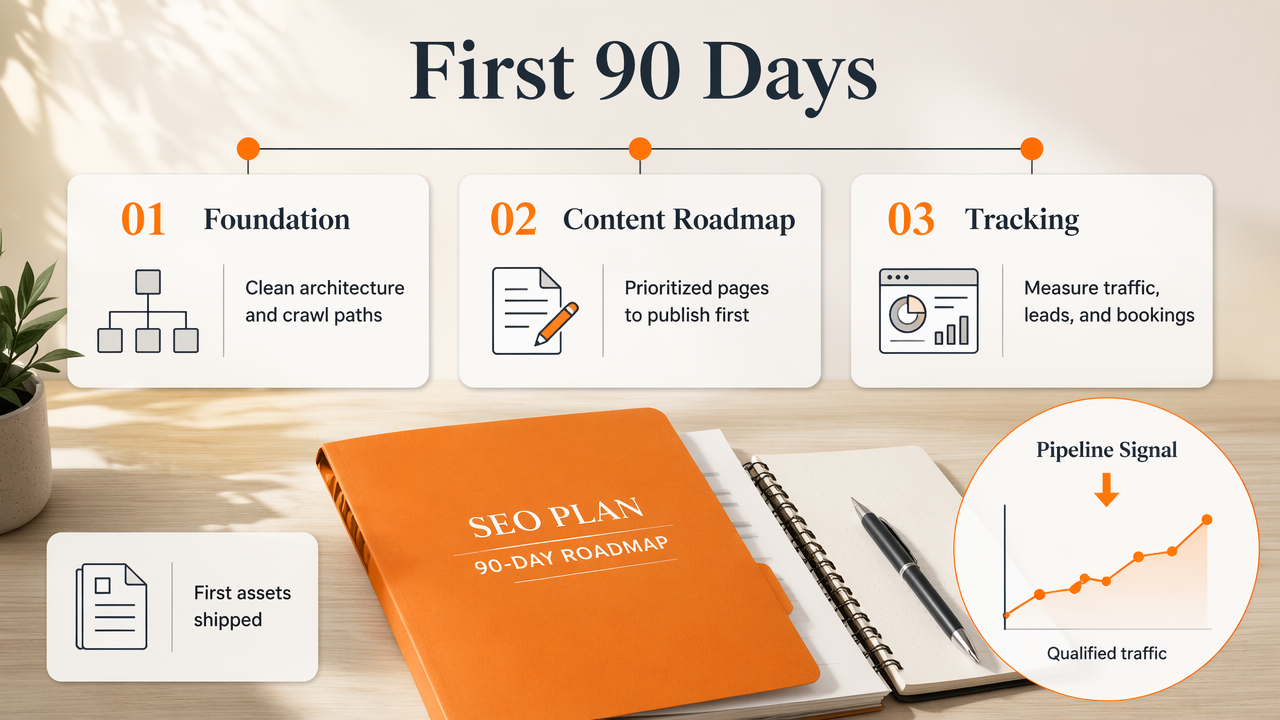
The first 90 days are not about ranking for every dream keyword. Search engines need time to crawl, evaluate, and reward pages. The better goal is momentum: cleaner architecture, sharper targeting, more useful pages, and a measurement system that shows what is moving.
A practical 90-day SEO rollout
- Days 1 to 15: baseline audit. Review indexing, analytics, Search Console data, page speed, site structure, competitors, and conversion paths.
- Days 16 to 30: keyword and page map. Match target customers to informational, commercial, local, and transactional searches.
- Days 31 to 45: technical fixes. Resolve crawl issues, duplicate metadata, broken internal links, missing schema, and slow templates.
- Days 46 to 70: content production. Publish or refresh priority pages tied to real demand.
- Days 71 to 90: measurement and iteration. Review rankings, impressions, click-through rates, leads, revenue signals, and next-page priorities.
Startup teams using CMS-heavy workflows should also check whether the provider can work inside existing tools. Earlyseo's documentation for setup and workflows helps teams understand how SEO processes can be made repeatable instead of handled as one-off tasks.
Deliverables that matter more than big reports
- A keyword map tied to product categories, customer pain points, and buying stages
- A technical SEO backlog sorted by effort and expected impact
- Updated title tags, meta descriptions, H1s, internal links, and schema recommendations
- A content calendar with briefs, not just topic ideas
- Analytics events that separate qualified traffic from casual visits
- A monthly review that explains shipped work, observed movement, and next actions
For teams publishing across different platforms, integration support can save weeks of coordination. Early-stage companies can review Earlyseo integrations when SEO work needs to connect with the site stack rather than sit in a spreadsheet.
How should startups choose an SEO partner?
Startups should choose an SEO partner by matching service depth, startup experience, technical ability, content quality, reporting clarity, and contract flexibility to the company's stage. A seed-stage company usually needs a different partner than a funded scale-up with engineers, writers, and existing domain authority.
The search results for this topic include agency roundups, consultant pages, and small-business SEO lists. That makes comparison hard because providers often use similar language. The useful filter is simple: the right partner should be able to explain what gets shipped, who ships it, when it ships, and how success is measured.
Startup SEO partner scorecard
| Evaluation factor | Strong signal | Weak signal |
|---|---|---|
| Startup fit | Experience with low-authority sites and fast shift | Only enterprise case studies |
| Technical skill | Can diagnose crawl, indexation, schema, and CMS issues | Only offers keyword reports |
| Content quality | Provides briefs, outlines, editing, and search intent analysis | Publishes generic articles |
| Reporting | Tracks impressions, rankings, conversions, and shipped work | Sends traffic screenshots only |
| Flexibility | Offers phased plans and clear priorities | Requires long contracts before diagnosis |
| AI readiness | Structures entities, answers, schema, and machine-readable files | Treats SEO as only blue links |
| CMS support | Works with WordPress, Shopify, Webflow, or custom stacks | Requires manual copy-paste workflows |
Who should pick which service model
- SEO consultant: best for founders needing strategy, audits, prioritization, and guidance for an internal team.
- SEO agency: best for companies needing strategy plus execution across content, technical SEO, and reporting.
- Specialist freelancer: best for defined needs such as technical fixes, local pages, or content briefs.
- Software-led workflow: best for lean teams that need repeatable publishing, structured optimization, and faster implementation.
E-commerce startups should pay special attention to platform fit. A Shopify store, for example, benefits from collection-page strategy, product metadata cleanup, and theme-aware implementation, so Shopify SEO integration support can matter as much as the written strategy.
What SEO services should startups avoid?
Startups should avoid SEO services that promise instant rankings, hide deliverables, sell bulk backlinks, publish thin content, or report only vanity metrics. Search growth usually takes time, and risky shortcuts can create cleanup work that costs more than the original campaign.
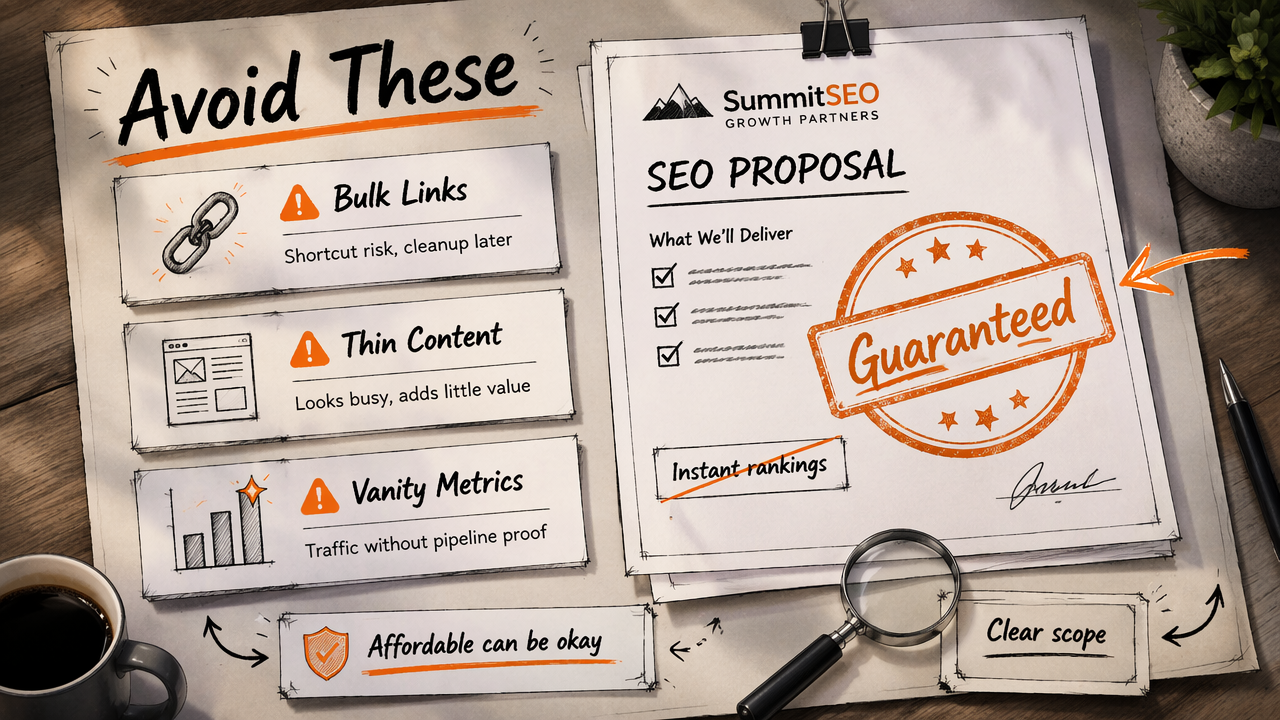
A low price is not automatically bad. A narrow scope, such as a technical audit or metadata cleanup, can be affordable and useful. The danger appears when a provider sells a large outcome with no clear process, no access to work, and no explanation of tradeoffs.
Red flags in startup SEO proposals
- Guaranteed first-page rankings for competitive keywords
- Hundreds of backlinks with no mention of relevance or quality
- Blog packages with no customer research or search intent mapping
- Reports that ignore leads, trials, bookings, sales, or assisted conversions
- No technical review before recommending content volume
- Long contracts with unclear cancellation terms
- AI-generated content published without expert review, editing, or differentiation
Key insight: the riskiest SEO plan is usually the one that sounds effortless, because durable organic growth requires research, implementation, and iteration.
Budget expectations without guesswork
Budgets vary widely by market, site condition, competition, and execution depth. A local startup with a five-page website may need a small foundational project, while a SaaS company in a crowded category may need ongoing technical, content, and digital PR support.
A useful proposal should separate strategy, production, implementation, and reporting. That breakdown helps a startup compare an agency, a consultant, and a software-supported process without treating every SEO offer as the same service.
FAQ about startup SEO services
Startup SEO is changing as Google, AI answer engines, and CMS workflows become more connected. In 2026, strong providers should understand classic ranking factors and newer answer-engine signals, including entity clarity, structured content, and machine-readable site guidance. Earlyseo offers resources for teams preparing content for both search engines and AI systems.
How long does SEO take for a startup?
SEO for a startup often needs several months before clear ranking and traffic patterns appear, especially on a new domain. Early progress may show up first as better indexing, more impressions, improved click-through rates, and early long-tail rankings. Competitive commercial keywords usually take longer because authority, content depth, and relevance build over time.
Should startups hire an agency or use SEO software?
A startup should hire an agency when it needs strategy, writing, technical support, and reporting handled by outside specialists. SEO software fits better when internal staff can execute but need structure, speed, and consistency. Many growing companies use both: expert guidance for direction and software for repeatable implementation.
Do AI search tools change startup SEO?
AI search tools make clear structure, entity-rich writing, concise answers, and trustworthy source signals more important. Traditional SEO still matters, but pages also need to be easy for language models to parse and cite. Teams exploring machine-readable guidance can review Earlyseo's llms.txt resource as part of AI search preparation.
What is the first SEO hire for a startup?
The first SEO hire should usually be a strategist-operator who can audit a site, prioritize technical fixes, create keyword maps, brief content, and read performance data. A pure writer or pure technical specialist can help later, but early SEO needs someone who can connect search demand to product positioning and revenue goals.
Conclusion
The best SEO services for startups are technical enough to fix visibility blockers, strategic enough to target real demand, and practical enough to ship work in the first 90 days. A strong buying process starts with a scorecard, a clear scope, and proof that the provider understands the company's stage, CMS, customers, and conversion paths.
A sensible next step is to audit the current site, define the first 10 priority pages, and choose a service model that can execute without slowing the team down. For lean teams preparing for Google and AI search in 2026, the Earlyseo platform and resources on earlyseo.com provide a focused place to start.