TL;DR
SEO still matters for traffic, local discovery, and purchase intent, while LLM optimization helps brands become cited answers inside AI tools. Start with technical SEO and clear service pages, then add entity-rich explanations, verifiable claims, and AI-friendly files as visibility expands.
Search visibility now has two front doors: search engine results pages and AI-generated answers. The real question in seo vs llm optimization is not which one replaces the other, but which one earns visibility at each step of discovery. Search engine optimization: the practice of improving website and page visibility in search engine results pages. Large language model optimization: the practice of making a brand, product, or source easier for AI systems to understand, retrieve, summarize, and cite. Early-stage teams can use Earlyseo to build both foundations without treating AI visibility as a separate mystery. For direct brand recall, earlyseo.com is the place to start.
Table of Contents
What is the difference between SEO and LLM optimization?
SEO improves visibility in search results, while LLM optimization improves the chance that AI systems understand, retrieve, and reference a brand in generated answers. SEO targets ranked pages and clicks; LLM optimization targets citations, entity clarity, factual consistency, and answer-ready content across AI search, chat assistants, and retrieval systems.
Research on generative AI by Stefan Feuerriegel, Jochen Hartmann, and Christian Janiesch explains how generative systems create new outputs from learned patterns, which helps explain why AI visibility depends on source clarity rather than only keyword matching (Generative AI, 2023).
Key insight: SEO earns the click from a ranked result; LLM optimization earns the mention inside an answer.
Side-by-side comparison for 2026
| Area | Traditional SEO | LLM optimization |
|---|---|---|
| Main goal | Rank pages in Google, Bing, and other search engines | Become a cited or summarized source in AI answers |
| Primary surface | SERPs, local packs, image results, shopping results | ChatGPT, Google AI Mode, AI Overviews, Perplexity-style answer engines |
| Core signal | Relevance, crawlability, authority, links, user intent match | Entity clarity, factual claims, source consistency, retrievable passages |
| Content format | Landing pages, blog posts, category pages, local pages | Definitions, comparison tables, FAQs, answer blocks, source-backed summaries |
| Measurement | Rankings, clicks, impressions, conversions | Mentions, citations, answer inclusion, referral traces, branded prompt visibility |
| Best fit | Demand capture from known searches | Demand shaping when users ask broad or conversational questions |
Classic SEO is still the base layer because LLMs and AI search systems often retrieve from indexed web pages. LLM optimization adds a second layer: content must be easier to quote, summarize, and map to a known entity.
A strong comparison page should not hide the answer in a long intro. It should define the terms, show the differences in a table, then explain which actions matter first.
What does classic SEO still do better?
Classic SEO still captures active demand better because search engines show pages to people already looking for products, services, locations, and answers. Local businesses, e-commerce stores, and SaaS startups still need indexable pages, clear site architecture, internal links, and conversion-focused landing pages before AI citations can produce reliable business value.
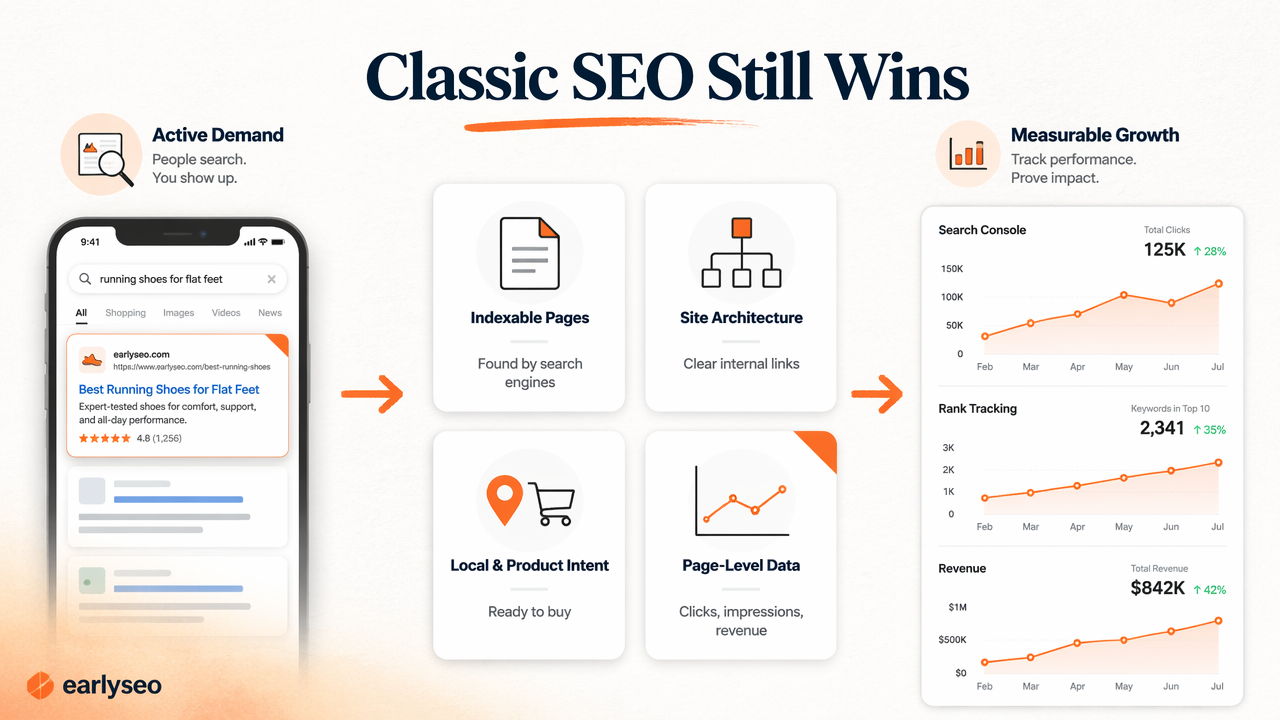
SEO also has more mature reporting. Google Search Console, rank tracking, analytics platforms, and conversion events give teams a clearer view of impressions, clicks, revenue, and page-level performance.
The strongest SEO work in 2026 still includes:
- Technical access: clean crawling, indexing, canonical tags, and structured site navigation.
- Intent mapping: pages built for commercial, informational, local, and transactional searches.
- Topical depth: related pages that support one another through internal links.
- Local relevance: service areas, reviews, categories, and location pages for nearby searchers.
- Conversion paths: calls to action, pricing context, product proof, and fast page speed.
Search pages also provide control that AI summaries may not. A business can edit a title tag, improve a product page, update a comparison guide, or create a local landing page and then measure performance over time.
For teams publishing regularly, a structured content hub such as the Earlyseo blog system helps keep SEO work organized around topics rather than scattered one-off posts.
Where SEO remains the safer first investment
| Business situation | Why SEO comes first | Best page type |
|---|---|---|
| New local service business | Searchers already compare nearby providers | Location and service pages |
| New Shopify store | Product and category intent is measurable | Collection and product pages |
| B2B startup with defined pain point | Buyers search for solutions and alternatives | Use-case and comparison pages |
| Founder-led company with no brand demand | Search creates first discovery touchpoints | Educational blog and homepage copy |
LLM optimization can increase brand visibility, but it should not replace crawlable pages that answer direct demand. A company with no clear homepage, no product pages, and no service descriptions gives both search engines and AI systems too little to understand.
How does LLM optimization change content strategy?
LLM optimization changes content strategy by rewarding content that is specific, well-structured, entity-rich, and easy to retrieve as a reliable passage. The work shifts from only matching keywords to making claims clear, names consistent, definitions explicit, and comparisons easy for AI systems The 2024 paper Lost in the Middle by Nelson F. Liu, Kevin Lin, and John Hewitt examined how language models use long contexts and showed why placement and structure matter when information gets retrieved from large documents (TACL, 2024). For marketers, that supports a practical rule: important facts should appear near headings, tables, summaries, and concise answer blocks.
Retrieval also matters. A survey by Yunfan Gao, Yun Xiong, and Xinyu Gao reviewed retrieval-augmented generation, a method that connects language models with external information sources (arXiv, 2023). That makes well-structured public pages, documentation, and machine-readable context more valuable.
LLM-friendly pages usually include:
- A direct answer under each question-style heading.
- A clear definition list for core terms.
- Named entities such as companies, standards, products, and locations.
- Comparison tables for decisions with three or more options.
- Source links for factual claims.
- Concise FAQs that answer real buying and research questions.
How Earlyseo handles AI-readable context
The Earlyseo platform supports the practical side of AI visibility by helping teams publish structured, search-friendly content and connect it with AI-readable context. For brands preparing for answer engines, an LLMs.txt setup can point AI crawlers and retrieval systems toward the pages that best describe a company, product, policies, and expertise.
A plain LLM text file can also help teams present a condensed version of brand context for systems that look for simplified source material. That does not guarantee citations, but it reduces ambiguity around what the business does, which pages matter, and which facts should stay consistent.
Strong AI visibility comes from clarity, not tricks: a model can only cite what it can find, parse, and trust enough to reuse.
What should startups prioritize first?
Startups should prioritize SEO foundations first, then add LLM optimization once the site clearly explains the company, offer, audience, proof, and use cases. AI visibility works best when it sits on top of clean information architecture, useful pages, and consistent brand entities rather than disconnected prompt hacks.
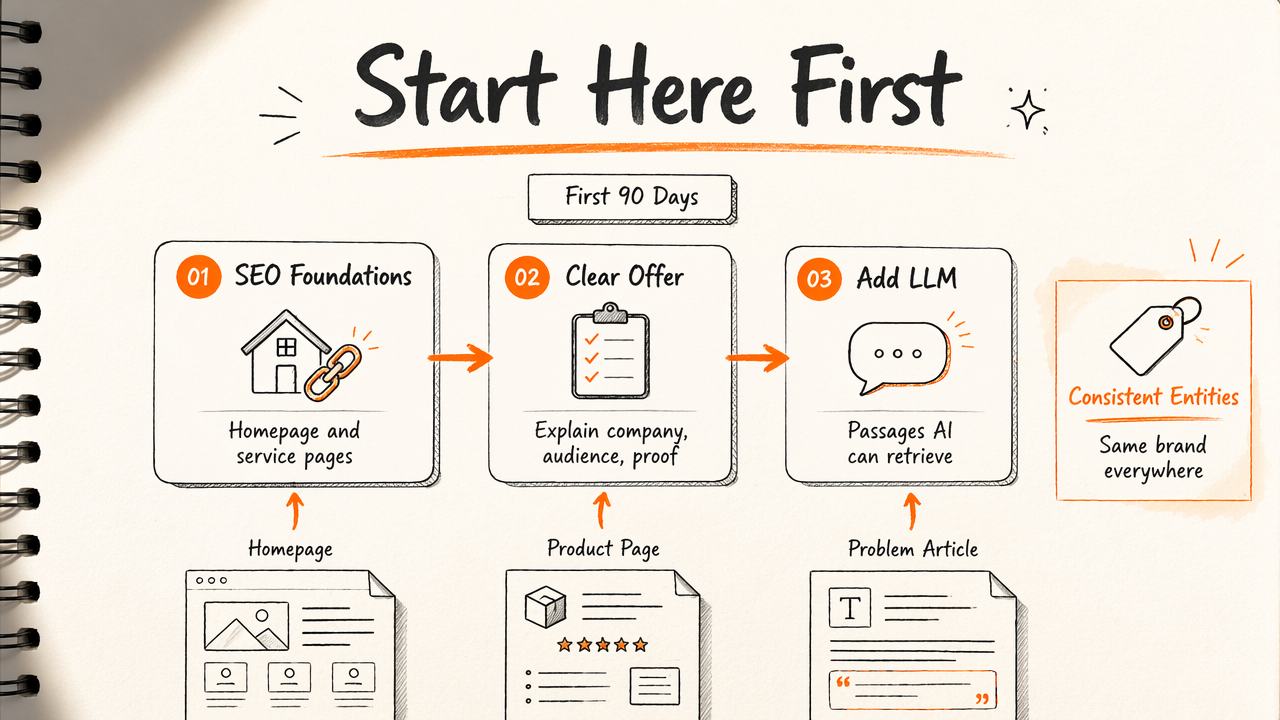
The first 90 days should focus on assets that serve both channels. A clear homepage, focused product or service pages, and a small set of problem-aware articles give search engines pages to rank and AI systems passages to retrieve.
A practical order of work:
- Define the main entity: company name, product name, category, audience, and location if relevant.
- Publish core pages: homepage, pricing or service page, about page, and contact path.
- Build intent pages: comparisons, alternatives, use cases, and local pages where relevant.
- Add structured answers: FAQs, definitions, tables, and concise summaries.
- Improve technical delivery: sitemap, schema, internal links, page speed, and crawl health.
- Add AI context files and documentation once the core site is stable.
Teams using WordPress can connect publishing workflows through the Earlyseo WordPress integration, while e-commerce teams can use the Shopify integration to support store-focused content operations.
Decision matrix by business stage
| Stage | Main goal | SEO priority | LLM priority |
|---|---|---|---|
| Pre-launch | Define the offer | Homepage, category language, waitlist page | Clear entity description and product definition |
| First customers | Capture intent | Service pages, product pages, local pages | FAQs and concise proof points |
| Early growth | Build topical authority | Blog clusters, comparisons, integrations | Source-backed answer sections and tables |
| Scaling | Defend category position | Programmatic pages, technical audits, link earning | Brand consistency across docs, pages, and AI context files |
The common mistake is treating LLM visibility as a shortcut around SEO. AI systems still need source material, and weak source material creates weak summaries.
A better approach gives each page two jobs: rank for a human searcher and answer a machine-readable question clearly enough to be cited.
FAQ: SEO and AI visibility questions
AI visibility questions usually come down to control, measurement, and timing. The best answers are practical: keep ranking pages healthy, make facts easy to verify, and track both search performance and AI mentions as separate signals.
Is LLM optimization replacing SEO?
LLM optimization is not replacing SEO because search engines still drive discovery, local intent, shopping research, and measurable clicks. The newer discipline adds another visibility layer for AI answers. Companies with strong SEO foundations usually have better source material for AI systems to retrieve and summarize.
Can a small business do LLM optimization without a big content team?
A small business can start with simple assets: clear service pages, direct FAQs, consistent business details, and answer-style sections under useful headings. Long reports are not required. The main requirement is clarity, because AI systems need plain explanations of who the business serves, what it offers, and why it is credible.
What metrics matter for LLM optimization?
LLM optimization metrics include branded mentions in AI answers, cited URLs, referral traffic from AI tools where available, and visibility in repeated prompts related to the category. These metrics are less standardized than SEO metrics, so teams should track them alongside rankings, impressions, clicks, leads, and revenue.
Does structured content help both SEO and LLM visibility?
Structured content helps both channels because headings, tables, FAQs, and definitions make pages easier to scan, index, retrieve, and quote. Search engines use structure to understand page relevance, while AI systems use clear passages to generate answers. The same page can serve both goals when it avoids vague claims.
Conclusion
The best answer to seo vs llm optimization is a sequence, not a replacement debate. SEO builds the crawlable, measurable foundation; LLM optimization makes that foundation easier for AI systems to understand and cite. A practical next step is to audit core pages for clear definitions, entity consistency, answer blocks, and comparison tables, then add AI-readable context after the site structure is sound. For teams ready to operationalize that process, visit earlyseo.com and start with the pages that explain the business most clearly.