TL;DR
Local schema helps search engines and AI systems understand a business entity, but it does not replace strong local SEO, reviews, links, or Google Business Profile work. Small businesses should add accurate JSON-LD for name, address, phone, hours, area served, services, and sameAs profiles, then validate it before publishing.
Local business schema markup turns ordinary business details into machine-readable facts that search engines can parse with less guesswork. Schema.org: a shared vocabulary for structured data markup on web pages, created to standardize how websites describe entities, places, products, services, and relationships. For small businesses, the goal is simple: make the business easier to identify, connect, and display across search, maps, and AI answer systems. Earlyseo gives growing teams a practical way to manage SEO foundations alongside structured data planning, especially when technical resources are limited.
Table of contents
- What local schema means in 2026
- What it can and cannot do for rankings
- Essential properties to include
- Practical examples by business type
- FAQs and next steps
Table of Contents
What is local business schema markup?
Local business schema markup is structured data that describes a physical or service-area business using Schema.org vocabulary, usually in JSON-LD format. It tells search engines the business name, location, contact details, opening hours, services, and related profiles in a standardized format that crawlers and knowledge systems can read.
The core type is LocalBusiness, a Schema.org type used for restaurants, banks, medical offices, stores, agencies, contractors, and other local entities. The official Schema.org LocalBusiness documentation lists more specific subtypes, including Restaurant, Store, MedicalBusiness, ProfessionalService, and HomeAndConstructionBusiness.
Search engines already crawl visible page content, but structured data removes ambiguity. A page may mention a phone number, address, and brand name in separate blocks. Schema connects those facts to one entity.
Key insight: schema does not create a better business, but it helps machines understand the business that already exists.
Research on knowledge graphs by Hogan, Blomqvist, and Cochez in ACM Computing Surveys explains how connected entities and relationships support machine-readable knowledge. Local schema works in the same broad direction: it links a business to places, services, categories, and public profiles.
For a broader technical workflow, teams can pair markup planning with the Earlyseo documentation, which helps keep SEO implementation organized across site updates.
What can and cannot schema do for local rankings?
Local schema can improve entity clarity, eligibility for some rich result features, and consistency across search systems, but it is not a direct shortcut to higher local rankings. Google's local visibility still depends on relevance, distance, prominence, content quality, reviews, citations, and the strength of the business's web presence.
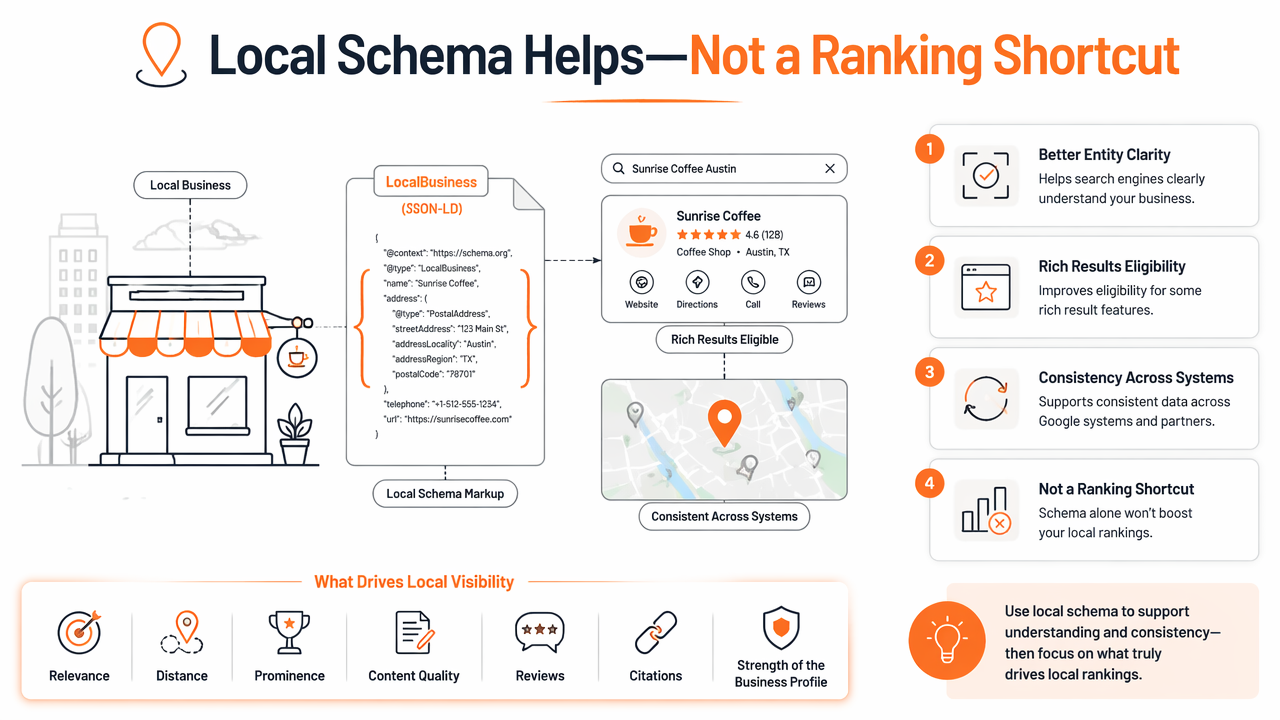
A practical way to think about schema is as confirmation, not persuasion. It confirms that a specific business exists at a specific location, serves specific areas, offers specific services, and matches profiles found elsewhere online.
Schema impact versus local SEO fundamentals
| Area | What schema can help | What schema cannot replace |
|---|---|---|
| Business identity | Clarifies name, address, phone, hours, and type | A verified Google Business Profile |
| Local relevance | Connects services, categories, and area served | Helpful service pages and local content |
| Trust signals | Links official profiles with sameAs |
Reviews, citations, and real-world reputation |
| Crawling | Gives machines structured facts | Crawlable pages and indexable content |
| AI visibility | Feeds entity understanding for answer systems | Authority, mentions, and strong source content |
Local search engine optimization is the process of improving visibility in unpaid local search results. Structured data fits into that process, but it works best after the visible basics are accurate.
Common misconceptions deserve a clear answer:
- Schema is not a ranking guarantee. It may support understanding, but search engines do not rank weak pages just because JSON-LD exists.
- Schema should match the page. Hidden or exaggerated claims can create inconsistency.
- Schema does not fix bad NAP data. Name, address, and phone details still need consistency across the website and local profiles.
- Schema is not only for developers. Modern CMS tools, WordPress plugins, Shopify themes, and SEO platforms can help publish it.
The future is more entity-driven. AI search systems increasingly summarize businesses, services, locations, and answers from structured and unstructured signals. The same logic appears in broader research on connected systems, including the Internet of Things Strategic Research Roadmap, where machine-readable relationships matter because devices and systems need shared context.
For AI-facing discoverability, businesses can also review Earlyseo's llms.txt resource as part of a broader plan for making site content easier for AI systems to interpret.
Which LocalBusiness properties should small businesses include?
Small businesses should include only accurate, visible, and maintainable properties: business name, URL, logo, image, address, phone number, opening hours, geo coordinates, area served, price range, service type, and sameAs links. The best schema is complete enough to identify the business without becoming bloated or stale.
Essential properties checklist
| Property | Purpose | Example value |
|---|---|---|
@type |
Defines the business category | LocalBusiness, Dentist, Restaurant |
name |
Official business name | Oak Street Dental |
url |
Canonical website URL | https://example.com |
telephone |
Main contact number | +1-555-010-2222 |
address |
Physical location | Street, city, region, postal code |
openingHoursSpecification |
Daily hours | Monday to Friday, 9:00 to 17:00 |
geo |
Latitude and longitude | 40.7128, -74.0060 |
areaServed |
Service area | Brooklyn, Queens |
sameAs |
Official social and directory profiles | Facebook, LinkedIn, Yelp |
makesOffer or hasOfferCatalog |
Services or offers | Plumbing repair, roof inspection |
Specific types are better than generic ones when they are accurate. A dental clinic should usually use Dentist, not only LocalBusiness. A bakery with a storefront can use Bakery. A law office can use LegalService.
Key insight: the most useful schema is specific, truthful, and easy to keep updated after hours, services, or locations change.
Implementation usually follows a short workflow:
- Pick the most specific Schema.org type that matches the real business.
- Add one JSON-LD block to the homepage or location page.
- Match schema details to visible page content.
- Add service and product details only when the page supports them.
- Validate the code with a structured data testing tool.
- Recheck the markup after redesigns, CMS changes, or new locations.
WordPress sites often use plugins or theme fields to publish JSON-LD. Storefronts using Shopify can combine product, organization, and local details when a physical shop or pickup location exists. For implementation paths, Earlyseo supports common CMS workflows through WordPress SEO integration and Shopify SEO integration.
How should different local businesses structure examples?
Different business models need different schema emphasis, because a plumber, a boutique retailer, and a multi-service clinic answer different search intents. The safest approach is to describe the real entity first, then add services, departments, or products only where they belong.
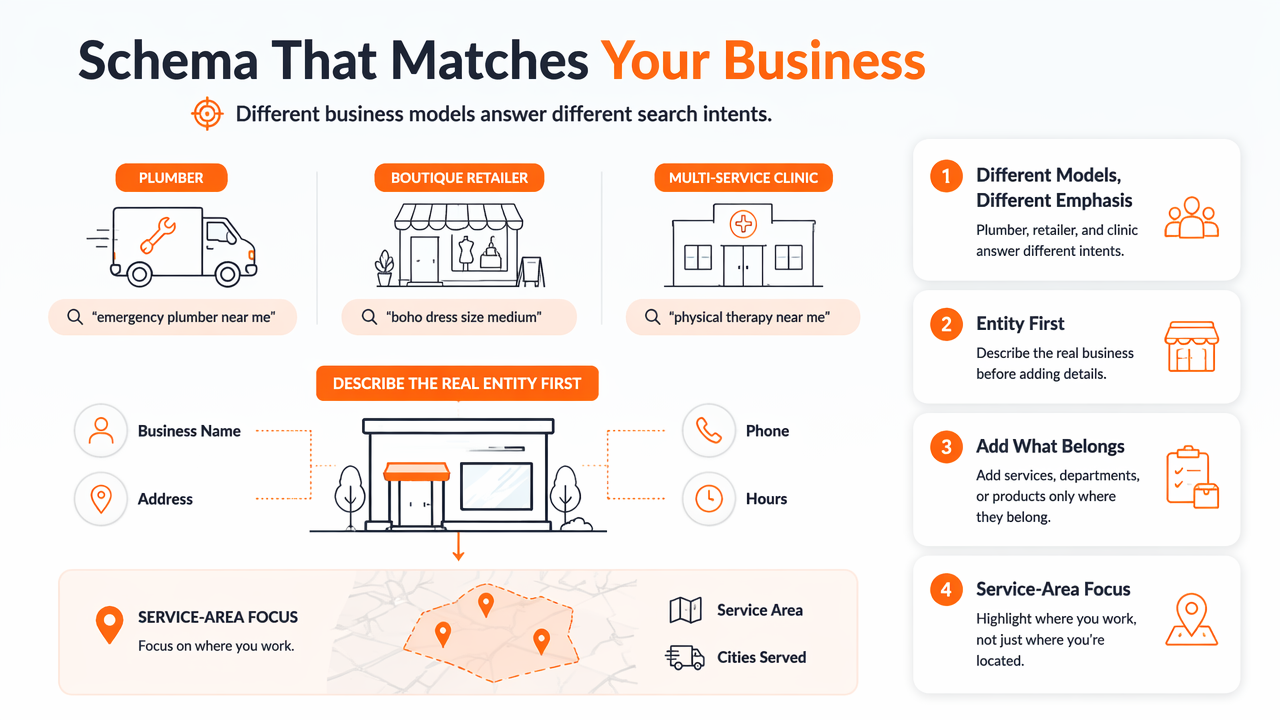
Service business example
A service-area company should focus on identity, phone, service areas, and offers. A plumber with no public showroom can still describe the business, but the address rules should match what appears on the website and business profiles.
{
 "@context": "https://schema.org",
 "@type": "Plumber",
 "name": "Northside Plumbing Co.",
 "url": "https://example.com",
 "telephone": "+1-555-010-3333",
 "areaServed": ["Austin", "Round Rock"],
 "makesOffer": {
 "@type": "Offer",
 "itemOffered": {
 "@type": "Service",
 "name": "Emergency plumbing repair"
 }
 }
}
Ecommerce-local hybrid example
A retailer with online sales and local pickup should connect store data with product availability where the site supports it. The local entity should not pretend that every online product is available in-store unless inventory data confirms it.
Useful fields include:
Storeor a more specific subtypeaddressandgeoopeningHoursSpecificationhasMapsameAs- Product markup on product pages
- Local pickup details where supported by the platform
The Earlyseo platform fits this hybrid use case because ecommerce and local pages often need separate optimization rules. Teams can review platform connections through Earlyseo integrations, then keep product SEO and location clarity in the same planning process. More practical resources are available on earlyseo.com.
Multi-service business example
A clinic, agency, contractor, or wellness center may need one LocalBusiness entity plus several service entries. For separate departments with unique hours or phone numbers, department markup can help search engines understand the structure.
Good modeling choices include:
- Use one primary business entity for the location.
- Add
departmentonly for real departments, not keyword variations. - Use
hasOfferCatalogfor grouped services. - Create separate service pages when each service has enough detail.
- Keep the same business name consistent across all markup.
Research on AI and machine learning in drug discovery by Sarkar, Das, and Rawat in the International Journal of Molecular Sciences is not about local SEO, but it reflects a broader point: modern machine systems rely on structured, high-quality data to interpret complex entities. Local businesses benefit from the same discipline on a smaller scale.
FAQ: Practical answers about local schema
Local schema works best when it is treated as a maintained business record, not a one-time code snippet. These answers cover the decisions small teams usually face before adding markup.
Does every local business need schema markup?
Most local businesses benefit from schema, especially those with physical locations, appointment-based services, delivery zones, or local pickup. It is not mandatory for indexing, but it gives search engines a clearer entity record. Businesses with only a single-page website can still add a small, accurate JSON-LD block.
Where should LocalBusiness schema be placed?
LocalBusiness schema usually belongs on the homepage for a single-location business or on each location page for multi-location brands. The markup should describe the entity represented by that page. A city landing page should not claim to be a separate location unless a real branch exists there.
Can multiple schema types appear on one page?
Multiple schema types can appear on one page when each type describes a real thing on that page. A local restaurant page may include Restaurant, Menu, and Review markup when the visible content supports those entities. Clean nesting is usually better than disconnected code blocks.
How often should local schema be reviewed?
Local schema should be reviewed whenever business hours, phone numbers, locations, services, ownership, or CMS templates change. A quarterly check is sensible for stable businesses. Seasonal businesses, clinics, restaurants, and ecommerce-local hybrids may need more frequent reviews because hours and offers change often.
Conclusion
Local business schema markup is a practical way to help search engines and AI systems understand a business, but it works only when the underlying business information is accurate. The next step is simple: choose the most specific Schema.org type, add the essential properties, validate the JSON-LD, and schedule a review after every site or profile change.
For teams building a stronger organic presence, Earlyseo can help organize the wider SEO work around structured data, CMS setup, and AI visibility. Visit earlyseo.com to map the next improvements before schema becomes another forgotten code block.