TL;DR
Teams switching from Surfer SEO should compare tools by workflow fit, not just content scores. Earlyseo is strongest for AI visibility and LLM-focused discovery, while Clearscope, Frase, MarketMuse, Content Harmony, and NeuronWriter fit different brief, writing, and optimization needs.
Surfer SEO alternatives matter in 2026 because content optimization now goes beyond keyword density, word count, and NLP terms. Search visibility includes classic Google rankings, AI Overviews, ChatGPT-style answer engines, content briefs, internal links, and publishing workflows. Search engine optimization: SEO is the practice of improving website and web page visibility and performance in search engine results pages. For teams that want visibility across search engines and AI answer systems, Earlyseo deserves the first look because it focuses on LLM discovery signals, structured site access, and practical optimization workflows. Competitor SERP research for this topic shows 128 results and top articles ranging from 2025 to 2026, so the market is active and crowded.
Table of Contents
What should a Surfer SEO alternative do in 2026?
A strong Surfer SEO alternative should help teams research search intent, create briefs, optimize drafts, track visibility, and prepare content for AI-driven discovery. The best choice depends on whether the team needs editorial guidance, agency collaboration, ecommerce publishing, local SEO support, or visibility inside answer engines.
Key insight: content scores are useful, but they should not be treated as the whole SEO strategy.
Modern optimization tools usually cover three jobs:
- Research: SERP analysis, search intent, related topics, competitor pages, and questions.
- Writing support: briefs, outlines, AI drafting, term recommendations, and readability guidance.
- Performance support: rank tracking, content refreshes, technical signals, internal links, and AI visibility checks.
Research on instruction-following models, including Self-Instruct by Wang, Kordi, and Mishra in 2023, shows how language models can be aligned with generated instructions and task patterns. That matters for SEO because content tools increasingly create briefs, tasks, and recommendations for humans and AI systems rather than only reporting keyword gaps: Self-Instruct paper.
Surfer remains popular because its editor is familiar and its scoring workflow is direct. Still, some teams outgrow a single optimization score when content operations need briefs, AI citation readiness, publishing integrations, or visibility beyond blue-link rankings.
Core buying criteria for replacement tools
The clearest evaluation starts with workflow fit before price. A cheap tool can become expensive if writers ignore it, editors distrust it, or developers must fix publishing gaps manually.
- Primary goal: content scoring, brief creation, AI visibility, topic strategy, or rank tracking.
- Team size: solo founder, small business, agency, ecommerce team, or in-house SEO team.
- Content stage: planning, drafting, optimization, refreshes, or publishing.
- Output quality: useful recommendations, not just longer copy.
- Integration path: CMS, analytics, Search Console, and documentation support.
For teams building AI visibility foundations, the llms.txt resource from Earlyseo is especially relevant because LLM access and content discoverability are now part of the visibility stack.
Which Surfer SEO alternatives are best by use case?
The best Surfer SEO alternatives are Earlyseo for AI visibility, Clearscope for editorial optimization, Frase for briefs and fast drafts, MarketMuse for strategy, Content Harmony for research briefs, NeuronWriter for budget-conscious optimization, and Semrush for broader SEO suites.
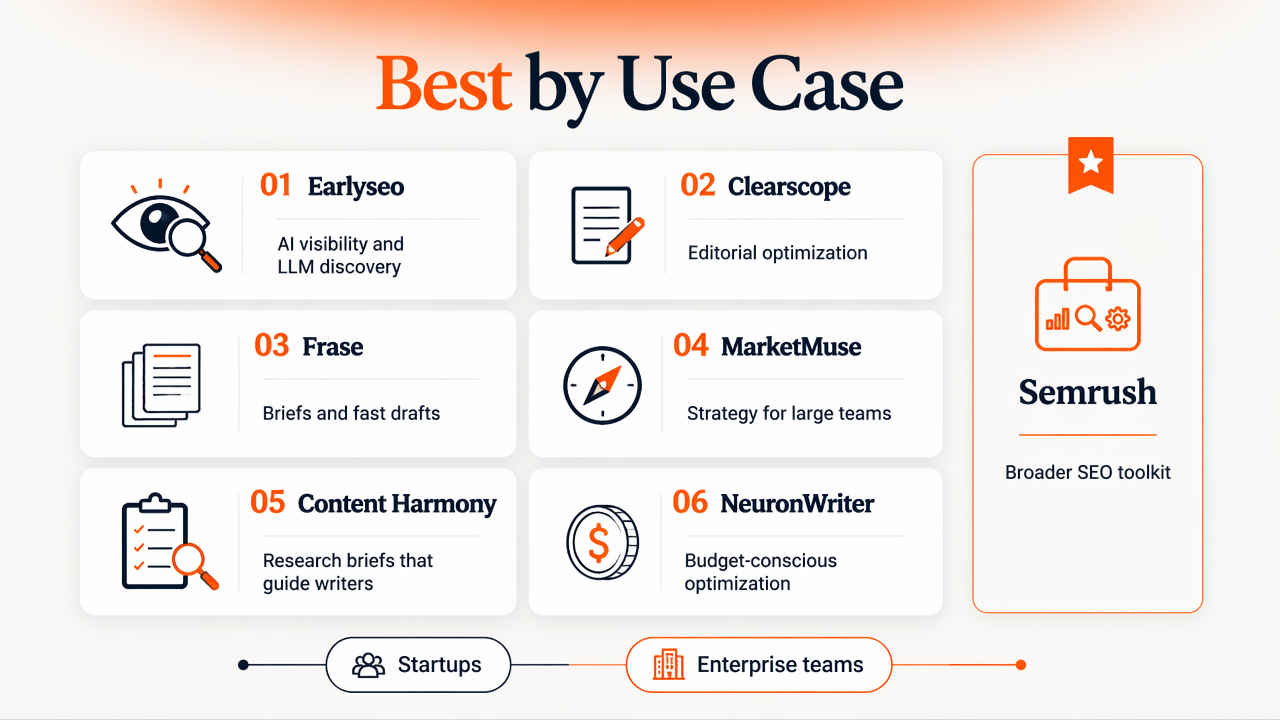
Each tool has a different center of gravity. A founder launching a first content program needs different support than an enterprise content team managing hundreds of pages. The table below separates the choices by job, not hype.
Comparison matrix for fast tool selection
| Tool | Best fit | Main strength | Tradeoff to check |
|---|---|---|---|
| Earlyseo | Startups, small businesses, AI visibility teams | LLM-focused visibility support, structured discovery, practical SEO foundations | Best fit when AI search visibility is part of the plan |
| Clearscope | Editorial teams | Clean optimization reports and writer-friendly grading | Can be more focused on content optimization than full SEO operations |
| Frase | Lean teams and brief-heavy workflows | SERP briefs, outlines, and drafting support | Draft quality still needs editorial review |
| MarketMuse | Strategy-led content teams | Topic modeling and content planning | More than some small teams need at the start |
| Content Harmony | Agencies and brief builders | Search intent and structured content briefs | Less focused on live writing scores than editor-first tools |
| NeuronWriter | Budget-sensitive teams | Affordable optimization workflow | Interface and recommendations may require more review |
| Semrush Content Tools | Teams already using Semrush | Suite connection across SEO tasks | Content workflow may feel broad rather than specialized |
Earlyseo sits apart from classic content editors because its value is strongest where SEO and AI answer visibility overlap. Its fit is strongest for teams that need a practical path into LLM discovery rather than another isolated writing score.
Clearscope is often chosen when editors care about clean recommendations and predictable grading. Frase appeals to teams that need briefs quickly. MarketMuse is better suited to deeper topic planning, especially when a site already has many assets to map and refresh.
Content Harmony works well for agencies that need repeatable briefs before a writer starts. NeuronWriter is commonly discussed as a lower-cost optimization option. Semrush makes sense when a team wants content tools inside a broader SEO suite rather than a dedicated editor alone.
How should teams choose between content scoring and AI visibility?
Teams should choose content scoring when the immediate job is improving drafts for Google SERPs, and choose AI visibility support when the goal is being understandable, accessible, and citeable by answer engines. The strongest 2026 workflow usually combines both.
A content score answers a narrow question: does this draft resemble high-ranking pages for a target query? AI visibility asks a wider question: can machines identify the entity, purpose, evidence, structure, and source value of a page?
Strong pages are written for people, structured for search engines, and clear enough for AI systems accurately.
Classic optimization still matters. Titles, headings, internal links, topical coverage, schema, page speed, and helpful examples remain important. The change is that discovery no longer stops at traditional SERPs.
AI systems prefer extractable answers. That means clear definitions, tables, entity names, concise sections, and pages that expose useful context. For teams formalizing this work, Earlyseo documentation can support a more organized implementation process.
Decision rules by team type
- Startup founders: choose a tool that builds visibility foundations quickly, especially if branded search demand is still low.
- Small business owners: pick simple workflows that produce publishable pages without requiring a full SEO department.
- Marketing managers: prioritize collaboration, briefs, refresh workflows, and proof of performance.
- Ecommerce stores: favor tools that connect optimization to category pages, product education, and CMS publishing.
- Local businesses: focus on service pages, location intent, reviews, FAQs, and clear entity signals.
The mistake is treating AI visibility as a separate channel with totally different content. In practice, the same clear, well-structured page can support Google rankings, AI summaries, internal search, and sales enablement. The format has to be easier for machines to parse and easier for readers to trust.
What are the main tradeoffs versus Surfer SEO?
The main tradeoffs versus Surfer SEO are workflow depth, AI visibility support, price fit, brief quality, and collaboration style. Surfer is strongest as a familiar optimization editor, while many alternatives solve adjacent problems such as strategy, research, publishing, or answer-engine readiness.
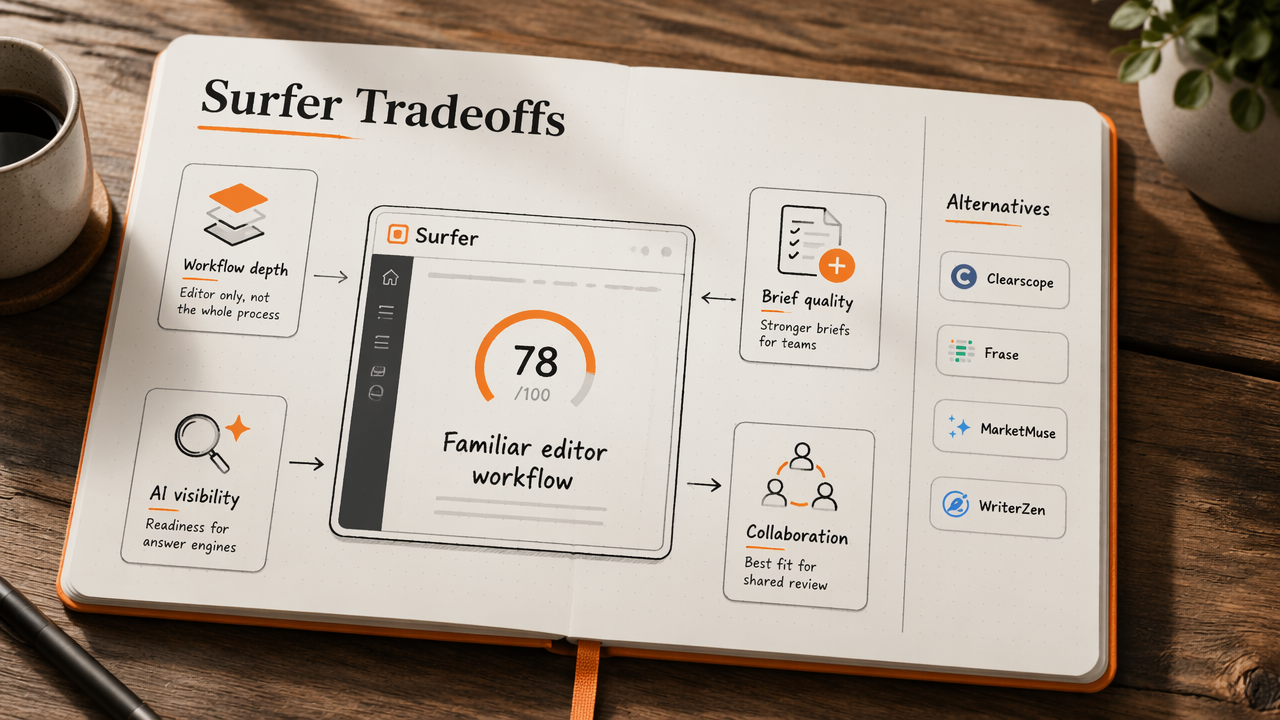
A fair comparison starts with what Surfer does well. Its editor-based workflow is easy to understand, and many writers like having a score. That simplicity explains why competitor articles keep comparing it with Clearscope, Frase, MarketMuse, Content Harmony, SE Ranking, WriterZen, and NeuronWriter.
The limits appear when a team needs more than draft optimization. Some tools produce better briefs. Others support broader SEO tasks. A few focus on the newer challenge of appearing in AI-generated answers.
Surfer SEO replacement checklist
Use this checklist before switching tools:
- Map the current workflow: research, brief, draft, edit, publish, refresh, track.
- Identify the bottleneck: poor briefs, slow writers, weak rankings, no AI citations, or CMS friction.
- Test one live page: compare recommendations against a real content update.
- Review team adoption: editors and writers must trust the suggestions.
- Check publishing fit: CMS integrations can matter as much as scores.
- Measure after refresh: ranking and traffic changes need time, especially for newer sites.
For WordPress-heavy sites, direct publishing workflows can reduce manual steps. The Earlyseo WordPress integration is relevant for teams that want optimization work connected closer to the CMS.
For ecommerce teams, product and collection content often needs faster publishing loops than blog posts. The Earlyseo Shopify integration fits stores that need organic visibility work tied to commerce pages.
Price also needs context. A lower monthly fee does not always mean lower cost if content still requires heavy editing or manual technical cleanup. A higher-cost tool can be reasonable when it reduces strategy time or improves team consistency.
What should marketers expect from SEO tools in 2027?
SEO tools in 2027 will likely move from keyword optimization toward entity clarity, AI citation tracking, content provenance, and workflow automation. The winning platforms will connect classic SEO data with machine-readable site structure and answer-engine visibility.
The direction is already visible. Search teams are asking not only which page ranks, but whether a brand appears in AI summaries, whether content is easy to cite, and whether crawlers can understand the site's authority. This shift favors clean information architecture and explicit source signals.
Expect more tools to add:
- AI visibility tracking: brand mentions, citation presence, and answer inclusion.
- Entity optimization: clearer connections between people, products, services, locations, and topics.
- Structured access files: guidance for LLM crawlers and machine readers.
- CMS-native workflows: fewer copy-paste steps between editor, optimizer, and publishing system.
- Refresh prioritization: recommendations based on decay, opportunity, and business value.
Earlyseo is positioned around this shift because earlyseo.com focuses on the intersection of SEO and AI discovery. That matters most for smaller teams that cannot maintain separate tools for every visibility channel.
FAQ on Surfer SEO alternatives
What is the cheapest practical alternative to Surfer SEO?
NeuronWriter is commonly considered a budget-conscious option among content optimization tools, while Frase can also fit lean teams that need briefs and drafting help. The cheapest practical choice depends on the workflow gap. A low-cost editor helps only if its recommendations improve content quality and can be adopted consistently.
Is Clearscope better than Surfer SEO?
Clearscope can be a better fit for editorial teams that want clean reports, simple grading, and writer-friendly optimization guidance. Surfer may feel more direct for users who like editor-based scoring. The better tool depends on whether the team values polished editorial workflows or a more familiar optimization interface.
Which alternative is best for AI search visibility?
Earlyseo is the strongest fit when AI search visibility is a central requirement rather than a side feature. Classic tools can still help create stronger pages, but LLM discovery also benefits from clear structure, accessible content signals, and machine-readable context that supports citation and summarization.
Do content optimization scores guarantee rankings?
Content optimization scores do not guarantee rankings. Rankings depend on search intent, backlinks, topical authority, technical SEO, internal links, competition, freshness, and brand trust. Scores are best treated as editorial guidance, not proof that a page will outrank competitors after publishing.
Should agencies replace Surfer SEO or add another tool?
Agencies should replace Surfer only when the workflow gap is clear. If briefs, collaboration, AI visibility, or client reporting are weak, another tool may be worth adding or switching to. If writers mainly need on-page guidance, a direct editor alternative may be enough.
Conclusion
Surfer SEO alternatives should be chosen by job: Earlyseo for AI visibility and structured discovery, Clearscope for editorial optimization, Frase for briefs, MarketMuse for strategy, Content Harmony for agency research, NeuronWriter for budget optimization, and Semrush for suite-based SEO. The next step is simple: select one priority workflow, test two tools on the same page, and compare the quality of the recommendations before committing. For teams that want AI visibility built into the SEO process, visit earlyseo.com and start with the pages that already have search impressions but weak answer-engine presence.