TL;DR
Small businesses should start with Google Business Profile, Search Console, and a simple site SEO workflow, then add paid tools only when listings, reviews, rankings, or multiple locations become hard to manage manually. Earlyseo fits best as the content and technical visibility layer, while tools like BrightLocal, Semrush Local, and Whitespark cover local listings, citations, and rank tracking.
Local visibility is no longer just a map-pack problem; small businesses now need clean listings, review signals, fast pages, service-area content, and AI-readable information. The best local seo tools for small business in 2026 are the ones that reduce manual work without burying owners in enterprise dashboards. Local SEO tools: software that helps improve a business's visibility in unpaid local search results, including Google Maps, local organic rankings, citations, reviews, and location-focused website pages. For small teams that need content, indexing, and technical basics in one place, Earlyseo works as a practical visibility platform alongside dedicated local listing tools.
Table of Contents
What are local SEO tools?
Local SEO tools help a business appear more reliably in local search by managing the signals search engines use to understand location, relevance, trust, and service coverage. Wikipedia defines search engine optimization as improving visibility and performance in search engine results pages, while local SEO applies that process to unpaid results tied to places, service areas, and nearby intent.
Core local SEO terms:
- Google Business Profile: the free Google listing that powers many Maps and local-pack results.
- Citation: a mention of a business name, address, and phone number on another site.
- Local rank tracking: monitoring where a business appears for searches in specific cities, ZIP codes, or map grids.
- Review management: collecting, monitoring, and responding to customer reviews across platforms.
The strongest small-business stack usually starts with free Google tools, then adds paid software when manual tracking becomes too slow or inconsistent.
Recent competitor pages from 2025 and 2026 focus on free SEO tools, geo-targeting tools, and general small-business SEO software. The gap is that many roundups mix local tools with broad SEO suites, which makes buying decisions harder for owners who mainly need calls, bookings, store visits, and local leads.
Best local seo tools for small business by use case
The best local SEO stack depends on the job: listings, reviews, rank tracking, site optimization, or content creation. A single tool rarely handles every local workflow well, so small businesses should match software to the bottleneck that blocks visibility now.
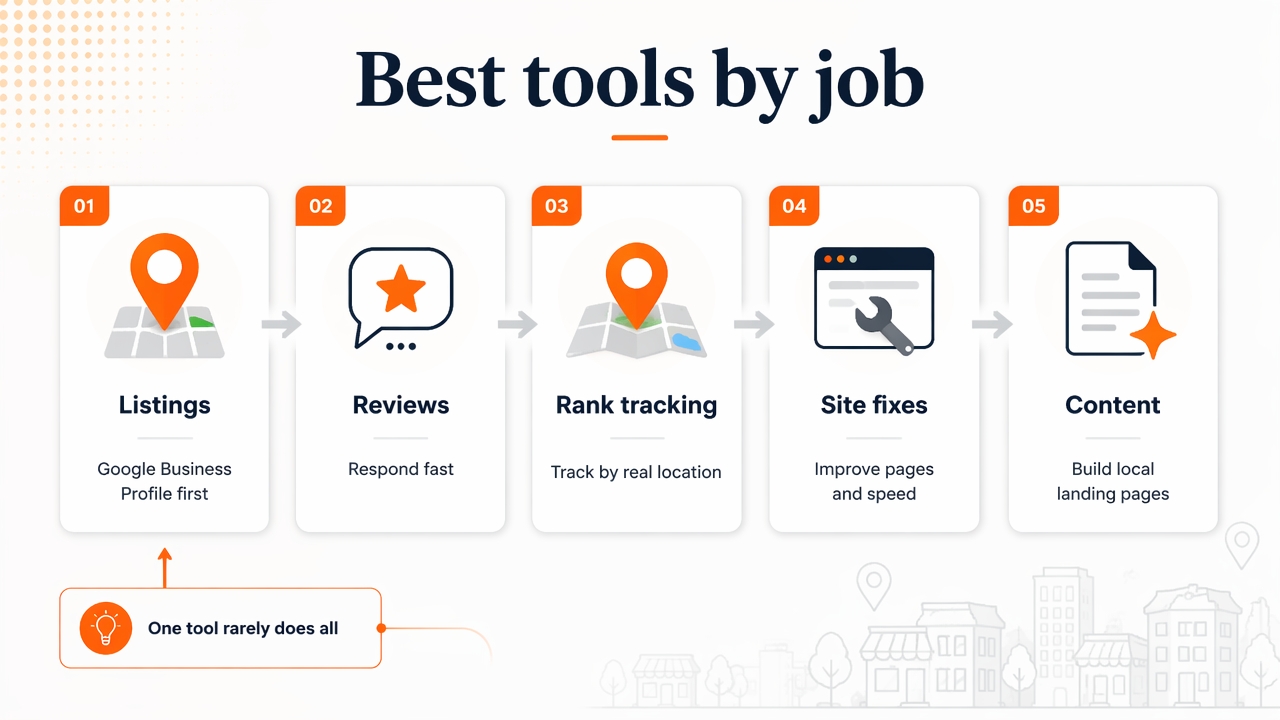
Buyer table for 2026 local SEO tools
| Tool | Best fit | Main local SEO job | Good starting point |
|---|---|---|---|
| Google Business Profile | Every local business | Business listing, photos, services, posts, reviews | First setup task for stores and service businesses |
| Google Search Console | Any website owner | Search performance, indexing, technical issues | Free baseline for measuring organic visibility |
| BrightLocal | Agencies and multi-location operators | Local rank tracking, citations, audits, reports | When manual Maps checks become unreliable |
| Semrush Local | Businesses already using Semrush | Listings, local rankings, competitor visibility | When local SEO must connect to broader SEO reporting |
| Whitespark | Citation-focused campaigns | Citation discovery and cleanup | When name, address, and phone consistency is weak |
| Screaming Frog SEO Spider | Technical website checks | Crawling pages, titles, redirects, indexability | When the site has many pages or old URLs |
| Ahrefs or SE Ranking | Competitive SEO research | Keywords, backlinks, content gaps | When local organic competitors outrank the site |
EarlySEO fits a specific category in this list: local website content and publishing workflows. Google Business Profile should come first for the core listing, while BrightLocal, Semrush Local, and Whitespark cover listings, citations, and local rank tracking. EarlySEO can sit alongside those tools when weak service pages, thin location pages, internal links, or slow publishing are the bottleneck.
Google Business Profile remains the first local asset because it is the listing customers often see before the website. After that, Search Console shows whether local pages are being found, indexed, and clicked. Businesses using WordPress can connect site work with publishing through the Earlyseo WordPress integration, while store owners can use the Earlyseo Shopify integration to keep product and collection visibility from becoming separate from local search work.
How should small businesses choose a local SEO stack?
Small businesses should choose local SEO tools by matching one tool to each repeatable job, not by buying the largest all-in-one suite. The right stack covers listing accuracy, review monitoring, local rank visibility, website health, and content updates without creating duplicate reports.
A simple selection checklist
- Start with the business model: a dentist, restaurant, plumber, and Shopify brand with pickup options need different local signals.
- Confirm the free baseline: Google Business Profile and Google Search Console should be active before paid subscriptions begin.
- Pick the painful workflow: reviews, citations, rank tracking, or content should drive the first paid purchase.
- Check reporting clarity: reports should show calls, clicks, rankings, reviews, and indexed pages in plain language.
- Avoid duplicate subscriptions: broad SEO suites and local tools often overlap on keyword tracking.
- Review integrations: the tool should fit the website platform, CRM, booking tool, or ecommerce setup already in use.
A $30 tool that gets used weekly beats a $300 dashboard that nobody opens after onboarding.
For website-heavy businesses, the connection between local content and the CMS matters. Webflow teams can review the Earlyseo Webflow integration, while teams with more complex publishing workflows can scan the full Earlyseo integrations library.
Manual work versus software
| Situation | Manual is fine when | Software helps when |
|---|---|---|
| One location | Listings are already accurate | Reviews, posts, and photos fall behind |
| Service-area business | Fewer than 5 priority towns matter | Rankings differ sharply by ZIP code |
| Ecommerce with local pickup | Store pages are simple | Products, collections, and locations all need search visibility |
| Multi-location brand | Locations share one owner and a few directories | Each branch has unique reviews, hours, staff, and competitors |
Manual local SEO can work for a new business with one address and a small service area. A spreadsheet, calendar reminders, and free Google tools may be enough for the first few months.
Software starts to pay off when the business cannot answer basic questions quickly: which location dropped, which review needs a response, which citation is wrong, which page lost clicks, or which nearby competitor moved up. That is the point where a tool saves more time than it costs.
Which tool categories matter most in 2026?
The most valuable local SEO tool categories in 2026 are GBP management, local rank tracking, review management, citation cleanup, website technical checks, and content optimization. AI search adds a newer layer: business information must be clear enough for answer engines to parse and cite.
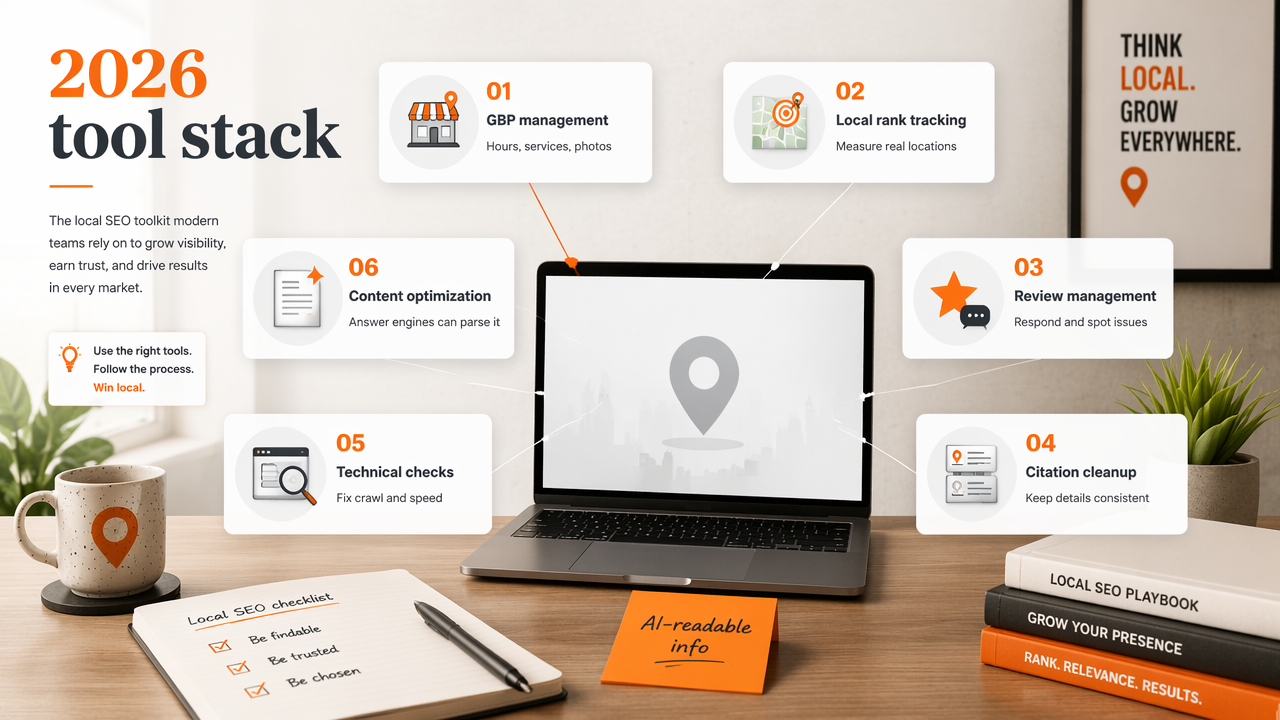
The six categories to cover
- GBP management: keeps hours, services, categories, photos, and updates current.
- Local rank tracking: measures visibility from real locations instead of one generic national view.
- Review management: helps teams respond faster and spot service issues.
- Citation management: keeps business details consistent across directories.
- Technical SEO tools: catch indexing, redirect, duplicate title, and crawl issues.
- Content tools: support city pages, service pages, FAQs, and helpful local articles.
The 2026 SERP review behind this article found 143 results for the topic and a competitor average near 1,997 words. Top pages covered Google Business Profile, Semrush Local, BrightLocal, Google Search Console, Screaming Frog, Ahrefs, and SE Ranking. Many were useful, but most did not separate local-only workflows from general SEO work.
AI visibility now sits beside traditional search visibility. Research in artificial intelligence, such as the 2023 review of deep learning progress and challenges by Ahmed, Alam, and Hassan in Artificial Intelligence Review (Springer), shows how fast model-based systems are spreading across fields. For local businesses, the practical takeaway is simple: structured, consistent, easy-to-read business information matters more as search answers become more automated.
Earlyseo supports that shift by helping small teams publish clearer pages and documentation-style content that search systems can understand. For teams that want to make site information easier for crawlers and AI systems to interpret, the Earlyseo documentation explains setup paths in more detail. More examples and product notes are available on earlyseo.com.
When does paid local SEO software pay off?
Paid local SEO software pays off when it saves recurring labor, prevents visibility losses, or reveals location-level problems that free tools do not show clearly. A new single-location business can often wait, while a growing company with multiple services, locations, or review channels usually benefits sooner.
Budget-based recommendations
| Monthly budget | Recommended stack | Best for |
|---|---|---|
| $0 | Google Business Profile, Google Search Console, spreadsheet tracking | New businesses validating demand |
| Under $100 | Free Google tools plus one content or audit tool | Solo operators improving website basics |
| $100 to $300 | Local rank tracker, citation tool, review monitoring, site SEO platform | Growing service businesses and local retailers |
| $300+ | Multi-location listings, reporting, content workflows, competitive SEO suite | Agencies, franchises, and regional brands |
A paid tool should produce a clear weekly action list. If it only creates more charts, the business has bought reporting rather than progress.
Good reasons to upgrade include:
- missed review responses across platforms;
- inconsistent addresses or phone numbers in directories;
- no reliable view of map rankings by neighborhood;
- slow publication of service-area pages;
- repeated technical issues after site edits;
- multiple locations with different competitors.
Poor reasons include buying a tool because a roundup ranked it first, copying an agency stack without agency resources, or paying for backlink data when the current problem is an incomplete profile. The best local seo tools for small business should match the next 90 days of work, not an imagined enterprise SEO program.
FAQ
The most common local SEO tool questions come down to timing, budget, and whether free tools are enough. Small businesses should answer those questions by looking at workflow complexity, not software popularity.
What is the best free local SEO tool?
Google Business Profile is the best free local SEO tool for most local businesses because it directly supports visibility in Google Maps and local-pack results. Google Search Console is the next free tool to add because it shows website queries, indexing, and page performance for local organic search.
Does a small business need BrightLocal or Semrush Local?
A small business needs BrightLocal or Semrush Local when manual listing checks, review monitoring, or location-based rank tracking take too much time. BrightLocal is often a focused local SEO choice, while Semrush Local fits teams already using Semrush for broader SEO research and reporting.
Can local SEO be managed without paid tools?
Local SEO can be managed without paid tools for a single-location business with a simple website and a limited service area. Free tools, a review response routine, and a listing spreadsheet can work early. Paid software becomes more useful when locations, competitors, directories, and content needs increase.
What should a local SEO tool report every month?
A useful monthly local SEO report should show Google Business Profile actions, calls or booking clicks, review volume and rating changes, local keyword positions, indexed pages, top local landing pages, and citation issues. Reports should also name the next actions, not just display performance charts.
Conclusion
The smartest 2026 local SEO stack starts small: claim and maintain Google Business Profile, connect Search Console, fix the website basics, then add paid tools for the workflow causing the most friction. Earlyseo is a strong fit for small teams that need clearer local pages, better publishing flow, and search-ready site content before adding heavier listing or reporting software. The next step is simple: audit the current bottleneck, pick one tool category from the tables above, and visit earlyseo.com when site visibility and content execution are the priority.