TL;DR
ChatGPT visibility depends on clear entities, trusted evidence, crawlable pages, and answer-ready formatting. Brands should treat AI visibility as an extension of SEO, then add structured answers, source clarity, and entity consistency across their site and wider web presence.
ChatGPT visibility is becoming a practical acquisition channel because AI answers now shape how buyers compare products, services, and local providers before visiting a website. SEO for ChatGPT visibility means making a brand, page, product, or expert explanation easier for AI systems to retrieve, understand, and cite. Earlyseo helps teams organize this work with AI-readable publishing workflows, including files such as llms.txt for AI crawler guidance and content structures built for answer engines.
SEO for ChatGPT visibility: the practice of improving a website and brand footprint so ChatGPT and connected AI search systems can identify, trust, retrieve, and cite the right information.
Traditional SEO still matters. Wikipedia defines search engine optimization as improving website and page visibility in search engine results pages, which aligns with the same crawlability, relevance, and authority foundations AI systems often depend on. The difference is format: AI engines reward pages that answer directly, explain entities clearly, and support claims with named sources.
Table of Contents
What is SEO for ChatGPT visibility?
SEO for ChatGPT visibility is the process of making content clear, credible, retrievable, and citation-worthy for ChatGPT and AI search experiences. It combines standard SEO, entity optimization, structured answers, third-party validation, and technical access so AI systems can confidently include a brand in generated responses.
The term overlaps with generative engine optimization, or GEO, but the practical work is not exotic. It starts with crawlable pages, strong topical coverage, and clean brand signals. Then it adds short answer blocks, comparison tables, definitions, and evidence that language models can quote or summarize.
Research on GPT systems shows why this matters. A 2024 IEEE Access review by Gokul Yenduri, M. Ramalingam, and G. Chemmalar Selvi examined GPT enabling technologies, applications, challenges, and future directions, showing how broad GPT adoption has pushed retrieval and content quality into mainstream digital strategy: GPT review in IEEE Access.
Key insight: ChatGPT visibility is not just ranking higher; it is being clear enough, trusted enough, and structured enough to become part of an answer.
Brands should avoid treating ChatGPT like a single search index. Depending on the product mode, ChatGPT may rely on model knowledge, browsing, connected search partners, plugins, or retrieved web content. Microsoft Copilot, for example, is a generative AI chatbot developed by Microsoft AI and launched in 2023, which shows how AI answer systems now blend chatbot interfaces with search-like retrieval.
Core terms AI systems need to understand
- Entity: a distinct brand, person, product, location, topic, or organization that can be identified across sources.
- Retrieval: the process of finding relevant documents or passages before generating an answer.
- Citation: a visible or implied source reference used to support an AI-generated response.
- Answer block: a short, direct paragraph or list that answers a specific question.
- Source consistency: matching names, descriptions, locations, and claims across owned and third-party sites.
How does ChatGPT choose sources to mention?
ChatGPT tends to mention sources that are accessible, relevant, entity-clear, and supported by signals beyond a single page. No public checklist guarantees inclusion, but practical patterns show that AI systems favor content that reduces uncertainty: clear definitions, direct answers, visible authorship, structured comparisons, and evidence from reputable sources.
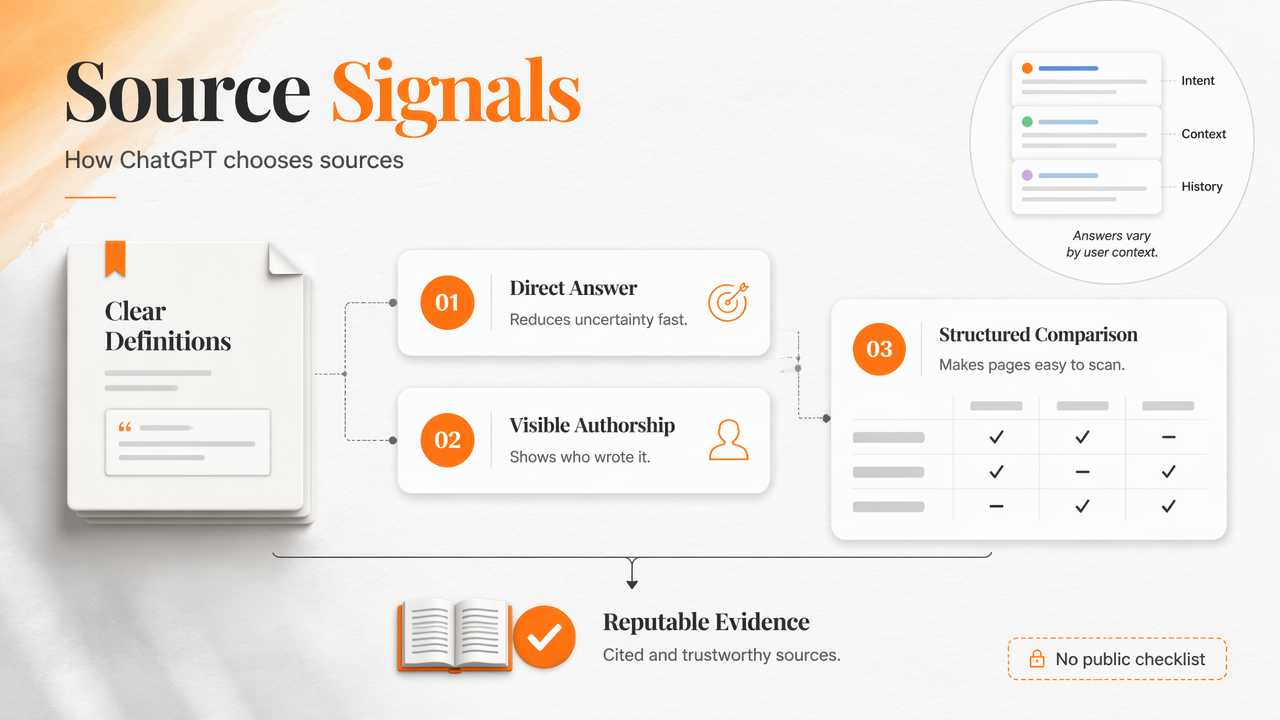
A 2024 World Wide Web paper by Jing Chen, Zheng Liu, and Xu Huang studied personalization challenges and opportunities for large language models, which matters because AI answers can vary by user intent, context, and previous interaction patterns: LLMs and personalization research. That means the goal is not one fixed ranking position. The goal is consistent eligibility across many related prompts.
Earlyseo's approach fits this practical reality by helping teams publish pages that are easier for AI crawlers and answer engines to parse. For teams managing many pages, the Earlyseo integrations hub is useful because AI visibility work usually sits inside an existing CMS workflow, not in a separate content silo.
Citation signals that matter most
| Signal | What ChatGPT needs | Practical action |
|---|---|---|
| Entity clarity | A clear brand, product, author, or location | Use consistent names, schema, and descriptions |
| Topical depth | Enough coverage to answer follow-up questions | Build clusters around problems, comparisons, and use cases |
| Evidence | Claims backed by named sources or first-party proof | Cite studies, docs, customer data, and policies where allowed |
| Crawl access | Pages that bots and search systems can reach | Check robots rules, sitemaps, and AI crawler files |
| Answer format | Passages that can be quoted cleanly | Use definitions, tables, FAQs, and short summaries |
A strong page does not need to be long for its own sake. Competitor articles in the current SERP average 3,523 words, but that benchmark mainly shows topical breadth. A shorter page can still win citations if each section answers a distinct question with clean structure.
Where traditional SEO still does the heavy lifting
Classic SEO remains the base layer. Fast pages, indexable HTML, descriptive titles, internal links, and earned mentions all help AI systems discover and trust information.
The difference is that AI answers often extract passages instead of sending searchers to ten blue links first. A page with vague introductions and buried answers may rank, yet still fail to become a citation. A page with crisp definitions and structured evidence has a better shot at both.
How to optimize content for ChatGPT visibility
Optimizing content for ChatGPT visibility requires a repeatable method: define the entity, answer the prompt directly, support the answer with evidence, structure the page for extraction, and make technical access easy. This method helps service businesses, ecommerce stores, SaaS companies, and local brands build citation-ready pages without chasing myths.
AI systems need disambiguation. A local plumber, a Shopify store, and a B2B software startup all need different trust signals, but the same basic pattern applies. Each page should state who the brand serves, what problem it solves, where it operates if relevant, and why the claim is credible.
A 2023 study in the International Journal for Educational Integrity tested AI-generated text detection tools, which is relevant because it showed the broader difficulty of reliably judging AI-written content: AI-generated text detection testing. For visibility work, the safer path is not hiding AI use. The safer path is publishing accurate, reviewed, useful content with clear ownership.
A 7-step ChatGPT visibility workflow
- Map the prompts: list questions buyers ask in ChatGPT, Google AI Mode, Perplexity, and Copilot.
- Define the entity: write one consistent brand, product, and service description across key pages.
- Build answer blocks: place 40 to 60 word direct answers under question-style headings.
- Add comparison assets: include tables for alternatives, pricing factors, features, and use cases.
- Support claims: link to credible studies, documentation, policies, and original data.
- Improve technical access: keep important pages indexable and readable in HTML.
- Refresh by intent: update pages when prompts, products, regulations, or market language change.
For teams publishing in WordPress, the WordPress integration for Earlyseo can support a workflow where AI-readable summaries and structured sections are built into normal publishing. Ecommerce teams can apply the same idea through the Shopify integration, especially for product collections, buying guides, and comparison pages.
Answer formats that AI can reuse
- Start major sections with one declarative answer sentence.
- Use definition lists for terms, acronyms, products, and service types.
- Add tables when comparing three or more options.
- Put proof near the claim it supports.
- Name brands, locations, standards, authors, and products explicitly.
- Keep paragraphs short enough for passage-level extraction.
Best practice: one page should answer one main search intent, then cover the follow-up questions a buyer would naturally ask next.
What should small businesses prioritize first?
Small businesses should prioritize entity consistency, local proof, service clarity, and answer-ready pages before advanced AI tactics. ChatGPT visibility depends on trust signals that are easy to verify, so a complete website, accurate profiles, real reviews, and clear service pages often matter more than clever prompt targeting.
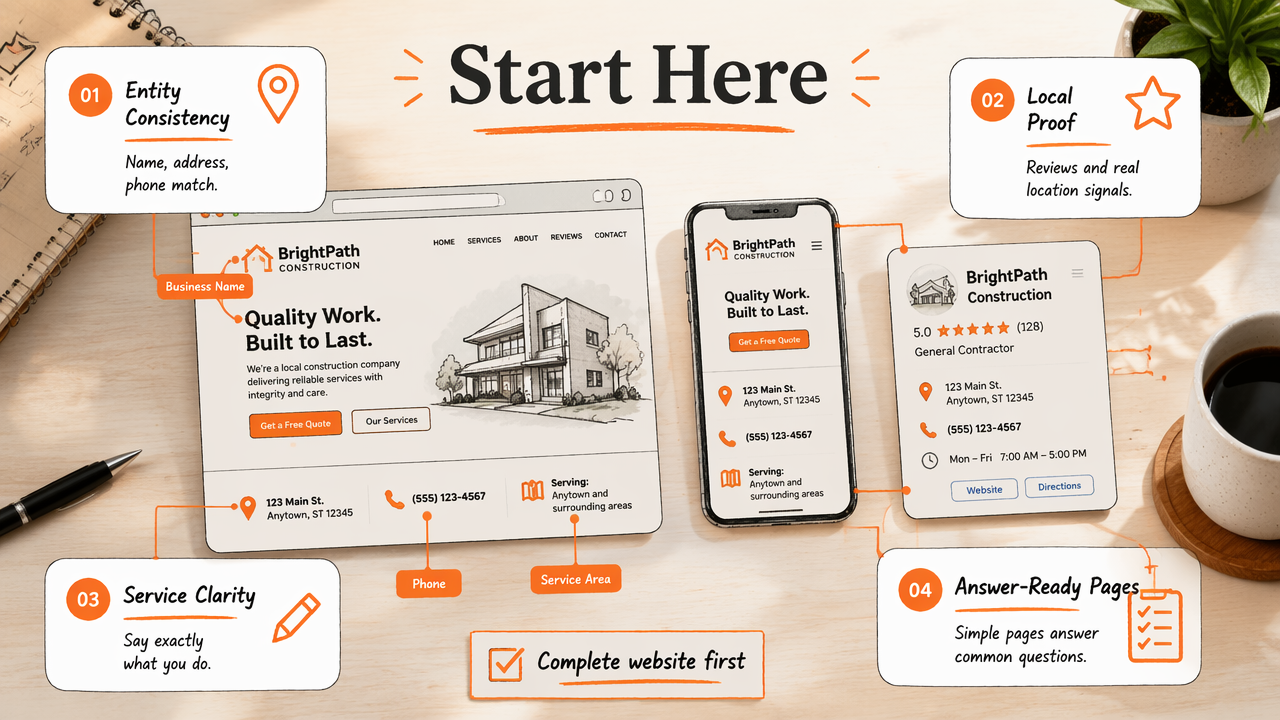
Local businesses need location and category clarity. A dental clinic, roofer, restaurant, or accountant should use the same business name, address, phone number, service categories, and service area language across its website and major directories. AI tools struggle when a company appears under several names or locations.
Service businesses should build pages around buyer decisions, not just keywords. A page called "emergency AC repair in Austin" should state response areas, hours, services, license details where relevant, pricing factors, and common scenarios. That gives an AI system concrete facts Ecommerce stores need clean product and category explanations. Product detail pages should answer who the product is for, what makes it different, sizing or compatibility details, shipping basics, return rules, and comparison points. For ongoing education, teams can organize related guides through Earlyseo's blog publishing area.
Priority checklist by business type
| Business type | First priority | Best citation asset |
|---|---|---|
| Local service business | Consistent name, address, service area, and reviews | Local service FAQ page |
| Ecommerce store | Clear product specs, comparisons, and policies | Buying guide or collection guide |
| SaaS startup | Defined category, use cases, integrations, and proof | Alternative and comparison page |
| Professional service firm | Author expertise, credentials, case examples | Expert explainer page |
| Multi-location company | Unique location pages with local details | Location-specific service hub |
Mistakes still happen. The most common ones are publishing generic AI-written pages, hiding important facts in images, blocking crawlers accidentally, making unsupported claims, and using inconsistent brand descriptions. These issues weaken retrieval because the system has less reliable text to work with.
Another overlooked task is maintaining AI access documentation. Some teams now add an LLM-focused text file or related crawler guidance to help clarify important site content for AI systems. This is not a magic ranking switch, but it can support cleaner discovery when used alongside strong pages.
What changes in AI visibility should teams expect by 2027?
AI visibility will likely become more measurable, more personalized, and more connected to structured brand data by 2027. The trend points toward answer engines that combine web retrieval, user context, shopping data, maps, reviews, and direct actions inside one conversational interface.
That shift changes reporting. Search Console and rank trackers still matter, but they do not fully show AI mentions. Teams will need prompt tracking, citation monitoring, referral analysis, branded search trend checks, and content quality reviews. Earlyseo is positioned around that shift because AI-readable publishing and structured answer design are moving from experiments into normal SEO operations.
Personalization will also make "average ranking" less useful. Two people may ask the same question and receive different sources based on location, intent, device, or prior context. The answer is to build durable signals: accurate entity data, strong topical coverage, and content that answers questions without fluff.
Future-ready SEO will look less like chasing one keyword position and more like becoming the clearest verified source for a category of questions.
FAQ: SEO for ChatGPT visibility
Can ChatGPT visibility be guaranteed?
No, ChatGPT visibility cannot be guaranteed because AI responses depend on model behavior, retrieval systems, prompt wording, personalization, and available sources. A brand can improve eligibility by publishing clear, crawlable, well-supported content, but no ethical provider can promise a fixed mention in every answer.
Is ChatGPT SEO different from traditional SEO?
ChatGPT SEO is different in format, not foundation. Traditional SEO improves crawlability, relevance, authority, and user value. AI visibility adds entity clarity, direct answer blocks, structured comparisons, and citation-ready evidence so a model can extract and summarize information with less ambiguity.
How long does AI visibility work take?
AI visibility work usually takes weeks to months because pages must be published, crawled, trusted, and reinforced across the web. Faster gains often come from improving existing high-intent pages with better definitions, tables, FAQs, schema, and updated evidence.
Does an llms.txt file replace SEO?
No, an llms.txt file does not replace SEO. It can help communicate AI-oriented site guidance, but content quality, technical access, internal linking, topical authority, and third-party validation still carry the main weight. It works best as a support layer, not the strategy itself.
Conclusion
SEO for ChatGPT visibility is now a practical part of search strategy, especially for brands that depend on discovery before a buyer visits a website. The next step is simple: audit the pages that should be cited, rewrite weak sections into direct answers, add comparison tables and proof, then make AI access easier with clean technical signals.
A focused 30-day plan works well: pick five high-intent prompts, update the matching pages, add entity definitions, cite credible sources, and track whether AI tools begin naming the brand more often. For teams that want this built into publishing instead of handled as a side project, Earlyseo offers a practical path. Visit earlyseo.com to review how the platform supports AI-readable SEO workflows.