TL;DR
Small businesses should choose an SEO agency for faster execution and broad expertise, in-house SEO for tighter brand control and daily ownership, and a hybrid model when content, technical fixes, and AI search visibility all matter. The best choice depends on budget stability, site complexity, publishing volume, and how much management time the business can realistically spare.
The choice between seo agency vs in house seo for small business is really a resourcing decision, not a marketing slogan. A small business, commonly defined as a company with fewer employees or lower revenue than larger corporations, needs SEO work that matches its cash flow, website complexity, and growth goals. SEO resourcing: the decision to assign search strategy, content, technical fixes, reporting, and accountability to an outside agency, an internal employee, or a mixed team. For teams that want guided execution without building a full department, Earlyseo can help organize SEO work around practical visibility gains, including search engines and AI answer surfaces.
Table of Contents
What is the real difference between an SEO agency and in-house SEO?
An SEO agency provides outside specialists across strategy, content, technical SEO, and reporting, while in-house SEO means a company hires or assigns internal staff to own search visibility every week.
Agency SEO usually fits businesses that need breadth fast. In-house SEO usually fits businesses that need deep product knowledge, faster internal coordination, and constant publishing support.
Key insight: the better choice is not the one with the better label; it is the one with the fewest bottlenecks for the next 12 months.
Core ownership model
In-house SEO: an employee or internal team manages keyword research, page updates, analytics, content briefs, internal links, and technical priorities.
SEO agency: an external partner handles agreed SEO deliverables, often across audits, campaigns, content planning, link strategy, local SEO, e-commerce SEO, or technical recommendations.
Hybrid SEO: internal staff own brand knowledge and approvals, while an agency or platform supports execution, audits, workflows, and specialized tasks.
Common agency strengths include:
- Access to several skill sets without hiring several roles
- Faster setup for audits, briefs, and reporting
- Experience across industries, website types, and ranking problems
- Less recruiting pressure for founders or lean marketing teams
Common in-house strengths include:
- Stronger understanding of customers, products, and margins
- Easier coordination with sales, support, product, and operations
- Faster brand approvals for content and landing pages
- More control over priorities and daily execution
How should a small business compare cost, speed, and control?
Small businesses should compare SEO options by total operating load, not just invoice size, because management time, tools, hiring risk, and execution speed all affect the real cost.
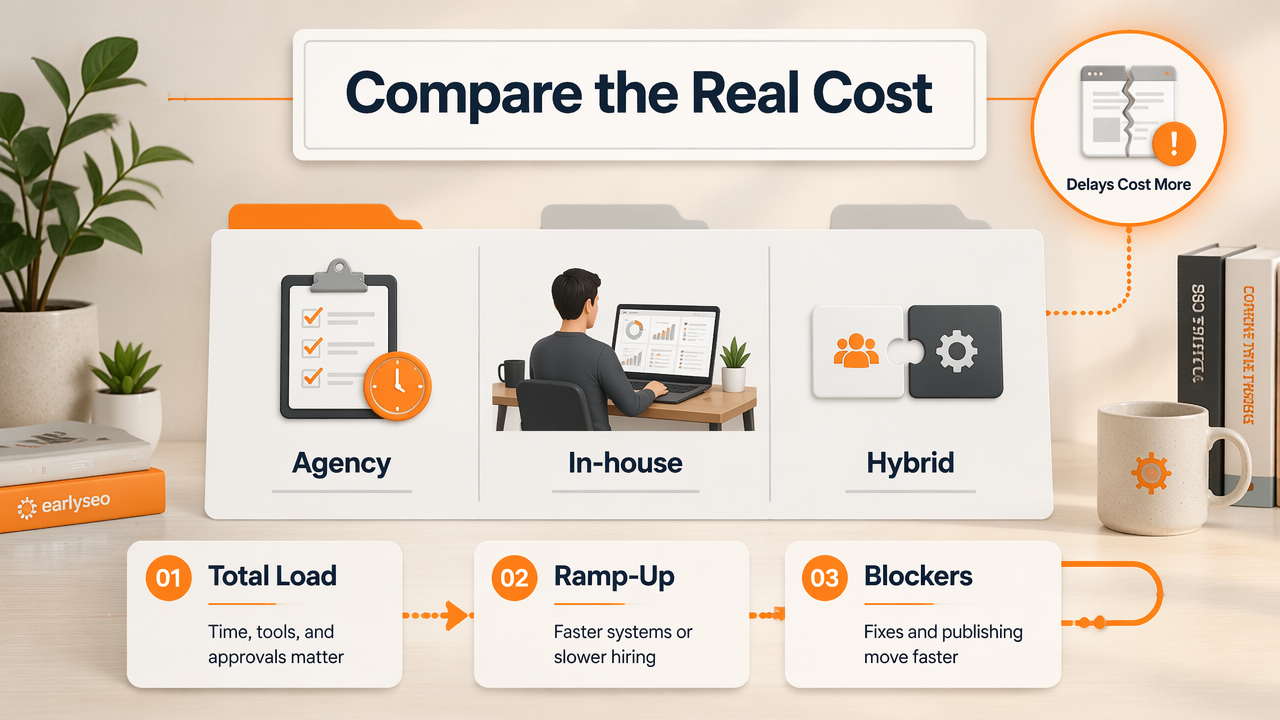
A cheaper option can become expensive when nobody has time to approve pages, publish content, or fix technical issues. A higher-cost option can pay off faster when it removes blockers and creates a repeatable workflow.
SEO agency vs in-house comparison table
| Decision factor | SEO agency | In-house SEO | Hybrid model |
|---|---|---|---|
| Ramp-up speed | Usually faster because systems and specialists already exist | Slower if recruiting, onboarding, or training is needed | Moderate, internal context plus outside structure |
| Expertise breadth | Broad across content, technical SEO, analytics, and local or e-commerce needs | Deep in the business, narrower unless multiple hires exist | Broad where needed, deep where internal knowledge matters |
| Cost pattern | Retainer or project cost | Salary, benefits, tools, and training | Mixed spend with flexible scope |
| Accountability | Contracted deliverables and reporting cadence | Direct internal accountability | Shared ownership, needs clear roles |
| Brand knowledge | Must be learned | Usually strongest | Strong if internal reviewers stay involved |
| Tool access | Often included in service | Must be purchased or managed internally | Can combine platform and partner tools |
| Best fit | Need speed and specialist coverage | Need daily ownership and heavy content output | Need control plus expert support |
The table shows why no single model wins every time. For a local service business with a small site, an agency may deliver faster technical cleanup and local page strategy. For an e-commerce store with constant product updates, internal ownership may matter more.
Teams using WordPress can reduce handoff friction through WordPress SEO workflow support, while online stores can connect search work closer to merchandising through Shopify SEO integrations. Those integrations matter because execution speed often beats strategy volume.
When should a small business hire an SEO agency?
A small business should hire an SEO agency when it needs specialized execution quickly, lacks SEO leadership, or has a defined growth target that internal staff cannot support alone.
Agency support is strongest when the problem is clear enough to scope. Examples include a technical audit, local visibility plan, content refresh project, migration support, or e-commerce category strategy.
Best-fit agency scenarios
An agency usually makes sense when the business has a website that already matters commercially. That may mean leads, bookings, online orders, quote requests, or store visits depend on search visibility.
Good agency-fit signals include:
- Organic traffic has stalled and internal staff cannot diagnose why.
- A site redesign, migration, or CMS change is coming.
- Local competitors dominate map results and service pages.
- Product or category pages need structured optimization.
- Content is being published, but rankings and conversions lag.
- Leadership needs reporting that connects SEO work to pipeline or revenue.
Agency SEO can also reduce opportunity cost. A founder should not spend every Friday learning crawl diagnostics if a specialist can identify indexation, internal linking, and template issues faster.
Where agency SEO can disappoint
Agency SEO can underperform when goals are vague, approvals are slow, or the business expects rankings without operational support.
The common weak points are not mysterious:
- No clear owner for approvals
- Slow developer access
- Thin product or service information
- No budget for content production
- Reporting focused on activity instead of outcomes
- Misalignment between SEO targets and actual profit margins
A strong agency relationship needs a simple operating rhythm: monthly priorities, weekly blockers, shared reporting, and fast access to website changes. Without that rhythm, even experienced specialists can get stuck waiting.
When does in-house SEO make more sense?
In-house SEO makes more sense when search work touches daily business operations, product knowledge is hard to outsource, or the company publishes and updates pages frequently.
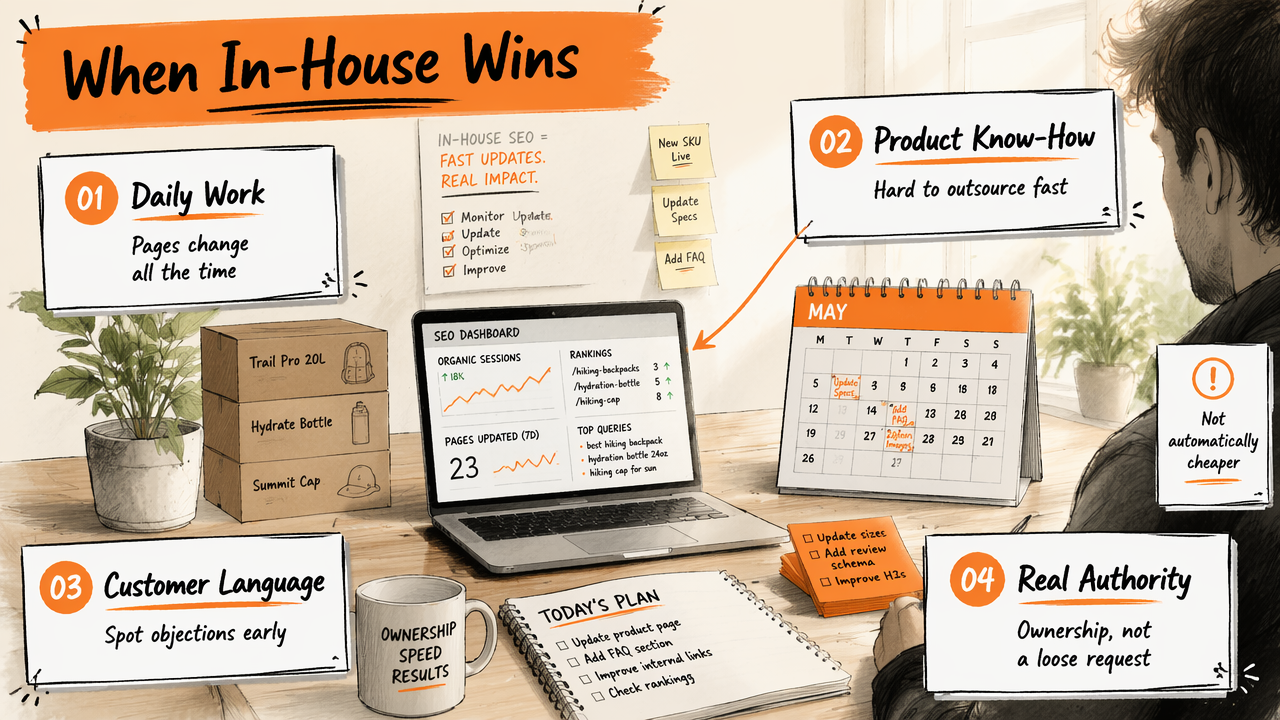
Internal SEO is not automatically cheaper. The real value comes from proximity. Someone inside the business can spot customer language, product changes, seasonal demand, and sales objections before an outside partner sees them.
Best-fit in-house scenarios
In-house SEO fits companies with enough recurring work to justify dedicated ownership. The role should have authority, not just a loose request to improve rankings.
Strong in-house signals include:
- A large or changing website
- Frequent blog, product, or landing page publishing
- Complex service lines or regulated claims
- Multiple locations or inventory categories
- Active collaboration with sales, support, and product teams
- A need for fast internal linking and content updates
Internal teams can also build durable knowledge. A staff SEO can learn which pages influence sales calls, which keywords bring poor-fit leads, and which content helps support teams answer repeat questions.
Management overhead for internal SEO
Hiring an SEO employee still requires management. Someone must set goals, approve tools, judge performance, and protect the role from becoming a general marketing catch-all.
A practical in-house setup includes:
- One clear SEO owner
- Access to analytics, CMS, and search reporting
- A publishing calendar
- Developer support for technical fixes
- A decision log for priorities
- Monthly review of ranking, traffic, leads, and revenue signals
The Earlyseo platform can support this model by giving small teams a structured place to manage SEO tasks, documentation, and visibility work. Teams that need setup guidance can use Earlyseo documentation to keep processes consistent instead of relying on scattered notes.
Is a hybrid SEO model the best choice for 2026?
A hybrid SEO model is often the best 2026 option for small businesses because it combines internal brand knowledge with outside expertise, automation, and flexible execution.
Search is no longer limited to classic blue links. Small businesses now have to think about Google organic results, local packs, product surfaces, AI Overviews, and answer engines. That wider surface area makes one-person SEO harder.
How the hybrid model works
A clean hybrid model gives each party a specific lane. The internal team owns business context, approvals, offers, customer insights, and final publishing decisions. The outside partner or platform handles audits, prioritization, technical guidance, content structure, and performance review.
A simple hybrid split looks like this:
| Workstream | Internal owner | External support |
|---|---|---|
| Customer language | Sales, support, founder | Keyword mapping and page targeting |
| Content approvals | Marketing or leadership | Briefs, outlines, refresh recommendations |
| Technical SEO | Developer or website manager | Audit, prioritization, validation |
| Local or e-commerce SEO | Operations or store manager | Page templates and optimization rules |
| AI search readiness | Marketing owner | Structured docs, entity clarity, answer formatting |
For 2026 planning, AI visibility deserves a place in the workflow. Businesses preparing documentation for answer engines can review llms.txt guidance for AI discovery, and teams with multiple tools can simplify connections through SEO integrations. More practical guidance is available on earlyseo.com.
Decision tree by stage
The best model changes as a business matures.
- Pre-revenue or very early local business: use a focused setup, basic technical cleanup, local pages, and a simple content plan. A full-time SEO hire is usually premature.
- Owner-led business with steady leads: choose an agency or platform-assisted workflow if internal time is limited.
- Growing company with a marketer: use hybrid SEO, with the marketer owning approvals and an outside resource supporting research, briefs, audits, and reporting.
- Content-heavy or e-commerce business: consider in-house ownership plus specialist support for technical SEO, templates, and AI search formatting.
- Multi-location or multi-category company: build an internal SEO owner role, then use outside help for audits, migrations, and complex projects.
Practical rule: if SEO decisions happen every day, hire or assign an internal owner; if specialist work happens in bursts, use an agency or hybrid support.
FAQ: choosing seo agency vs in house seo for small business
Small businesses should choose based on execution capacity, not preference, because SEO results depend on consistent publishing, technical fixes, measurement, and ownership.
Is an SEO agency cheaper than hiring in-house?
An SEO agency can be cheaper at the start because it avoids recruiting, salary, benefits, and multiple tool subscriptions. In-house SEO may become more efficient when there is enough weekly work to justify a dedicated role. The fairest comparison includes management time, content production, developer access, and the cost of delays.
Can one in-house marketer handle all SEO?
One marketer can handle basic SEO if the site is small and the goals are focused. The role becomes harder when technical SEO, content strategy, local visibility, analytics, and AI search formatting all need attention. Many small businesses pair one internal owner with outside help for audits, templates, and specialized fixes.
What should be measured in the first 90 days?
The first 90 days should measure completed fixes, indexed pages, content updates, local profile improvements, ranking movement for priority terms, and early lead quality signals. Revenue impact may take longer, so early reporting should separate controllable work from lagging outcomes such as organic conversions and customer acquisition cost.
How does Earlyseo fit this decision?
Earlyseo fits businesses that want structured SEO execution without immediately building a full internal department. It can support agency, in-house, or hybrid workflows by organizing tasks, integrations, and documentation around visibility work. For a closer look at options, visit earlyseo.com after deciding which operating model fits the business stage.
Conclusion
The smartest answer to seo agency vs in house seo for small business is stage-based. Agencies work well for speed, breadth, and defined projects. In-house SEO wins when daily ownership, brand depth, and constant publishing matter. Hybrid SEO is often the most practical 2026 model because it keeps strategy close to the business while adding specialist support where it counts.
Next step: list the next 10 SEO tasks, mark which require internal knowledge, technical skill, content production, or reporting, then choose the model that removes the most blockers in the next quarter.