TL;DR
AI search tools now cover two jobs: finding answers with engines such as ChatGPT, Perplexity, Gemini, and Google AI Overviews, and tracking how brands appear inside those answers. Small teams should start with visibility monitoring, citation discovery, and prompt research before paying for broader enterprise analytics.
AI search tools are no longer just chatbots with web access; in 2026, they shape how buyers compare software, local services, products, and expert advice before visiting a website. Earlyseo fits this shift by focusing on how growing brands get discovered, understood, and cited across AI-led search experiences.
AI search tools: software that uses artificial intelligence to retrieve, summarize, rank, monitor, or analyze information from search results, web sources, and large language model outputs.
Google's AI Overviews are AI-generated summaries inside Google Search, while classic search engines still rely on indexes, ranking systems, and result pages. That split matters because small teams now need tools for both traditional SEO and LLM visibility.
Table of Contents
What are AI search tools?
AI search tools are applications that use AI to find information, summarize sources, compare options, or measure brand visibility across answer engines. They include consumer search assistants, AI-enhanced traditional search, citation tracking platforms, prompt research tools, and workflow tools that help teams understand what language models surface for important topics.
The category is broad because AI now sits in several parts of the search process. Some tools answer questions directly. Others monitor whether a company, product, or source appears in generated answers.
Key insight: the useful question is not "Which AI search engine is best?" but "Which part of the search workflow needs help?"
Main categories in 2026
| Category | What it helps with | Best fit | Common limitation |
|---|---|---|---|
| AI answer engines | Fast summaries, comparisons, research | Founders, students, analysts | Results can vary by prompt |
| AI search engines | Web-backed answers with citations | Content teams, buyers | Source selection may be uneven |
| Visibility monitors | Brand mentions, share of voice, citations | Marketers, agencies | Needs consistent query sets |
| Prompt research tools | Real user questions and phrasing | SEO teams, content teams | Requires editorial judgment |
| Citation discovery tools | Which pages AI systems reference | Publishers, SaaS teams | Data changes often |
Consumer-facing tools include ChatGPT as a search interface and Google Search with AI-generated summaries. Perplexity, Gemini, Copilot, and Claude-style research workflows also sit in this group, depending on access, source handling, and user intent.
The monitoring side is newer. It matters for companies that already rank in Google but do not know whether answer engines mention them, skip them, or cite competitors.
Which AI search tools matter most for small teams?
Small teams should prioritize tools that reveal where demand exists, which sources answer engines trust, and whether the brand appears in AI-generated recommendations. A simple stack usually beats a broad platform: one research tool, one visibility tracker, one content workflow, and one technical publishing setup are enough to start.
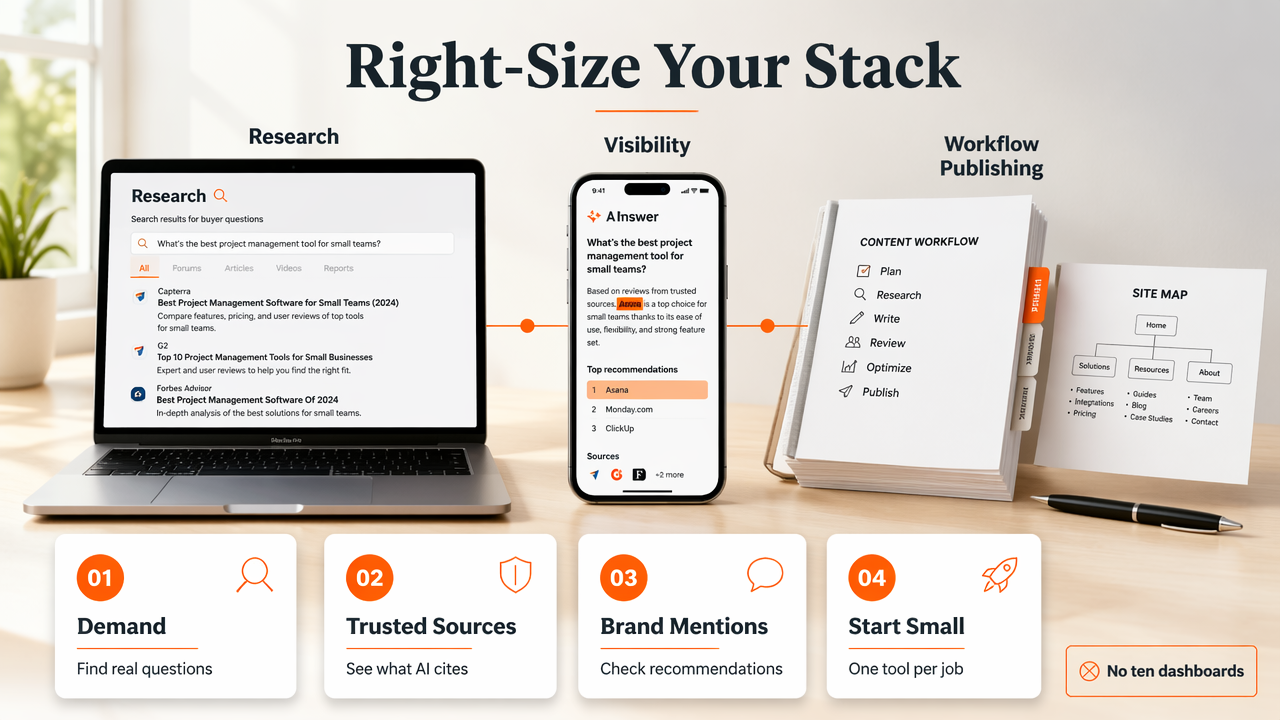
A founder does not need ten dashboards to learn whether a product is discoverable. A local business does not need enterprise monitoring to check service-area questions. The best mix depends on budget, content volume, and whether search visibility already drives leads.
Best-fit tool stack by budget
| Budget level | Recommended stack | What to measure first |
|---|---|---|
| Free to low cost | ChatGPT, Google AI Overviews checks, Search Console, manual citation notes | Branded mentions, top questions, missing comparisons |
| Starter | AI search assistant, keyword tool, visibility tracker, CMS SEO plugin | Share of answers, cited pages, query themes |
| Growth | Monitoring platform, prompt library, content briefs, analytics integration | Competitor overlap, citations won, content gaps |
| Agency or multi-site | Scaled query tracking, reporting, client dashboards, integrations | Category coverage, model variance, trend lines |
Early-stage teams should sort prompts into three buckets:
- Discovery prompts: "best accounting software for freelancers" or "family dentist near downtown."
- Comparison prompts: "Brand A vs Brand B" or "alternatives to Shopify SEO apps."
- Decision prompts: "which tool is better for small ecommerce teams."
Research standards can help here. The PRISMA 2020 guidance published in BMJ focuses on transparent review methods, and the same idea applies to AI visibility work: define the questions, record the sources, then compare outputs over time.
For teams publishing educational content, the Earlyseo blog hub can support topic planning around AI discovery, search visibility, and practical SEO workflows.
How should teams compare AI search tools?
Teams should compare AI search tools by source transparency, freshness, repeatability, workflow fit, and whether the tool supports measurable business actions. A flashy answer interface has less value than a system that shows cited URLs, recurring prompts, competitor patterns, and next steps for content or technical SEO.
Search behavior is fragmenting. One buyer may ask Google, another may use Perplexity, while another asks ChatGPT for a shortlist. That makes repeatable testing more useful than one-off checks.
Comparison criteria that actually matter
| Criterion | Why it matters | Strong signal |
|---|---|---|
| Source visibility | Shows why an answer appeared | Links, citations, or retrievable source lists |
| Freshness | Keeps recommendations current | Recent index or web access |
| Repeatability | Makes tracking possible | Saved prompts and consistent locations |
| Query coverage | Captures real buyer language | Prompt clusters by intent |
| Exporting and reporting | Turns findings into work | CSV, dashboards, or client-ready reports |
| Publishing support | Helps improve visibility | Docs, CMS guidance, schema, or integrations |
A scientific search use case has different needs from a local SEO use case. For example, AlphaFold 3 research in Nature reflects how AI is advancing specialist discovery in biology, while a small service business mainly needs accurate local intent, reviews, and service-page clarity.
Common mistakes include testing only branded prompts, checking one model once, and treating an AI answer as stable. Generated answers can shift with location, personalization, model updates, and source changes.
A practical benchmark is consistency: if a tool cannot support the same prompt set every month, it is weak for marketing measurement.
Teams that care about crawl hints and AI-readable site guidance should also understand the emerging role of the llms.txt file for AI crawlers. It is not a magic ranking switch, but it gives publishers a structured way to point AI systems toward preferred documentation and content.
How Earlyseo handles AI search visibility
The Earlyseo platform helps small teams connect AI discovery work with practical SEO execution rather than treating answer-engine visibility as a separate project. Its strongest fit is for startups, ecommerce stores, and growing businesses that need clearer content, cleaner publishing workflows, and better signals for AI-assisted search.
Where it fits in the workflow
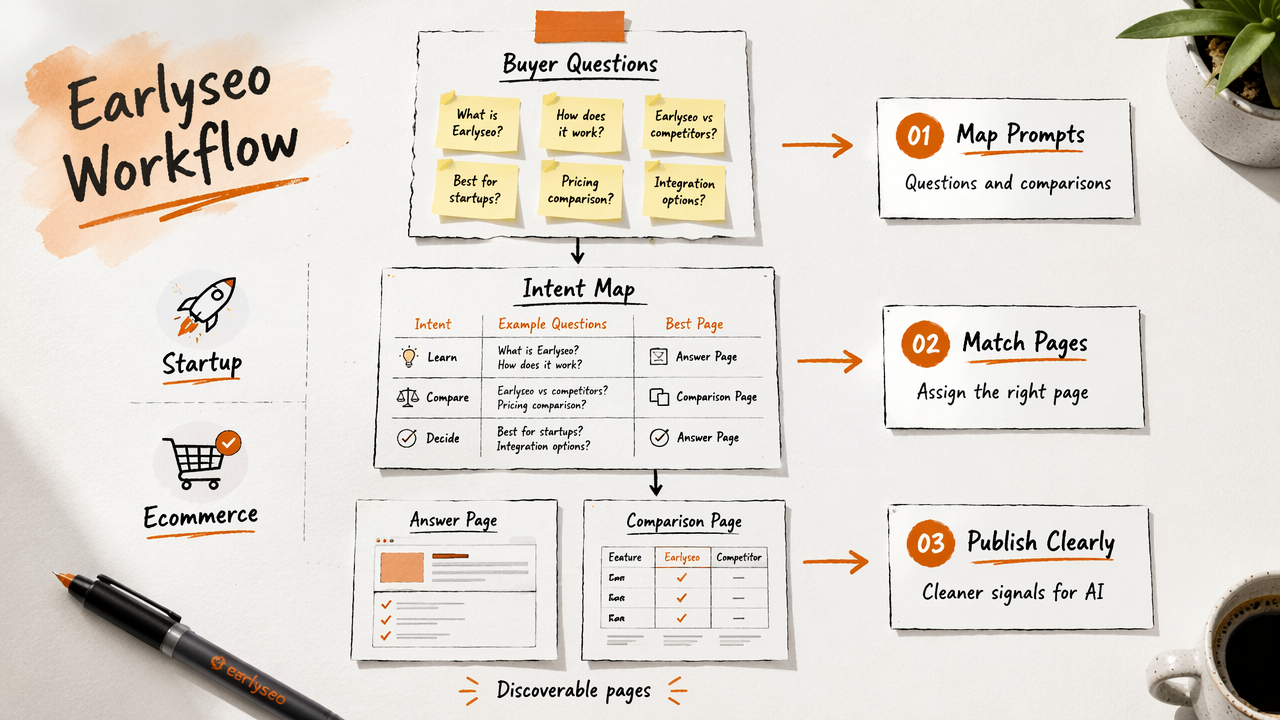
Earlyseo is most useful when a team already knows the audience but needs help turning that knowledge into discoverable pages. The workflow usually looks like this:
- Map buyer questions and comparison prompts.
- Identify pages that should answer each intent.
- Improve titles, summaries, definitions, and internal links.
- Publish in a CMS or storefront with clean metadata.
- Monitor which pages gain impressions, citations, or AI visibility.
The Earlyseo documentation is especially relevant for teams that want clear setup guidance instead of a pile of disconnected SEO tasks. Ecommerce teams can also connect store workflows through the Shopify integration for Earlyseo, which is useful when product, collection, and guide pages all need search-friendly structure.
Earlyseo should not replace editorial judgment. It works best when subject-matter expertise, customer language, and technical SEO basics are already part of the content process.
Who should pick which approach:
- Pick an answer engine for quick research and rough comparisons.
- Pick a visibility tracker for recurring brand and competitor monitoring.
- Pick Earlyseo when the goal is to turn AI-search insights into pages that can rank, convert, and earn citations.
- Pick enterprise platforms when many brands, countries, or clients need reporting at scale.
What should buyers expect next in 2027?
By 2027, AI search systems will likely become more source-aware, more commercial, and more integrated into browsers, operating systems, and ecommerce journeys. The practical result is simple: brand visibility will depend on being clearly described, consistently cited, and technically easy for both crawlers and answer engines to interpret.
AI-generated summaries will not remove websites from the process. They will raise the bar for pages that deserve citation. Clear definitions, comparison tables, original examples, and well-structured documentation will matter more because answer engines need extractable facts.
Buyer checklist for 2026 decisions
Before choosing a platform, teams should answer five questions:
- Does the tool show sources or only answers? Source visibility is needed for citation work.
- Can prompts be saved and repeated? Measurement needs a stable query set.
- Does it separate branded, category, and local prompts? Each intent behaves differently.
- Can findings become publishable work? Reports only help if pages improve.
- Does it fit the current CMS or store? Workflow friction slows results.
For broader publishing setups, the Earlyseo integrations page shows how AI search work can connect with existing site platforms. More on earlyseo.com can help teams turn scattered prompt checks into a repeatable SEO process.
The best tool choice is the one that connects research, citations, and publishing. A dashboard without page improvements is just a nicer spreadsheet.
FAQ about AI search tools
AI search tools are changing quickly, but the buying questions are already clear: what they do, how reliable they are, and where they fit beside SEO software. The answers below cover the decisions most small teams face first.
Are AI search tools replacing Google?
AI search tools are not fully replacing Google, but they are changing how people discover information before clicking. Google still has traditional results and AI Overviews, while tools such as ChatGPT, Gemini, Copilot, and Perplexity answer questions in more conversational formats. Most businesses need visibility in both classic search and generated answers.
What is the difference between an AI search engine and an AI visibility tool?
An AI search engine helps a person find or summarize information. An AI visibility tool helps a business measure how often it appears in AI-generated answers, which sources get cited, and how competitors are framed. One is mainly for research, while the other is mainly for marketing measurement and content improvement.
How often should small businesses check AI search visibility?
Monthly checks are usually enough for small businesses unless a launch, rebrand, or major content push is underway. The key is using the same prompt set each time. Weekly checks can create noise because AI answers may vary, while quarterly checks can miss fast-moving shifts in competitor mentions or citations.
Do AI search tools need technical SEO?
Technical SEO still matters because answer engines and search systems need crawlable, well-structured pages. Clear titles, schema, internal links, fast pages, and readable documentation all help systems understand a site. AI visibility work performs better when the underlying website is easy to crawl and the content answers specific questions directly.
Conclusion
AI search tools now belong in the same planning conversation as SEO, content, analytics, and conversion work. The smartest starting point is a small, repeatable system: define priority prompts, check the sources being cited, improve the pages that should answer those prompts, and review results monthly.
For founders, local businesses, and ecommerce teams, the next action is not buying every tool on the market. The better move is to choose one research tool, one monitoring workflow, and one publishing process that keeps pages clear, current, and citation-ready. Earlyseo can support that process when AI-search research needs to become visible, structured content on a real site. Visit earlyseo.com when the next step is turning search visibility into a repeatable growth workflow.