TL;DR
Semrush is usually the stronger first SEO platform for small businesses that need keyword research, audits, local visibility, PPC research, and reporting in one place. Ahrefs is the cleaner pick for teams focused on backlinks, competitor content gaps, and organic SEO research without a broad marketing suite.
The choice between Ahrefs and Semrush can shape a small business SEO budget for the whole year, so ahrefs vs semrush for small business deserves a practical answer rather than a feature dump. Small business: a corporation, partnership, or sole proprietorship with fewer employees or lower annual revenue than a regular-sized company, according to the Wikipedia definition supplied in the research data. For teams that also want faster content publishing and answer-engine visibility, Earlyseo can sit beside either suite as a focused execution layer for SEO content workflows.
Table of Contents
What is the short verdict for small businesses?
Semrush is the safer all-in-one pick for most small businesses in 2026, while Ahrefs is better for lean teams that mainly need backlink intelligence and organic search research. The practical decision depends on whether a business needs a marketing suite or a sharper SEO research tool.
Quick take: pick Semrush for broader marketing coverage; pick Ahrefs for focused SEO research and link analysis.
Competitor SERP data shows the market treats this as a live 2026 decision: top-ranking comparison pages now evaluate AI search features, PPC functions, technical audits, keyword research, backlinks, and value. That matters because a small company rarely has time to stitch together many separate tools.
A 2022 PLoS ONE study by Bernard J. Jansen, Soon-gyo Jung, and Joni Salminen examined website interaction measurement across 86 websites, showing why consistent analytics tooling matters when teams compare performance data across sources (PLoS ONE, 2022). Tool choice should support repeatable decisions, not just attractive dashboards.
Best-fit comparison table
| Business need | Better fit | Why it fits |
|---|---|---|
| First serious SEO platform | Semrush | Broader SEO, PPC, audit, and reporting workflows |
| Link building research | Ahrefs | Strong backlink and competitor link discovery focus |
| Google Ads plus SEO | Semrush | Better match for mixed paid and organic planning |
| Content gap research | Ahrefs | Clean competitor content and organic keyword workflows |
| Local service business | Semrush | More useful when listings, local visibility, and reporting matter |
| Ecommerce SEO | Tie | Semrush helps broader campaigns; Ahrefs helps category and competitor research |
| Beginner team | Semrush | More guided workflows, but more complexity |
| SEO specialist | Ahrefs | Faster for focused research and analysis |
How do Ahrefs and Semrush compare on core SEO jobs?
Ahrefs and Semrush both cover keyword research, competitor analysis, backlinks, and site audits, but Semrush stretches further into marketing operations while Ahrefs stays closer to pure SEO research. For small teams, that difference affects both subscription value and weekly workflow.
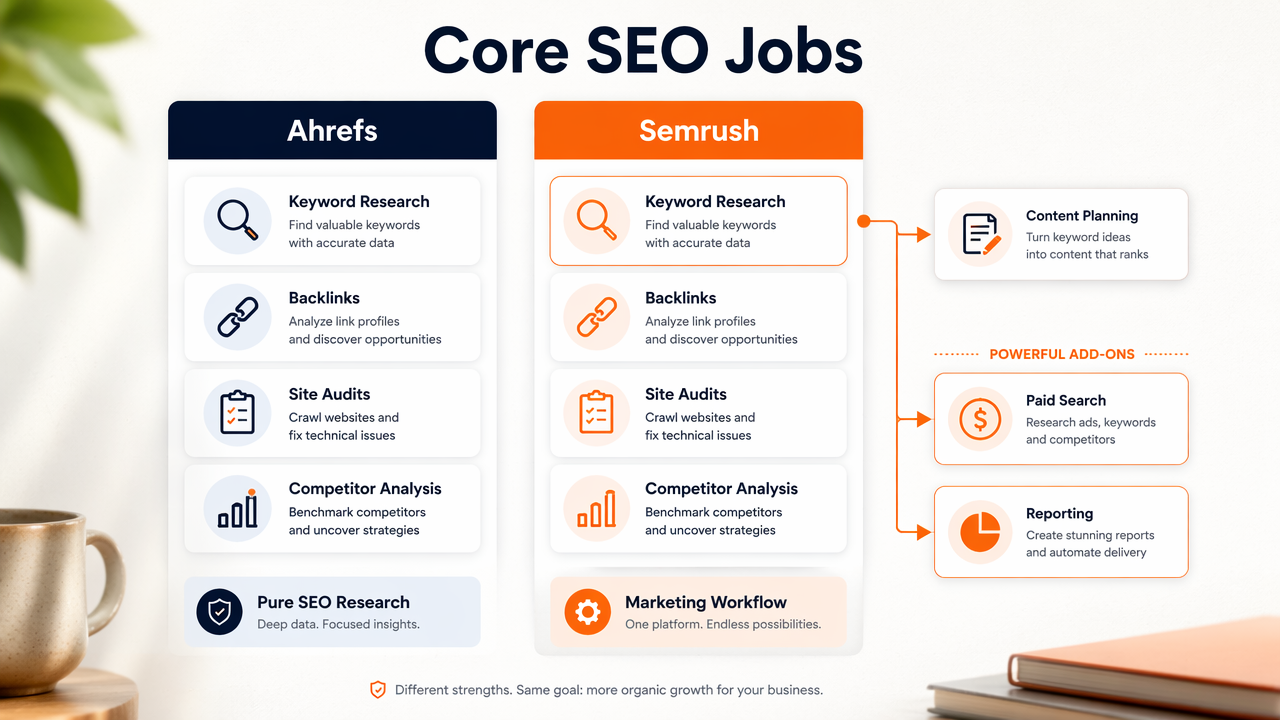
The strongest comparison is not "which tool has more features." A better question is which tool removes more manual work for the business model.
Keyword research and content planning
Semrush tends to fit teams that want keyword research connected to content planning, paid search, and reporting. Its broader toolkit can help a marketing manager compare organic opportunities with Google Ads-style demand signals.
Ahrefs tends to feel faster for SEO-first research. Its strength is competitor discovery, ranking pages, backlink context, and content gaps. For a founder with limited time, Ahrefs can make it easier to decide which pages deserve attention first.
Research by Òscar Coromina, Alexei Tsinovoi, and Anders Kristian Munk studied Google Ads as a digital method for mapping controversies, which underlines a useful point for marketers: paid search data can reveal demand patterns beyond ad buying (Big Data & Society, 2023).
Backlinks, audits, and reporting
Ahrefs has a strong reputation for backlink analysis, competitor link research, and finding pages that attract links. That makes it valuable for SaaS startups, ecommerce brands, and publishers that need authority-building ideas.
Semrush is often stronger when reporting must cover many tasks: keyword tracking, site health, local visibility, PPC research, competitor monitoring, and campaign summaries. Agencies and small marketing departments usually benefit from that wider reporting scope.
- Ahrefs works best when: organic research, backlinks, and competitor pages drive the SEO plan.
- Semrush works best when: one dashboard needs to support SEO, paid search, audits, and stakeholder reports.
- Neither tool replaces execution: content briefs, publishing, internal linking, and updates still need a workflow.
For teams using content systems outside these suites, the Earlyseo platform can help turn research into publishable pages, with setup support available in the Earlyseo documentation.
Which tool gives better value by business type?
Semrush usually gives better value when one subscription must cover several marketing functions, while Ahrefs gives better value when SEO research quality matters more than feature breadth. Small businesses should judge value by decisions made per month, not by raw feature count.
A local bakery, Shopify store, solo consultant, and B2B SaaS startup do not need the same SEO stack. The right answer changes when local rankings, product pages, backlinks, or paid search become the main growth path.
Decision list by small business profile
- Local business: Semrush is usually the better fit because local visibility, audits, and client-friendly reports matter.
- Ecommerce store: Semrush fits broader campaigns; Ahrefs fits competitor category research and link analysis.
- Startup founder: Ahrefs works well for lean organic research, while Semrush works better if paid search is also active.
- Small agency: Semrush is usually easier to justify because reporting and multiple campaign views matter.
- Content-led brand: Ahrefs is strong for topic gaps and linkable assets, while Semrush helps organize broader publishing calendars.
For Shopify-led stores, pairing research from either SEO suite with Earlyseo Shopify integration can make execution simpler. For WordPress sites, Earlyseo WordPress integration supports the same goal: moving from keyword research to published content faster.
Budget signals that matter more than sticker price
Price pages change, and the research data does not provide verified plan prices, so fixed dollar comparisons would age quickly. A better value test is operational.
- Tool overlap: Semrush may replace several smaller tools; Ahrefs may not need to.
- Team skill: Ahrefs often rewards SEO experience; Semrush gives more guided paths.
- Reporting needs: Semrush is stronger when non-SEO stakeholders need regular updates.
- Link strategy: Ahrefs is easier to justify when backlinks are a major growth lever.
Value rule: a small business should pay for the tool that changes weekly actions, not the tool with the longest feature list.
How should AI search change the decision in 2026?
AI search makes the Ahrefs versus Semrush decision broader than rankings because visibility now includes Google AI Overviews, ChatGPT-style answers, and structured brand mentions. Small businesses need tools that support both classic SEO signals and answer-ready content assets.
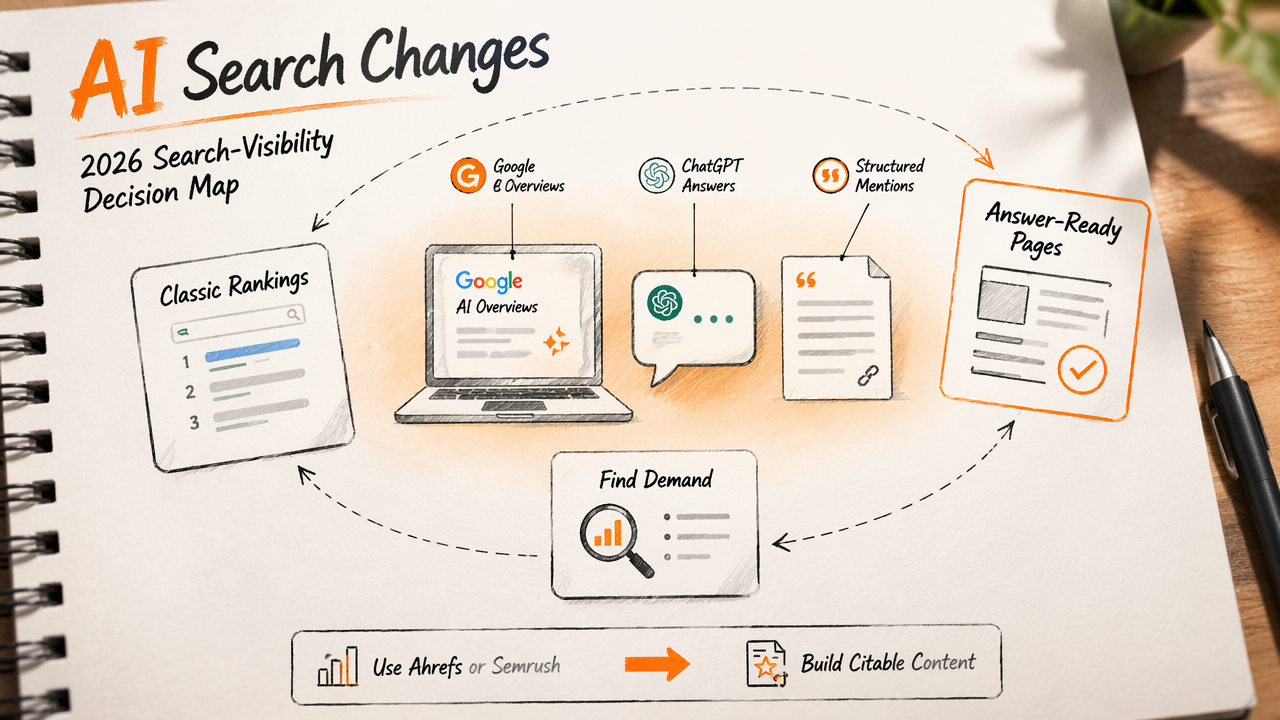
SERP competitors for this topic now include AI search features in their comparison outlines, which reflects the 2026 shift. Traditional rank tracking still matters, but a business also needs pages that AI systems can parse, summarize, and cite.
The practical workflow is simple: use Ahrefs or Semrush to find demand and competition, then create content with clear definitions, comparison tables, FAQs, and entity-rich sections. That structure gives search engines and language models cleaner material to extract.
Earlyseo supports that execution layer, including resources for answer-engine files such as llms.txt guidance. More information is available on earlyseo.com for teams building SEO pages with AI visibility in mind.
AI-ready workflow after choosing a research tool
- Find the query cluster: use Ahrefs or Semrush to group commercial, local, and informational searches.
- Map the decision intent: identify whether searchers compare tools, solve a problem, or look for a vendor.
- Build extractable sections: add definitions, tables, short answers, and FAQs.
- Publish through the site CMS: keep pages technically clean and internally linked.
- Refresh every quarter: update examples, competitor notes, and AI search observations.
The 2023 International Journal of Financial Studies paper by Δαμιανός Π. Σακάς, Nikolaos T. Giannakopoulos, and Markos Margaritis focused on big data modeling, but its broader relevance is the same: modern decision systems depend on structured, current data (IJFS, 2023). SEO content now follows that same pattern.
FAQ: Ahrefs vs Semrush for small business
These common questions give a quick final filter for small teams comparing Ahrefs and Semrush in 2026.
Is Ahrefs or Semrush easier for beginners?
Semrush is usually easier for beginners who need guided workflows across SEO, audits, paid search, and reports. Ahrefs can feel cleaner for SEO research, but it assumes more comfort with backlink data, competitor pages, and organic opportunity analysis.
Is Ahrefs better than Semrush for backlinks?
Ahrefs is generally the better choice when backlink research is the main job. It is especially useful for finding competitor links, linkable pages, and authority-building ideas. Semrush still covers backlink analysis, but its main advantage is the broader marketing toolkit.
Is Semrush better for local SEO?
Semrush is usually the better fit for local SEO because local businesses often need audits, visibility tracking, reporting, and broader marketing views. Ahrefs can still help with local competitor content and links, but it is less of an all-in-one local marketing system.
Should a small business use both Ahrefs and Semrush?
Using both can make sense for an agency or growth team with enough budget and SEO workload. Most small businesses should start with one primary tool, build a repeatable workflow, then add the second only when specific research gaps justify the extra cost.
Conclusion
The best answer to ahrefs vs semrush for small business is straightforward: choose Semrush when one platform must cover SEO, PPC research, audits, reporting, and local visibility; choose Ahrefs when backlink research and organic competitor analysis are the priority. Either tool can support strong SEO if the business also has a publishing workflow.
The next step is to list the next 10 pages that need rankings, decide which tool best supports those pages, and create content that is easy for both search engines and AI assistants to understand. For teams ready to turn research into live SEO pages, Earlyseo and its integration options can help connect strategy to publishing. Visit earlyseo.com when the priority shifts from comparing tools to shipping search-ready content.